How Much Are Electric Scooters? 2026 Prices
The best-selling adult electric scooters cost about $150 to $300, and the average adult stand-up scooter on Amazon sold for about $206 in October 2026. Kids' scooters run roughly $100 to $300, and $500 to $1,000 buys the big-battery Segway and NIU commuters. Battery size drives most of the gap: 187 Wh at the cheap end of the commuter scooters we cover against 608 Wh near the top, which we estimate as 7 to 9 miles against 23 to 28 miles a charge.
The short version
- Amazon's best-selling adult scooters cost about $150 to $300, most of them $150 to $200: VOLPAM and WERHY listings held #1 and #2 in Amazon's Electric Scooters in late October 2026.
- The average adult stand-up scooter on Amazon sold for about $206 in October 2026 (products priced $100 to $600). Seated scooters averaged about $337 and kids' scooters about $166.
- You mostly pay for battery. The budget best sellers on this page carry 187 to 289 Wh where stated, which we estimate as 7 to 13 miles at full speed, and the $500 to $1,000 scooters up to 608 Wh, up to 28 miles. The exception is the older NIU KQi2 Pro, with 365 Wh (14 to 17 miles) in the budget band.
- You do not pay for speed. 13 of the 16 adult scooters on this page ship at 19 or 20 mph, the cheapest and the dearest alike. More money buys range, air tires, suspension, water resistance and longer warranties.
- Running costs are small: about 5 to 6 cents of electricity to charge a 281 Wh battery, roughly half a cent a mile. Plan instead for a helmet, a lock, tires, brake parts and, one day, a battery.
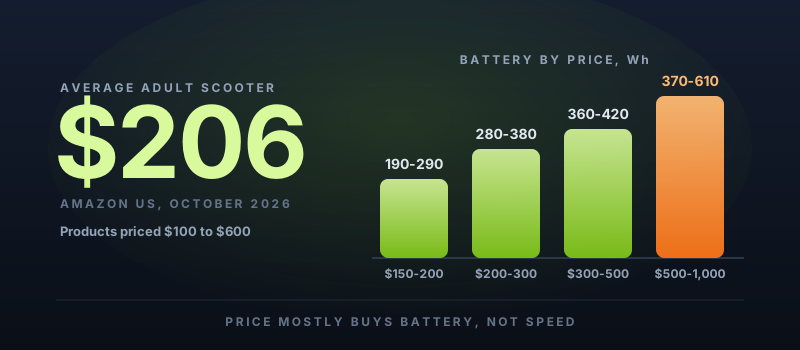
How much does an electric scooter cost?
The best-selling adult electric scooters on Amazon cost about $150 to $300, and in October 2026 the average adult stand-up scooter there sold for about $206 (across products priced $100 to $600). Kids' scooters start lower, at roughly $100 to $300. The brand-name commuters from Segway and NIU with the biggest batteries cost $500 to $1,000, and every scooter on this page cost under $1,000 when we checked on October 30, 2026.
What the extra money buys is mostly battery, and with it range and weight. Across the adult scooters on this page, battery size climbs from 187 Wh on the VOLPAM Q1 to 608 Wh on the NIU KQi 300X, and weight climbs with it, from 26 lb to 54.2 lb. Top speed barely moves: 13 of the 16 adult scooters here ship at 19 or 20 mph, whatever they cost.
We have not ridden these scooters. Every spec below comes from the maker's spec sheet or manual, or from the Amazon listing where the maker publishes none, and we say which. Every product price is Amazon's figure at our last check, and every range figure is our estimate, with the method at the end of this page.
The full guide, section by section. Tap any section to read it.
Electric scooter prices at a glance
Electric scooter prices at a glance
| Budget | What it buys, on paper | Scooters on this page | Ranked guide |
|---|---|---|---|
| Kids, about $100 to $300 | 7.5 to 12.4 mph, rider limits of 110 to 132 lb, small batteries | Gotrax GKS Mini, Segway Ninebot C2 Lite and C2 Pro, Hiboy Q2 Lite (seated) | For kids |
| About $150 to $200 | mostly 350 W motors, 19 mph, 187 to 289 Wh where stated and 8.5-inch solid or honeycomb tires; the older NIU has 365 Wh on 10-inch tubeless tires | VOLPAM Q1, WERHY H5, MAXSHOT V1, NIU KQi2 Pro | Under $200 |
| $200 to $300 | 281 to 378 Wh, rear shocks or dual suspension | MAXSHOT V1 SPRO, Hiboy S2 | Under $300 |
| $300 to $500 | 358 to 418 Wh, 10-inch tires, IPX4 or IPX5; seated models | Hiboy S2 Pro, Hiboy KS4 Pro, NAVEE GT3, Gotrax A5 (seated) | Under $500, with a seat |
| $500 to $1,000 | 368 to 608 Wh, tubeless air tires, suspension, IPX5, IPX6 or IP55, longer warranties | Segway Ninebot E3 Pro, F3, Max G2 and Max G3; NIU KQi 300P and 300X | Long range, for adults |
What does each budget buy?
What does each budget buy?
Kids' electric scooters: about $100 to $300
Kids' scooters are the cheapest tier, and Amazon's average kids' scooter sold for about $166 in October 2026. The money buys a speed and a rider limit sized for a child. The Gotrax GKS Mini ($119.99 at our last check) is a kick-start scooter that its listing rates for ages 6 to 12 and riders up to 120 lb, at 7.5 mph; the listing states no battery size. The Segway Ninebot C2 Lite ($179.99 at our last check) is rated for ages 6 to 10, 110 lb and 9.9 mph on a 56 Wh battery, and the C2 Pro ($279.99 at our last check) for ages 9 and up, 132 lb and 12.4 mph, and it folds where the Lite does not. The Hiboy Q2 Lite ($229.99 at our last check) adds a seat for ages 5 to 8. The Gotrax and Hiboy listings state UL 2272, and Segway states that both C2 models are tested to UL 2272 by TÜV Rheinland. Put a helmet in the budget too, and use it on every ride. Our best electric scooters for kids ranks them by age, and riders who have outgrown them have the best electric scooters for teens.
Budget adult scooters: about $150 to $200
This is where most of Amazon's best sellers are. VOLPAM and WERHY listings held #1 and #2 in Amazon's Electric Scooters in late October 2026, with two MAXSHOT listings also in the top five: the V1, in this band, and the V1 SPRO, in the next band up. The money buys a 350 W motor, a 19 mph top speed and a small battery on 8.5-inch solid or honeycomb tires, which cannot go flat and do little to soak up bumps.
The VOLPAM Q1 ($159.98 at our last check) carries 187.2 Wh by a sibling Q1 listing, which we estimate at 7 to 9 miles at full speed, and weighs 26 lb by its listing; no certification stated. The WERHY H5 ($159.98 at our last check) weighs 30 lb by its listing and states no battery size, so we cannot estimate its range; no certification stated. The MAXSHOT V1 ($149.99 at our last check) gives a 37 V, 7.8 Ah battery on its listing, about 289 Wh, which we estimate at 11 to 13 miles, at 31 lb, and the listing states UL 2272.
The brand-name exception is the NIU KQi2 Pro ($199.99 at our last check): 300 W rated (600 W peak), a 365 Wh battery we estimate at 14 to 17 miles, 10-inch tubeless tires, IP54 and a 2-year warranty on the main body, at 40.6 lb. The catch is its age. NIU's own US store shows it sold out and tagged OLD, and parts for a model its maker no longer sells may be harder to find. Our best electric scooters under $200 ranks this tier (the NIU sits right at its $200 line, so it leads our under $300 guide instead), and if you will carry the scooter up stairs, the best lightweight electric scooters compares weights.
$200 to $300: a bigger battery and some suspension
The MAXSHOT V1 SPRO ($265.99 at our last check) lists a 42 V, 10.5 Ah battery. 42 V is the full-charge voltage of a standard 36 V pack, so we count about 378 Wh, which we estimate at 14 to 17 miles. It adds dual suspension and 10-inch honeycomb tires at 37 lb, the listing states UL 2272, and every spec comes from the listing alone. Its 22 mph top speed is over New York's 20 mph e-scooter limit.
The Hiboy S2 ($299.98 at our last check) has a smaller 280.8 Wh battery (10 to 13 miles by our estimate) at 35.5 lb, and what the price buys is a maker that publishes its spec sheet, manual and range test conditions: 350 W rated (500 W peak), rear shocks, a rear disc brake, IPX4 and a 220 lb limit. It was in the top 10 of Amazon's Electric Scooters in late October 2026, and the listing states UL 2272. Our best electric scooters under $300 ranks this tier.
$300 to $500: where batteries stop being small
The Hiboy S2 Pro ($422.95 at our last check) and Hiboy KS4 Pro ($399.98 at our last check) are the same scooter underneath: Hiboy sells one motor wheel and one replacement battery for both. Each has a 500 W rated motor, 417.6 Wh (15 to 19 miles by our estimate), 10-inch honeycomb tires, rear shocks, IPX4 and a 220 lb limit, at 39.7 lb and 40.6 lb. The KS4 Pro has wider handlebars; buy whichever is cheaper on the day.
The NAVEE GT3 ($449.99 at our last check) has a smaller 358 Wh battery (13 to 16 miles) and weighs more, at 46.3 lb. What you pay for there is 10-inch tubeless air tires, suspension at both ends, IPX5 and a 24-month limited warranty on most parts. The listing states UL 2272 on all three.
If you want to sit, the Gotrax A5 ($379.99 at our last check) is a seated scooter whose listing gives a 400 W rated motor, 12-inch air-filled tires and a 15.5 mph top speed at 50.7 lb; the listing states UL 2272 and gives no battery size. Amazon's seated scooters averaged about $337 in October 2026. A heavier, faster seated scooter can count as a moped in some states, so check your state's definition before you buy. Our best electric scooters under $500 ranks the stand-up models, and the best electric scooters with a seat covers the A5 and its rivals.
$500 to $1,000: range, air tires and longer warranties
The top tier is Segway and NIU, and the money goes on battery, tubeless air tires, suspension, water resistance and warranty. It does not go on speed: all six ship at 20 mph. The Segway Ninebot E3 Pro ($599.99 at our last check) is the way in, with a 368 Wh battery (14 to 17 miles by our estimate), front and rear suspension and IPX5 at 40.1 lb. The Segway Ninebot F3 ($849.99 at our last check) and NIU KQi 300P ($749 at our last check) step up to 477 Wh and 486.7 Wh (18 to 22 miles each), with a front disc brake on the F3 and discs front and rear on the 300P.
The range leaders are the Segway Ninebot Max G2 ($999.99 at our last check), with 551 Wh and an estimated 20 to 25 miles at 53.5 lb, and the NIU KQi 300X ($899 at our last check), with 608.4 Wh and an estimated 23 to 28 miles at 48.7 lb. The Segway Ninebot Max G3 ($999.99 at our last check) has the best hardware of the Segways we cover: front and rear disc brakes, hydraulic suspension at both ends, IPX6 and a 286 lb limit. Segway's US store marks it end of life, though, and we give it no range estimate because an app unlock takes it to 28 mph. Segway states that its four are tested to UL 2272 by TÜV Rheinland, and NIU's US store states UL 2272 for both NIUs, whose Amazon listings mention only UL certification, with no standard named. Our best long-range electric scooters ranks this tier by range, the best electric scooters for commuting by the daily ride, and the best electric scooters for adults against everything else.
What makes one electric scooter cost more than another?
What makes one electric scooter cost more than another?
Battery capacity, more than any other spec. Here is each price band on the figures from the spec sheets and listings:
| Price band | Battery, where stated | Our range estimate at full speed | Weight | Top speed |
|---|---|---|---|---|
| Kids, about $100 to $300 | 56 to 108 Wh | none for kids' scooters | 16.3 to 25.8 lb | 7.5 to 12.4 mph |
| About $150 to $200 | 187 to 289 Wh (365 Wh on the older NIU) | 7 to 17 miles | 26 to 40.6 lb | 17.4 to 19 mph |
| $200 to $300 | 281 to 378 Wh | 10 to 17 miles | 35.5 to 37 lb | 19 to 22 mph |
| $300 to $500, stand-up | 358 to 418 Wh | 13 to 19 miles | 39.7 to 46.3 lb | 19 to 20 mph |
| $500 to $1,000 | 368 to 608 Wh | 14 to 28 miles (none for the Max G3) | 40.1 to 54.2 lb | 20 mph |
Read down the battery column and the pattern is plain. The biggest pack on this page is about three times the smallest adult one, and our range estimate grows with it, from 7 to 9 miles on the VOLPAM Q1 to 23 to 28 on the NIU KQi 300X. Weight rises with the battery, which matters if you carry the scooter: the 551 Wh Max G2 weighs 53.5 lb, about twice the 26 lb on the VOLPAM listing.
Two exceptions show what else the money buys. The NIU KQi2 Pro puts 365 Wh into the budget band, and it is an older model that NIU's own US store shows sold out and tagged OLD. The Segway E3 Pro sits a tier above the Hiboy S2 Pro with a smaller battery (368 Wh against 417.6 Wh), and the difference pays for tubeless air tires in place of honeycomb, suspension at both ends in place of rear shocks, IPX5 against IPX4, a 265 lb limit against 220 lb, and a two-year limited warranty that Segway markets against Hiboy's one year.
What does not rise with price is speed. The cheapest and the dearest adult scooters here ship at 19 or 20 mph. More would be of little use in two of the biggest markets anyway: New York defines an e-scooter as one that goes 20 mph or less (VTL §114-e), and California limits motorized scooters to 15 mph (Vehicle Code §22411).
Brakes and water ratings improve with price, less neatly. The VOLPAM, WERHY and MAXSHOT V1 listings pair an electronic brake with a drum, the MAXSHOT V1 SPRO listing names no brake type, and none of the four states a water rating. The Hiboy models add a rear disc and IPX4. At $500 to $1,000 every model is rated IPX5, IPX6 or IP55, the NIU KQi 300P, KQi 300X and Max G3 have discs front and rear, and the E3 Pro and Max G2 still use a front drum with a rear electronic brake.
What does an electric scooter cost to run?
What does an electric scooter cost to run?
Very little in electricity. The figures below use about 17 cents per kWh, the US rate our savings calculator uses and a little above the EIA's 2024 US average residential price of 16.5 cents, and each scooter's stated battery size. The low figure is the battery's capacity at that rate; the high figure allows a quarter more for losses in the charger, an allowance we chose to be generous rather than a measured number.
| Scooter | Battery | One full charge |
|---|---|---|
| Segway Ninebot C2 Lite (kids') | 56 Wh | about 1 cent |
| VOLPAM Q1 | 187.2 Wh | 3 to 4 cents |
| Hiboy S2 | 280.8 Wh | 5 to 6 cents |
| Segway Ninebot Max G2 | 551 Wh | 9 to 12 cents |
| NIU KQi 300X | 608.4 Wh | 10 to 13 cents |
Per mile, at the 22 to 27 Wh per mile our range estimates use, that is roughly half a cent a mile. A 5-mile round trip on 250 working days is 1,250 miles a year, or about $5 to $7 of electricity a year.
The real running costs are the parts that wear. Three to plan for, in rising order of cost:
- Tires. The solid and honeycomb tires on most budget scooters cannot go flat, at the price of a harsher ride. The tubeless air tires on the Segway, NIU and NAVEE models ride better and need their pressure kept up (Segway specifies 42 to 48 psi on the Max G2 and E3 Pro). Segway says its self-sealing tires plug punctures up to 4 mm, and its Max G3 warranty treats tires as wear parts, with three months of cover.
- Brake parts. Makers treat them as consumables. NIU covers brake discs, levers, cables and the throttle on the KQi 300X for 6 months, against 2 years for the main body, and Amazon's warranty text for the Segway F3 gives brake parts 1 year against 2 for the frame.
- The battery. The one large bill. Lithium packs lose capacity with use, and warranty cover for that varies widely. The Hiboy S2's one-year warranty excludes battery capacity loss. Segway's Max G3 warranty document gives the battery one year and covers a claim only if the pack holds under 70% of its capacity at 77°F. NIU covers the battery for two years as part of the main body on the KQi 300P and 300X. We have no replacement-pack prices we can stand behind, so check before you buy that the maker sells one at all: Hiboy sells a single replacement battery that fits both the S2 Pro and the KS4 Pro, while WERHY has no website and we found no verifiable MAXSHOT site.
How do warranties differ by price?
How do warranties differ by price?
Read past the headline number. Here is what each maker or listing says:
| Scooter | Warranty, per the maker or listing |
|---|---|
| VOLPAM Q1 | 12 months or 180 days, depending on the part |
| MAXSHOT V1 | 1 year; one listing bullet says components are "tested to last up to 180 days of regular use" |
| Hiboy S2 | 1 year for the original owner, excluding battery capacity loss |
| Hiboy S2 Pro | 1 year; the listing says some parts get 6 months |
| Gotrax A5 | 365 days on parts |
| NAVEE GT3 | 24 months limited on most parts, including the motor, hub and frame; NAVEE's warranty policy gives the battery 12 months |
| Segway Ninebot F3 | 2 years on the frame and main parts; 1 year on the stem and folding mechanism, battery, charger, brake parts and lights (Amazon warranty text) |
| Segway Ninebot Max G3 | 2 years marketed; 1 year on the battery, charger, stem, folding mechanism and brake parts; 3 months on wear parts such as tires |
| NIU KQi 300X | 2 years on the main body, including battery, motor, frame and controller; 6 months on brake discs, levers, cables and throttle; 3 months on lights, fenders and kickstand |
The VOLPAM, MAXSHOT and Hiboy warranties run a year or less on most parts. NIU, NAVEE and Segway give two years on the frame and motor; NAVEE gives the battery one year, and Segway gives the battery, stem and brakes one year.
What else should you budget for?
What else should you budget for?
A helmet. CPSC estimates that only 18% of injured e-scooter riders were wearing one, per its April 2026 report, and CPSC's own advice is to always wear a bicycle helmet. Buy it with the scooter.
A lock, if it will live outside. Every adult stand-up scooter on this page folds, and carrying it inside is the cheapest security there is. If it will wait outside a shop or a station, add a lock.
Your local rules. In California, riding a motorized scooter needs a driver's license or instruction permit (Vehicle Code §21235), and Pennsylvania does not allow e-scooters on public roads. Neither costs anything at checkout, and either can make a scooter the wrong purchase. Scooters are not e-bikes, so the US e-bike classes do not apply to them.
Is an electric scooter cheaper than an e-bike?
Is an electric scooter cheaper than an e-bike?
Yes, by about half. On Amazon in October 2026, among products priced $100 to $600, the average adult stand-up scooter sold for about $206 and the average e-bike for about $405, and Amazon sold about 1.5 times as many scooters as e-bikes. The median in-stock e-bike in our own catalogue was $634.50 when we counted in August 2026, about where the top scooter tier sits. Both cost pennies to charge. What an e-bike's extra money buys is a bigger battery and pedals: budget e-bikes carry 360 to 720 Wh, against 187 to 608 Wh on the adult scooters here. Our electric scooter vs e-bike guide sets out which suits which trip, and how much an e-bike costs gives the e-bike price bands.
Is a cheap electric scooter worth it?
Is a cheap electric scooter worth it?
Often, for a short, flat, dry trip. Most $150 to $200 best sellers cover an estimated 7 to 13 miles at full speed where the battery is stated, enough for a round trip of about 5.5 to 9 miles plus a quarter to spare, and most weigh 26 to 31 lb on their listings, light enough for a flight of stairs. Know what you give up at that price:
- Certification. On October 30, 2026, 8 of the 44 scooters we cover stated no certification, and 7 of those 8 sold for under $220 when we added them, including two of Amazon's top sellers, the VOLPAM Q1 and WERHY H5. UL 2272 is the fire and electrical safety standard for scooters: New York City requires it for scooters sold there, and California has required UL 2272 battery testing since January 1, 2026. Even a stated claim is not proof, so see our electric scooter safety guide for how to check one and where to look up recalls.
- Battery. 187 to 289 Wh on most of the best sellers on this page that state it, and some state none, so their range cannot be estimated at all.
- Support and parts. Of the 14 best-selling scooters on Amazon on October 4, 2026, five were no longer buyable two weeks later, including the one at #1. When a listing disappears, its support and spare parts often go with it.
- Ride. Solid or honeycomb tires, little or no suspension, and no water rating on the VOLPAM, WERHY or MAXSHOT listings.
Spend more if your round trip is longer than about 9 miles, you ride in the rain, or you need UL 2272 where you live or for your building. Our under $300 and under $500 guides rank the next steps up.
How we got these numbers
How we got these numbers
Product prices are Amazon US figures for each scooter's main listing at our last check, shown live where Amazon's terms allow. The price bands come from those prices on October 30, 2026. Market averages come from our October 2026 pull of Amazon US listings priced $100 to $600, one row per product. Amazon placements are category placements in Amazon's Electric Scooters on the dates given, and they change week to week. Specs come from each maker's spec sheet or manual, or from the Amazon listing where the maker publishes none.
Range figures are our estimate: battery watt-hours divided by 22 to 27 Wh per mile, the middle half of 32 full-speed range tests that eRideHero and RiderGuide published for 26 commuter scooters, adjusted to a rider of about 175 to 180 lb. We give no estimate for kids' scooters or for a scooter that can be set above 24 mph. Charging costs use 17 cents per kWh. We have not ridden or tested any of these scooters. Last checked October 30, 2026.
Frequently asked questions
How much is a good electric scooter?
It depends on the trip. For short, flat rides, most $150 to $200 best sellers work, with an estimated 7 to 13 miles at full speed. For a daily commute, plan on about $300 to $700 for a maker that publishes its specs and range test conditions: the Hiboy S2 ($299.98 at our last check) has 280.8 Wh, rear shocks and a rear disc brake, and the Segway Ninebot E3 Pro ($599.99 at our last check) has 368 Wh, an estimated 14 to 17 miles, suspension at both ends and tubeless air tires. See the best electric scooters for adults.
What is a reasonable price for an electric scooter?
About $150 to $300 for an adult scooter, which is where Amazon's best sellers sit. The average adult stand-up scooter on Amazon sold for about $206 in October 2026, among products priced $100 to $600. Most $150 to $200 best sellers have a 350 W motor, a 19 mph top speed and, where the battery is stated, an estimated 7 to 13 miles at full speed. Kids' scooters are reasonable at roughly $100 to $300 (Amazon's kids' average was about $166), and seated scooters averaged about $337.
Why are electric scooters so expensive?
Mostly battery. On the adult scooters in this guide, battery size runs from 187 Wh at the cheap end to 608 Wh at the top, and our range estimate grows from 7 to 9 miles to 23 to 28. The rest of the money buys tubeless air tires in place of solid ones, suspension, a water rating of IPX5 or better, and longer warranties. It does not buy speed: the cheapest and the dearest adult scooters here both ship at 19 or 20 mph.
How much does it cost to charge an electric scooter?
A few cents. At about 17 cents per kWh (a little above the EIA's 2024 US average residential price of 16.5 cents), a full charge of the Hiboy S2's 280.8 Wh battery costs about 5 to 6 cents and the Segway Ninebot Max G2's 551 Wh battery about 9 to 12 cents, allowing up to a quarter extra for charger losses. That is roughly half a cent a mile, or about $5 to $7 a year for a 5-mile round trip on 250 working days. Tires, brake parts and eventually a battery cost far more than the electricity.
Is a cheap electric scooter worth it?
For short, flat, dry trips, often yes. Most $150 to $200 best sellers cover an estimated 7 to 13 miles at full speed where the battery is stated and weigh 26 to 31 lb on their listings. The trade-offs are small batteries, solid tires with little or no suspension, short warranties and certification: two of Amazon's top sellers in October 2026, the VOLPAM Q1 and WERHY H5, state no certification. Check UL 2272 and recalls first with our electric scooter safety guide.
How much does a kids' electric scooter cost?
Roughly $100 to $300, and Amazon's average kids' scooter sold for about $166 in October 2026. The Gotrax GKS Mini ($119.99 at our last check) is listed for ages 6 to 12 at 7.5 mph, the Segway Ninebot C2 Lite ($179.99 at our last check) is rated for ages 6 to 10 at 9.9 mph, and the C2 Pro ($279.99 at our last check) for ages 9 and up at 12.4 mph. Add a helmet to the budget, and use it on every ride. See the best electric scooters for kids.
Do more expensive electric scooters go faster?
Mostly no. 13 of the 16 adult scooters on our price page ship at 19 or 20 mph, from the $150 to $200 best sellers to the $500 to $1,000 Segway and NIU commuters. The extra money buys battery, air tires, suspension, water resistance and warranty. More speed would be of little use in two big markets anyway: New York defines an e-scooter as one that goes 20 mph or less, and California limits motorized scooters to 15 mph.
Keep reading
Guide
Electric Scooter Safety (2026): UL 2272, Recalls
Buy an electric scooter whose maker states UL 2272 and names the lab, check the model against CPSC...
ReadGuide
Electric Scooter vs E-Bike (2026): Which to Buy
Buy an electric scooter for short, flat trips that end with stairs, a train or a small apartment;...
ReadGuide
Class 1 vs 2 vs 3 E-Bikes Explained (2026)
The US e-bike class system is actually simple: Class 1 is pedal-assist only at 20 mph, Class 2...
Read
Reviewed by