How Much Does an E-Bike Cost? 2026 Prices
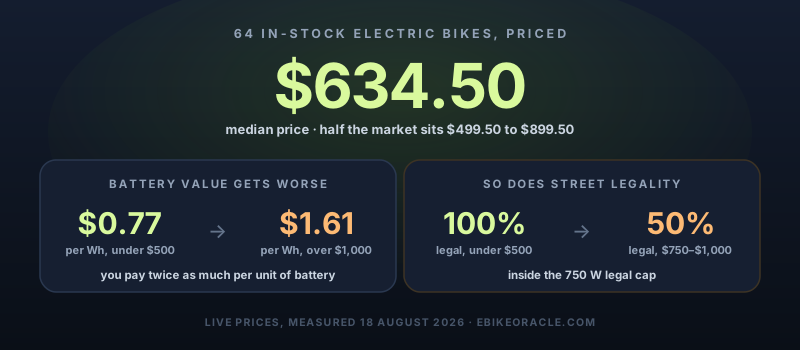
The median in-stock electric bike we track costs $634.50, and half the market sits between $499.50 and $899.50. You can buy a working, street-legal e-bike for $199. Two things surprise people once you look at real prices rather than a range someone invented: cost per watt-hour of battery roughly doubles as you spend more ($0.77/Wh under $500 against $1.61/Wh over...
The short version
- Median price: $634.50. Half of all in-stock bikes fall between $499.50 and $899.50.
- The floor is $199 for a working Class 2 bike. The ceiling in our catalogue is $1,599.
- Battery gets worse value as you spend more — $0.77 per watt-hour under $500, $1.61 per watt-hour over $1,000.
- 100% of sub-$500 bikes are inside the 750 W cap. Only 50% of $750–$1,000 bikes are.
- Running costs are trivial: roughly $0.10–$0.20 of electricity per full charge, and a replacement battery is the only large bill you should expect.

Our pick for most readers
Funhang City Cruiser 26
$320
As an Amazon Associate I earn from qualifying purchases. Ebike Oracle may also earn a commission on links to other retailers. Full disclosure.
How much does an electric bike actually cost?
Across the 64 in-stock bikes we currently track and price-sync, the median is $634.50. The middle half of the market runs from $499.50 to $899.50, the cheapest working bike is $199, and the most expensive is $1,599. Nineteen of those bikes are under $500 and fifty-four are under $1,000, so the honest shape of this market is not the "$1,000 to $3,000" band most guides quote: it is a market clustered in the mid-hundreds with a thin tail above a thousand dollars. What changes as you climb that ladder is mostly battery capacity and weight rather than quality. Average battery rises from 418 Wh below $300 to 970 Wh above $1,000, and average weight rises with it, from 50 lb to 83 lb. You are buying range and heft. What does not reliably improve is legality, and the value you get per unit of battery actually gets worse, which are the two things this page exists to show you.
The full guide, section by section. Tap any section to read it.
What do you get at each price?
What do you get at each price?
Every row below is the average of the bikes we actually had in stock on 18 August 2026, not a manufacturer category.
| Price | Bikes | Avg battery | Avg motor | Claimed range | Avg weight |
|---|---|---|---|---|---|
| Under $300 | 5 | 418 Wh | 588 W | 23 mi | 50 lb |
| $300–$500 | 14 | 468 Wh | 473 W | 28 mi | 56 lb |
| $500–$750 | 20 | 669 Wh | 806 W | 34 mi | 64 lb |
| $750–$1,000 | 15 | 762 Wh | 1,043 W | 40 mi | 77 lb |
| $1,000–$1,500 | 9 | 970 Wh | 1,389 W | 43 mi | 83 lb |
| Over $1,500 | 1 | 960 Wh | 1,500 W | 68 mi | 83 lb |
Read the range column with suspicion. Those are manufacturer claims, and the arithmetic rarely supports them. A useful check on any bike: watt-hours divided by 20 is a realistic mixed-riding range in miles, because a fat-tyred e-bike at 20 mph draws roughly 15 to 30 Wh per mile. A 468 Wh battery is therefore a real-world 16 to 31 miles, not the 28 claimed as a best case. We run that division on every bike we review, and the claim fails more often than it holds.
Why does a more expensive e-bike give you less battery per dollar?
Why does a more expensive e-bike give you less battery per dollar?
This is the finding that surprised us most when we ran it across the catalogue. Cost per watt-hour, which is the closest thing to an honest value metric on an electric bike:
| Price band | Median cost per watt-hour |
|---|---|
| Under $500 | $0.77 |
| $500–$750 | $0.88 |
| $750–$1,000 | $1.25 |
| Over $1,000 | $1.61 |
Across everything we track the median is $1.12 per watt-hour. So a bike over $1,000 costs you roughly twice as much per unit of stored energy as one under $500.
That is not a scandal, and it is not a reason to always buy cheap. Above about $750 the money stops going into cells and starts going into suspension, hydraulic brakes, torque sensors, better frames and certification. Those are real things and some of them matter a great deal, particularly brakes on a heavy bike. But if what you want is range, the cheapest watt-hours in this market are at the bottom of it, and a second battery for a cheap bike is usually better value than a dearer bike.
🔴 Does spending more get you a street-legal bike? No — the opposite.
🔴 Does spending more get you a street-legal bike? No — the opposite.
This is the part almost nobody tells you, and it is where price and law collide.
Federal law defines a low-speed electric bicycle as having a motor of less than 750 watts (16 CFR § 1512.2), and nearly every state that adopted the three-class framework kept that ceiling. Oregon is the only state that permits 1,000 W. So we checked how many bikes in each price band actually stay inside it:
| Price band | Bikes with stated wattage | Inside the 750W cap and 28 mph |
|---|---|---|
| Under $500 | 15 | 100% |
| $500–$750 | 16 | 69% |
| $750–$1,000 | 14 | 50% |
| Over $1,000 | 10 | 60% |
Every single sub-$500 bike we track is street legal on wattage and speed. Only half of the $750–$1,000 bikes are. The reason is straightforward once you see it: cheap bikes compete on price and land on 350–500 W hub motors, while the mid and upper market competes on power and advertises 1,000 W, 1,500 W or a "peak" figure well beyond the cap.
So if legality matters to you, and it should, the budget end of this market is the safer place to shop, which is the exact reverse of how buying usually works. Check the rules where you live on your state page before you spend, and read class 1, 2 and 3 explained so you know which number to look for.
What does an e-bike cost to run?
What does an e-bike cost to run?
Almost nothing, and this is where e-bikes genuinely beat every alternative.
A full charge of a typical 500 Wh battery uses about 0.5 kWh of electricity once you allow for charger losses. At the US average residential rate of roughly 17 cents per kWh that is about 9 cents a charge, or 10 to 20 cents for the bigger 700–1,000 Wh packs. If you charge three times a week all year you are looking at $15 to $30 a year in electricity.
The real running costs are the ordinary bicycle ones: tyres, brake pads, cables and chains. Budget $50 to $150 a year if you ride regularly, more if you ride in winter salt.
The one large bill is the battery. Lithium packs lose capacity with cycles, and a replacement is typically $300 to $750 depending on capacity and whether the brand still sells it. That last clause matters more than the price: a battery you cannot buy makes the bike scrap. Prefer a bike whose battery is a standard, currently-sold part, and see how long e-bike batteries last for what to expect.
What about the costs people forget?
What about the costs people forget?
Three of them, and they can add several hundred dollars to a purchase that looked like $500.
A helmet, lights and a lock. A decent lock for a bike worth several hundred dollars is $60 to $120 on its own, and it is not optional in a city. Many cheap bikes ship with lights that are adequate to be seen but not to see by.
Returns. This is the one that catches people. Direct-from-brand purchases frequently charge return freight of $150 to $200 per bike plus a restocking fee, because shipping a 60 lb boxed bike back is genuinely expensive. Amazon returns on e-bikes are usually free, which is worth real money on a purchase you might not keep. Read the return policy before the spec sheet.
Assembly and setup. Most bikes arrive 85% assembled and need handlebars, pedals, a front wheel and brake adjustment. A shop will do it for $75 to $150 if you would rather not, though many shops decline to work on direct-order e-bikes at all.
So what should you actually budget?
So what should you actually budget?
Three honest brackets, based on what the money buys in this market rather than on aspiration.
$200 to $500 — a real bike, and the legally safest bracket. 350–500 W, 400–470 Wh, 50–56 lb, and in our data a 100% record on staying inside the federal wattage cap. Expect mechanical disc brakes, a single speed or basic 7-speed, and a genuine 16 to 30 miles. This is where our best-converting recommendations live, and it is not a compromise so much as a different set of priorities. See the best e-bikes under $500.
$500 to $1,000 — the volume of the market. 669–762 Wh, better brakes, more suspension, 64–77 lb. Thirty-five of our sixty-four in-stock bikes sit here. This is where you should look if you want 30-plus real miles or you weigh more than the cheap bikes are rated for. Check the wattage claim carefully, because this is where 1,000 W motors start appearing.
Over $1,000 — you are buying components, not capacity. 970 Wh average, hydraulic brakes, full suspension, torque sensors, UL certification more often. Also the worst value per watt-hour in the market at $1.61/Wh, and only 60% of these bikes stay inside the legal wattage cap. Worth it for the brakes and the certification on a heavy bike. Not worth it if you are buying range.
How we got these numbers
How we got these numbers
Every figure on this page comes from the 64 published bikes in our own catalogue whose primary offer was in stock on 18 August 2026, with prices synced from the retailer rather than typed by hand. Quartiles are computed across that set. The per-watt-hour figures use each bike's stated battery capacity in watt-hours divided by its live price, reported as the median of each band. The legality columns count bikes with a manufacturer-stated rated wattage against a 750 W ceiling and the 28 mph Class 3 limit. One wording note, because it changes three of the numbers: we treat a rated 750 W exactly as inside the cap, which is how the state three-class statutes are written ("not more than 750 watts"), even though the federal text at 16 CFR § 1512.2 says "less than 750 watts". Three of the sub-$500 bikes are rated at exactly 750 W, so on the stricter federal reading that band is 80% rather than 100%. Bikes that state only a "peak" figure are excluded rather than guessed at, which is why the row totals are smaller than the band totals.
Prices in this market move constantly, sometimes weekly. Treat the bands and the ratios as the durable finding and the exact median as a snapshot. Last verified 18 August 2026.
Top-rated pick
 Amazon
Funhang
Funhang City Cruiser 26
Reading up because you're shopping? This is the highest-rated bike we've reviewed (8.6/10) with a live US listing.
As an Amazon Associate I earn from qualifying purchases. Ebike Oracle may also earn a commission on links to other retailers. Full disclosure.
Frequently asked questions
How much does a good electric bike cost?
The median in-stock e-bike we track is $634.50, and the middle half of the market runs $499.50 to $899.50. That is the realistic answer for a bike that works and is legal, and it is well below the "$1,000 to $3,000" range most guides quote. Below $500 you can still get a genuinely functional Class 2 bike, and in our data every sub-$500 bike stays inside the 750 W federal legal limit — which is not true of the more expensive bands.
What is the cheapest electric bike worth buying?
The floor in our catalogue is $199 for a working Class 2 bike, and there are 19 bikes under $500. At that price expect roughly 418–468 Wh of battery, a 350–500 W motor, mechanical disc brakes and a real-world range of about 16 to 30 miles. What you are not giving up is legality: sub-$500 bikes had a 100% record on staying inside the federal wattage cap in our data. See the best e-bikes under $500.
Why are some electric bikes so expensive?
Above roughly $750 the money stops buying battery and starts buying components: hydraulic brakes, full suspension, torque sensors instead of cadence sensors, better frames and UL certification. Those are real, and hydraulic brakes on a 70 lb bike genuinely matter. But value per watt-hour gets worse as you climb — a median of $0.77/Wh under $500 against $1.61/Wh over $1,000. If what you want is range rather than components, a second battery for a cheaper bike usually beats a dearer bike.
How much does it cost to charge an electric bike?
About 9 to 20 cents a charge. A 500 Wh battery uses roughly 0.5 kWh including charger losses, which at the US average of about 17 cents per kWh is 9 cents; a 1,000 Wh pack is closer to 20 cents. Charging three times a week for a year costs $15 to $30 in electricity. The meaningful running costs are ordinary bicycle maintenance at $50 to $150 a year, plus an eventual $300 to $750 battery replacement.
Are cheap electric bikes street legal?
More reliably than expensive ones, which surprises most people. Federal law caps a low-speed electric bicycle at under 750 W (16 CFR § 1512.2) and only Oregon permits 1,000 W. In our catalogue 100% of sub-$500 bikes with a stated wattage were inside that cap, against 69% at $500–$750 and just 50% at $750–$1,000. Cheap bikes compete on price and land on 350–500 W motors; the mid-market competes on power and advertises 1,000 W and up. Check your state before buying.
What hidden costs come with an electric bike?
Three worth budgeting for. A lock, helmet and lights realistically add $100 to $250. Returns are the expensive surprise: buying direct from a brand often means $150 to $200 in return freight plus a restocking fee, while Amazon returns on e-bikes are usually free. And assembly runs $75 to $150 at a shop, though many shops will not service direct-order e-bikes at all. Read the return policy before the spec sheet.
Keep reading
Guide
Class 1 vs 2 vs 3 E-Bikes Explained (2026)
The US e-bike class system is actually simple: Class 1 is pedal-assist only at 20 mph, Class 2...
ReadGuide
Do You Need a License for an E-Bike? (2026)
In 49 states and Washington, DC you do not need a license, registration, or insurance to ride a...
ReadGuide
Are E-Bikes Worth It in 2026? The Real Cost to Own
For most commuters, yes — an e-bike is one of the cheapest vehicles you can own. A full...
Read
Reviewed by