Class 1 vs 2 vs 3 E-Bikes Explained (2026)
The US e-bike class system is actually simple: Class 1 is pedal-assist only at 20 mph, Class 2 adds a throttle at 20 mph, Class 3 raises the pedal-assist cap to 28 mph. The complication is that bike-path rules, state laws, and helmet requirements vary by class — and getting it wrong can mean a ticket, a deactivated trail pass,...
The short version
- Class 1 — pedal-assist only, cuts out at 20 mph. The widest path and trail access.
- Class 2 — adds a throttle, still capped at 20 mph. Same access as Class 1 in most states.
- Class 3 — pedal-assist to 28 mph. Faster, but often barred from bike paths and usually carries helmet and minimum-age rules.
- All three are capped at a 750 W rated motor under the federal definition (15 U.S.C. §2085).
- The class is what decides where you can ride — not the price, the brand, or the frame.

Our pick for most readers
Heybike Cityscape 2.0
$609
As an Amazon Associate I earn from qualifying purchases. Ebike Oracle may also earn a commission on links to other retailers. Full disclosure.
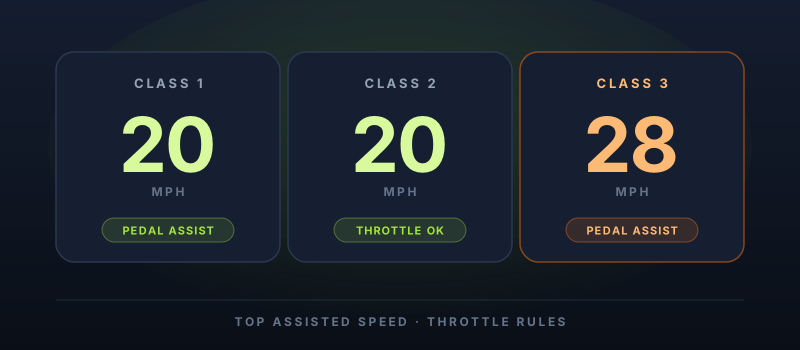
The 30-second answer
| Class | Pedal-assist max | Throttle | US states allowed |
|---|---|---|---|
| Class 1 | 20 mph | No | 50 of 50 (everywhere) |
| Class 2 | 20 mph | Yes, up to 20 mph | 50 of 50 |
| Class 3 | 28 mph | Yes (varies; usually 20 mph or none) | 44 of 51 |
All three classes cap rated motor power at 750 W — that's federal law (15 USC §2085). Anything above 750 W rated isn't an e-bike under US law; it's a motor vehicle. That's exactly why a Sur-Ron or Talaria electric dirt bike isn't street legal — no pedals, thousands of watts, and it's treated as an off-road motorcycle.
One 2026 exception to "no license needed." In most states an e-bike of any class is a bicycle — no license, registration, or insurance. New Jersey changed that on 19 July 2026: every e-bike now needs a driver's license and MVC registration (full NJ rules), and Hawaii requires a one-time registration (HI rules). Everywhere else, ride freely. Check your state on the legality checker.
And two 2026 changes to the age and helmet rules below. Hawaii's Act 259 (HB2021), effective 15 July 2026, adopted the Class 1/2/3 framework itself, raised its helmet requirement from under-16 to under-18 on every class, barred under-16s from operating a Class 2 or Class 3 without parent or guardian supervision, banned wheelies and stunt riding on public streets, and now requires manufacturers to label each bike with its class, top assisted speed and motor wattage. Separately, Tennessee's SB 1782 raised its Class 3 minimum operating age from 14 to 16 on 1 July 2026. Only a handful of states have changed their e-bike law this year — we track every one of them, with the statute, in the 2026 e-bike law tracker.
The full guide, section by section. Tap any section to read it.
The full breakdown
The full breakdown
Class 1 — pedal-assist only, 20 mph
Pedal-assist means the motor only engages when you're pedalling. There's no throttle — no twist-grip, no thumb button, no way to make the bike go without your legs moving.
Class 1 is the most universally permitted class. Every state allows them, every multi-use trail allows them, every national forest road allows them. If you're going to ride mountain bike trails or shared-use paths, Class 1 is the safe pick.
Common Class 1 bikes: most premium e-MTBs (Specialized Turbo Levo, Trek Rail), most European commuters (Bosch active-line bikes), and any e-bike sold in the EU/UK (where 250W / 25 km/h pedal-assist is the legal max — equivalent to Class 1).
Class 2 — pedal-assist + throttle, 20 mph
Same 20 mph cap as Class 1, but adds a throttle so you can ride without pedalling. Useful for: starting from a stop on a hill, riding when injured, hauling kids without breaking a sweat, anyone who can't pedal continuously.
Class 2 is permitted in all 50 US states but increasingly restricted on multi-use bike paths because non-pedalling riders surprise other trail users. Many city trails (Boulder, Denver, Portland) ban Class 2. Always check local rules.
Common Class 2 bikes: most US Amazon e-bikes under $1,500 (Heybike, Vivi, Razor, Aventon Sinch). Cheaper to manufacture than Class 1 because the assist sensor is simpler.
Class 3 — pedal-assist to 28 mph (throttle varies)
The fastest e-bike class. Pedal-assist works up to 28 mph (vs 20 mph for Classes 1 and 2). Most Class 3 bikes also have a throttle, but the throttle is usually capped at 20 mph (federal law) — so you can't twist-grip your way to 28.
Class 3 is US-only. The UK + EU don't have a Class 3 equivalent — their EAPC laws cap all e-bikes at 25 km/h (15.5 mph) pedal-assist with no throttle. International riders importing US Class 3 bikes find out the hard way that their bikes aren't road-legal.
Class 3 is recognized in 44 of the 51 US jurisdictions (50 states + DC) as of 2026 — Hawaii joined on 15 July 2026, when Act 259 adopted the three-class framework and made Class 3 street-legal there for the first time. The seven that still don't recognize a 28 mph class — meaning a Class 3 bike isn't street-legal as a bicycle there — are the District of Columbia, Kentucky, Massachusetts, Montana, North Carolina, Pennsylvania, and South Carolina (each caps e-bikes at 20 mph). In the 44 that do allow Class 3, the rules vary:
- Most states require a helmet for Class 3 riders (regardless of age)
- Many states require Class 3 on roads only (not bike paths)
- A few states require minimum age 16 for Class 3
Verify your own state on the state-by-state street-legal table — it's the same dataset that powers our legality checker, reviewed against the PeopleForBikes tracker.
Common Class 3 bikes: Heybike Cityscape 2.0, Heybike Mars 2.0, most Lectric models, Aventon Pace 500.3 + Level. The Class 3 segment is fastest-growing because the speed actually matters for traffic-keeping-pace commuting.
How to tell what class your e-bike is
How to tell what class your e-bike is
- Check the spec sheet. The class is usually printed in the listing.
- Test the throttle. No throttle = Class 1. Throttle that works without pedalling = Class 2 or 3.
- Check the speed cap. Pedal-assist that quits at 20 mph = Class 1 or 2. Pedal-assist that goes to 28 mph = Class 3.
- Look for a class sticker. California + a few other states require a label on the frame: "CLASS X — XX MPH MAX MOTOR-ASSISTED."
Many modern e-bikes are switchable — a setting in the display lets you toggle between Class 1, 2, and 3. If you ride mixed terrain (some bike paths require Class 1, some streets prefer Class 3), this is the feature to look for.
Class implications by ride type
Class implications by ride type
Daily street commuting: Class 3 is the fastest pick — keeps pace with traffic, makes a 5-mile commute feel like 3.5. Class 1 is fine for short urban hops where 20 mph is plenty.
Bike paths + shared-use trails: Default to Class 1. Class 2 is allowed in most places but increasingly restricted. Class 3 is usually banned.
Mountain bike trails: Most US trail systems are Class 1 only. The IMBA position is Class 1 mountain e-bikes are equivalent to mountain bikes for trail-impact purposes; Classes 2 and 3 are not.
Family / kid hauling: Class 2 is popular here — the throttle is useful when you're starting from a stop with 80 lb of kids on the rear deck. Make sure your bike's payload rating includes the kids (most cargo Class 2 bikes are rated 400+ lb).
What about UK / EU EAPC?
What about UK / EU EAPC?
If you're in the UK or EU, none of the above applies — those markets use the EAPC framework (Electrically Assisted Pedal Cycle):
- 250 W rated motor max (vs US 750 W)
- 25 km/h (15.5 mph) pedal-assist cap
- No throttle
- Minimum rider age 14
- No licence, no insurance, no registration if EAPC-compliant
EAPC bikes are roughly equivalent to a US Class 1 limited to 25 km/h. Bikes that exceed EAPC limits (US-spec Class 2 and 3 bikes imported privately) are classed as mopeds/motorcycles in the UK and require licence, MOT, road tax, and insurance.
Bottom line
Bottom line
For most US buyers: A switchable Class 1/2/3 bike gives you flexibility — ride Class 3 on roads, drop to Class 1 for trail systems. The Heybike Cityscape 2.0 and Mars 2.0 both work this way.
For US trail / e-MTB buyers: Stay Class 1. Don't even buy a Class 2 — most trails will ban it.
For UK / EU buyers: Stick to EAPC-compliant bikes (250 W / 25 km/h / no throttle). Eleglide, ENGWE, Pure Cycles, Brompton Electric — all EAPC-compliant by default.
As an Amazon Associate I earn from qualifying purchases. Ebike Oracle may also earn a commission on links to other retailers. Full disclosure.
Best Class 3 we rate
 Amazon
Heybike
Heybike Cityscape 2.0
Class 3 is the fastest tier that's still legally a bicycle — 28 mph pedal-assist, road-legal in most states, usually barred from bike paths. This is the best-rated Class 3 we've reviewed (8.3/10).
Class 3 is not legal in every state. Check yours before buying.
As an Amazon Associate I earn from qualifying purchases. Ebike Oracle may also earn a commission on links to other retailers. Full disclosure.
Frequently asked questions
Is a 750W e-bike legal in the US?
Yes — federal law (15 USC §2085) caps rated motor power at 750W for all three e-bike classes. Bikes commonly advertise "1000W peak" or "1500W peak" — those are momentary peak power, not rated continuous. If the rated continuous power is 750W or below and the bike fits Class 1/2/3 speed caps, it's legal as an e-bike. Above 750W rated = it's a motor vehicle requiring registration, licence, and insurance in most states.
Do I need a licence or insurance to ride an e-bike in the US?
In almost every state, no — a compliant Class 1/2/3 e-bike is legally a bicycle, so no driver's licence, insurance, or registration is required. Two exceptions as of 2026: New Jersey now requires a driver's licence and MVC registration for every e-bike (S4834/A6235, enforcement began 19 July 2026 — throttle-capable bikes also need insurance), and Hawaii requires a one-time $30 registration. A handful of other states add Class 3 helmet or minimum-age rules but no licence. Check your state on our legality checker before you ride.
Can I ride a Class 3 e-bike on the bike path?
Usually no. Most US bike paths and multi-use trails restrict Class 3 because the 28 mph cap is too fast for shared-use settings. Most Class 3 bikes have a switchable mode that drops them to Class 2 (20 mph) or Class 1 (20 mph pedal-assist only) — use the switch when you're on a path. Always check local trail rules before riding.
Is Class 1 or Class 3 better for commuting?
Class 3, if your commute involves road riding and you want to keep pace with car traffic. The 28 mph cap makes a meaningful difference on a 5+ mile commute. Class 1 is fine for short city hops (under 3 mi) or if you mostly ride bike paths where Class 3 isn't allowed. Most Class 3 bikes are switchable to Class 1 for the bike-path leg of your ride.
Why is the European EAPC limit so much lower than the US?
Two reasons. (1) European cycling infrastructure is denser — most rides are city-scale, not commute-scale, so 25 km/h is enough for most. (2) The 250W limit aligns with the EU Type Approval framework, which would otherwise classify the bike as a moped (M-class) and require licence + MOT + insurance. The 250W / 25 km/h regime is the threshold below which a vehicle stays a "bicycle" legally.
Are e-bikes considered motor vehicles in any US state?
Federal law (HR 727, 2002; 15 USC §2085) defines a compliant e-bike as a 'low-speed electric bicycle,' not a motor vehicle — but road classification is set by each state. As of 2026, most states treat e-bikes as bicycles. The notable outlier is New Jersey, which abolished the three-class framework (S4834/A6235, enforcement began 19 July 2026): every e-bike now needs a licence and registration, and a bike over 750 W and over 28 mph is classified as a motorcycle. Hawaii requires registration but still treats e-bikes as bicycles otherwise. Alabama, once the classic 'holdout,' adopted the standard three-class bicycle system in 2021 (Act 2021-134) — e-bikes there need no licence or registration. Always confirm on our state law pages.
Keep reading
Guide
Do You Need a License for an E-Bike? 49 States: No (2026)
In 49 states and Washington, DC you do not need a license, registration, or insurance to ride a...
ReadGuide
Are E-Bikes Worth It in 2026? The Real Cost to Own
For most commuters, yes — an e-bike is one of the cheapest vehicles you can own. A full...
ReadGuide
How to Choose an E-Bike in 2026: A Beginner's Buying Guide
Choosing an e-bike comes down to six decisions, in order: (1) the class (1, 2, or 3 —...
Read
Reviewed by