Electric Scooter vs E-Bike (2026): Which to Buy
Buy an electric scooter for short, flat trips that end with stairs, a train or a small apartment; buy an e-bike for longer or hillier rides, cargo and rain. The adult scooters we cover weigh 22 to 54.2 lb, and we estimate 7 to 28 miles a charge. Budget e-bikes weigh 55 to 70 lb and carry bigger batteries.
The short version
- A scooter suits a round trip of up to about 5.5 to 9 miles on a budget model, or about 16 to 18 miles on a premium commuter battery (Segway Ninebot Max G2, NIU KQi 300X), sized so the battery covers the round trip plus a quarter.
- An e-bike goes further on its bigger battery: budget e-bikes carry 360 to 720 Wh against 187 to 608 Wh on the commuter scooters we cover (two heavy off-road scooters reach 749 and 864 Wh), and you can pedal up hills a scooter has to climb on its motor alone.
- On Amazon in October 2026, the average adult stand-up scooter sold for about $206 and the average e-bike for about $405 (products priced $100 to $600).
- A scooter is not an e-bike in US law. California requires a driver's license or instruction permit to ride a motorized scooter and limits it to 15 mph; Pennsylvania does not allow e-scooters on public roads.
- Scooters weigh 22 to 54.2 lb on their makers' spec sheets and listings and fold long and slim; the lightest e-bike we list weighs 31 lb and most budget e-bikes weigh 55 to 70 lb.
The short answer
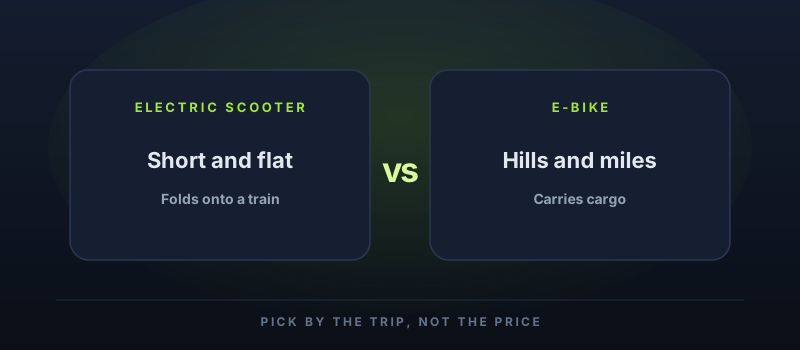
Pick an electric scooter if your round trip is short (up to about 5.5 to 9 miles on a budget scooter, about 16 to 18 on the biggest batteries), mostly flat, and ends with stairs, a train or a small apartment, and if the law where you live allows it. Pick an e-bike if your round trip is longer than that, has real hills, means carrying shopping or a work bag, or happens in the rain, or if you live in California without a driver's license or in Pennsylvania. A scooter costs about half as much on Amazon and weighs less; an e-bike carries a bigger battery, more weight and a clearer legal status. We cover both, and we have not ridden any of them: the numbers below come from maker spec sheets, Amazon listings, our own estimates (method shown) and the statutes.
The full guide, section by section. Tap any section to read it.
Scooter vs e-bike at a glance
Scooter vs e-bike at a glance
| Electric scooter | E-bike | |
|---|---|---|
| Typical price on Amazon | about $206 on average for adult stand-up scooters (October 2026, products priced $100 to $600) | about $405 on average for e-bikes in the same price window |
| Weight | 22 lb (Roinside UP2P, listing) to 54.2 lb (Segway Ninebot Max G3), makers' figures where they exist | 31 lb for the lightest we list (Gotrax Nano); 45 to 55 lb for folding Class 2 bikes; 55 to 70 lb for most budget full-size bikes |
| Folded size | long and slim: of those that state one, 42.1 x 16.9 x 20.5 in (MAXSHOT V1, listing) to 48 x 23.2 x 23.3 in (Segway Max G3) | small 14-inch folders run about 28 x 22 x 14 in (Bodywel 14" Mini) to 30 x 14 x 22 in (Gotrax Nano) |
| Battery | 187 to 608 Wh on the adult commuter scooters we cover; up to 864 Wh on heavy off-road models | 360 to 720 Wh on budget e-bikes |
| Our estimated range | about 7 to 13 miles on budget scooters; 20 to 28 miles on the Segway Max G2 and NIU KQi 300X | about 18 to 36 miles, at the 20 Wh per mile our e-bike guides plan on |
| Top speed as shipped | 15.5 to 20 mph on the adult scooters we cover (Segway unlocks 22 mph on the Max G2 and 28 mph on the Max G3 in its app) | Class 1 and Class 2: 20 mph; Class 3: pedal assist to 28 mph |
| Legal status | its own category; rules vary by state (see the law section) | a bicycle in 49 of the 51 US jurisdictions we track, when it fits one of the three classes |
| Hills | no pedals, so the motor does it all; makers rate climbs from 15% (Hiboy S2) to 30% (Segway Max G3) | pedals and gears add your legs to a 350 to 750 W budget motor |
| Carrying cargo | a max load of 220 to 300 lb that includes you and your bag; no rack on the adult spec sheets we hold | rear racks on many (the Funhang Fat 26 carries 60 lb on its rack) |
| Rain | IPX4 to IPX6 on the branded models; several budget listings state no rating | IPX5 battery packs on the budget Funhang bikes we cover; fenders keep road spray off |
| Wheels | 8.5 to 11 inch | 14 to 26 inch |
| Safety standard | UL 2272 (certification required in New York City; California requires the battery to be tested to it) | UL 2849 for the whole bike, UL 2271 for the battery (UL 2849 is required in New York City) |
How far each one goes on a charge
How far each one goes on a charge
Battery size decides range on both, and scooters carry smaller batteries. We estimate a scooter's range by dividing its battery's watt-hours by 22 to 27 watt-hours per mile, the band published full-speed tests show for a 175 to 180 lb rider. Makers measure their own figures with lighter riders at about 9 to 11.4 mph on flat ground, and in those full-speed tests scooters covered a median 59% of the advertised range.
| Scooter | Battery | Maker claims | We estimate |
|---|---|---|---|
| VOLPAM Q1 | 187.2 Wh (listing) | 15 mi | about 7 to 9 mi |
| Gotrax GXL V2 | 187.2 Wh | 12.5 mi | about 7 to 9 mi |
| Hiboy S2 | 280.8 Wh (36 V x 7.8 Ah, manual) | 17 mi | about 10 to 13 mi |
| Segway Ninebot E3 Pro | 368 Wh | 34 mi (Eco, 9 mph) | about 14 to 17 mi |
| Hiboy S2 Pro | 417.6 Wh (36 V x 11.6 Ah) | 25 mi | about 15 to 19 mi |
| Segway Ninebot Max G2 | 551 Wh | 43 mi (25 mi at 22 mph) | about 20 to 25 mi |
| NIU KQi 300X | 608.4 Wh | 37.3 mi | about 23 to 28 mi |
Budget e-bikes start where most scooters stop. Our under-$500 e-bike guide covers bikes with 360 to 720 Wh batteries, and at about 20 Wh per mile that is roughly 18 to 36 miles. The two estimates are not the same test: the scooter figure assumes full speed with no help from you, and an e-bike rider can pedal to stretch a charge.
Size either one the way our e-bike commuter guide does: take the low estimate and make sure it covers your round trip plus a quarter, which means dividing it by 1.25. A 7-mile scooter estimate then covers a round trip of about 5.5 miles, an 11-mile one about 9, the Max G2's 20 about 16, the KQi 300X's 23 about 18, and an 18 to 36 mile e-bike about 14 to 29.
Weight, folding and stairs
Weight, folding and stairs
This is where a scooter wins. The Gotrax GXL V2 weighs 27 lb and the Hiboy S2 35.5 lb on their makers' spec sheets, and both fold into a long, slim shape that fits under a desk or beside a door. Even the heavy scooters, the Segway Max G2 at 53.5 lb and the Max G3 at 54.2 lb, weigh about what a budget full-size e-bike's lighter end does.
E-bikes get light only by getting small. The lightest e-bike we list is the Gotrax Nano at 31 lb, a 14-inch folder with a 250 W motor and a 15.5 mph assist cap. Folding Class 2 bikes run 45 lb (Bodywel 14" Mini) to 55 lb (RPINT Mini 14, and the Vivi 20 and 26 inch folders), and our folding guide calls even the 48 lb Gotrax R1 fine for a trunk or an elevator and tiring on stairs. Most budget full-size e-bikes weigh 55 to 70 lb.
Folded, the two shapes differ: a scooter is longer (about 42 to 48 inches) and slimmer, a 14-inch e-bike is shorter (about 28 to 30 inches) and bulkier. Measure the space you have, a closet, a trunk or a train rack, against the folded numbers on the page of the one you want.
Hills, cargo and rain
Hills, cargo and rain
Hills. A scooter has no pedals, so its motor does all the climbing. Makers rate their climbs at 15% for the Hiboy S2, 18% for the Segway E2 Pro, E3 Pro and NAVEE GT3, 22% for the Segway Max G2, 25% for the NIU KQi 300X and 30% for the Segway Max G3. Segway rates its climbs with a 165 lb rider at 9.3 mph and 70% battery, so a heavier rider gets less. On an e-bike you add your own legs and its gears; even so, a 250 W motor leaves hills mostly to you, and a single-speed bike makes climbs over about 5% slow work.
Cargo. A scooter's max load, 220 lb on the Hiboy S2 and S2 Pro, 265 lb on the Segway E3 Pro and Max G2, 286 lb on the Max G3 and 300 lb on the SAIMNZE A11 (listing), covers you and whatever you carry, and none of the adult spec sheets we hold lists a rack, so the load goes on your back. In CPSC's 2024 follow-up of injured e-scooter riders, 32% were carrying or holding something. Many e-bikes take a rear rack, and payloads on the light e-bikes we list run 220 to 330 lb.
Rain. The branded scooters carry IP ratings from IPX4 (Hiboy S2, Segway E2 Pro) through IPX5 (Segway E3 Pro and Max G2, NAVEE GT3) and IP55 (NIU KQi 300X) to IPX6 (Segway Max G3). Several budget listings state none, and the Gotrax GXL V2 manual says not to ride it in wet conditions. An e-bike with fenders keeps road spray off your clothes, and the budget Funhang e-bikes we cover state IPX5 battery packs.
The law: a scooter is not an e-bike
The law: a scooter is not an e-bike
The US three-class e-bike system does not apply to scooters. An e-bike that fits Class 1 or 2 (20 mph) or Class 3 (pedal assist to 28 mph), with a 750 W motor, is treated as a bicycle in 49 of the 51 US jurisdictions we track; New Jersey (registration and a license) and Hawaii (registration) are the exceptions. Scooters have their own rules, under five different names, and NCSL counts 28 states plus DC with an e-scooter law. The states where the difference matters most:
| State | Electric scooter | E-bike |
|---|---|---|
| California | driver's license or instruction permit required; helmet under 18; no sidewalks; 15 mph limit; roads posted at 25 mph or less unless in a bike lane (Vehicle Code sections 21235 and 22411) | a bicycle; no license for Class 1, 2 or 3 |
| Pennsylvania | e-scooters are not legal on public roads; a bill to change that (HB 1633) has not passed (Capital-Star) | a bicycle for Class 1 and 2; Class 3 is not allowed |
| New York | an e-scooter goes 20 mph or less and weighs under 100 lb, with a floorboard or a seat (VTL 114-e) | a bicycle |
| New Jersey | a legal e-scooter is stand-up, under 19 mph and no more than 750 W (NJ chart) | registration and a license |
Speed is the line to watch. Seventeen states cap a scooter's built-in speed at 20 mph and 12 set a 15 mph riding limit (NCSL). Most budget scooters we cover reach 19 mph, which is over California's 15 mph limit and under New York's 20 mph definition. Ages differ too: NCSL counts 15 states with a minimum age for e-scooters, mostly 16, while most states set no minimum age for a Class 1 or Class 2 e-bike (Utah, Hawaii and Louisiana are the exceptions). Check your state on our law pages, which cover e-bikes, and check your city for scooters.
Safety
Safety
CPSC estimates 79,300 emergency room visits from e-scooters in 2024, and only 18% of the injured riders it followed up wore a helmet (CPSC report). Whichever you buy, wear a helmet and look for the right certificate: UL 2272 for a scooter, UL 2849 for an e-bike. Most scooter recalls since 2023 were mechanical, folding stems, forks and brakes, which UL 2272 does not test. Our scooter safety guide has the recall table and the UL status of every scooter we cover.
Which to buy, by trip
Which to buy, by trip
- Round trip up to about 5.5 to 9 miles, flat, with stairs or a train: a budget scooter. We estimate 7 to 13 miles a charge from 187 to 289 Wh; the low estimates of 7 to 11 miles cover a round trip of about 5.5 to 9 miles plus a quarter. Start with the best electric scooters under $200.
- Round trip of about 9 to 18 miles, charging at home: a mid or big-battery scooter, from the Hiboy S2 Pro (about 15 to 19 miles estimated, a round trip of about 12) to the Segway Ninebot Max G2 (about 20 to 25, a round trip of about 16) and the NIU KQi 300X (about 23 to 28, a round trip of about 18), or an e-bike. The commuting scooter guide ranks them on range, weight and IP rating.
- Round trip over about 18 miles, or no charger at work: an e-bike. A 360 to 720 Wh budget battery covers a round trip of about 14 to 29 miles plus a quarter, and you can pedal to stretch it; see the best e-bikes under $500.
- Steep hills on the route: an e-bike, or a scooter rated for 22% or more (Segway Max G2 at 22%, NIU KQi 300X at 25%, Segway Max G3 at 30%).
- Groceries, a work bag or a child: an e-bike with a rack. Scooters are built for one rider and what they can wear.
- Rain most weeks: a scooter rated IPX5 or better (IPX5: Segway E3 Pro and Max G2, NAVEE GT3; IP55: NIU KQi 300X; IPX6: Segway Max G3), or an e-bike with fenders.
- California without a driver's license or permit, or anywhere in Pennsylvania: an e-bike. A scooter needs a license or permit on California roads and is not legal on Pennsylvania's.
- A rider under 16: check the state minimum age for scooters first; most states set none for a Class 1 or Class 2 e-bike. Our teens' scooter guide puts the state ages up front.
Where to go next
Where to go next
- All electric scooters we cover, with our range estimate and UL status on every page.
- All e-bikes we review, and the best e-bikes under $500 for the budget end.
- E-bike laws by state, before you choose between the two.
Bottom line
Bottom line
A scooter is the cheaper, lighter answer to a short, flat trip with stairs at one end. An e-bike is the answer to distance, hills, cargo and a clear legal status. If your round trip is under about 5.5 to 9 miles and you carry it upstairs, start with a budget scooter; past about 18 miles, or with a hill or a bag, start with an e-bike.
Frequently asked questions
Is an electric scooter or an e-bike better for commuting?
It depends on the distance. For a round trip up to about 5.5 miles with stairs or a train, a scooter is lighter and cheaper: the Gotrax GXL V2 weighs 27 lb, and we estimate 7 to 9 miles from its 187.2 Wh battery, enough for that trip plus a quarter. Up to about 16 to 18 miles, a big-battery scooter like the Segway Ninebot Max G2 (about 20 to 25 miles estimated) or the NIU KQi 300X (about 23 to 28) still works. Beyond that, or with hills or a bag, an e-bike with a 360 to 720 Wh battery covers more ground and carries more.
Is an electric scooter cheaper than an e-bike?
Yes, by about half on Amazon. Among products priced $100 to $600 in October 2026, the average adult stand-up scooter sold for about $206 and the average e-bike for about $405. Most of the best-placed scooters sit at the low end of that window, from budget models like the VOLPAM Q1 up to the Segway E-series, while bigger-battery models such as the Segway Ninebot Max G2 cost more. See our scooters under $200 and e-bikes under $500.
Which goes farther on a charge, an e-bike or a scooter?
An e-bike, usually, because it carries a bigger battery and you can pedal. Budget e-bikes carry 360 to 720 Wh, about 18 to 36 miles at 20 Wh per mile. The adult scooters we cover carry 187 to 864 Wh, and we estimate 7 to 13 miles for budget models and 23 to 28 miles for a premium commuter such as the NIU KQi 300X, at full speed for a 175 to 180 lb rider. The biggest pack we cover, 864 Wh, is on the 62 lb OOTD T10 off-road scooter. Scooter makers claim more because the ones that publish their test conditions use lighter riders at about 9 to 11.4 mph.
Do e-bike laws apply to electric scooters?
No. The three US e-bike classes do not cover scooters, which have their own rules in each state. California requires a driver's license or instruction permit to ride a motorized scooter and limits it to 15 mph, New York defines an e-scooter as one that goes 20 mph or less and weighs under 100 lb, and Pennsylvania does not allow e-scooters on public roads. A 19 mph scooter like the Hiboy S2 is under New York's line and over California's.
Are electric scooters good on hills?
Only up to their rating, because a scooter has no pedals and its motor does all the climbing. Makers rate climbs at 15% for the Hiboy S2, 18% for the Segway E3 Pro and NAVEE GT3, 22% for the Segway Ninebot Max G2, 25% for the NIU KQi 300X and 30% for the Segway Max G3. Segway rates its own climbs with a 165 lb rider at 9.3 mph, so a heavier rider gets less. On an e-bike you can add your legs and its gears, which is why we point riders with steep routes to e-bikes.
Which is easier to carry up stairs, a scooter or an e-bike?
A scooter. The Gotrax GXL V2 weighs 27 lb and the Hiboy S2 35.5 lb on their makers' spec sheets, while most budget full-size e-bikes weigh 55 to 70 lb. The lightest e-bike we list, the Gotrax Nano, weighs 31 lb but is a 14-inch folder with a small battery. Big-battery scooters close the gap: the Segway Ninebot Max G2 weighs 53.5 lb, so if stairs are daily, weigh the range you need against the carry.
Can you ride an electric scooter in the rain?
Some are rated for it and some are not. The Segway Ninebot E3 Pro, Max G2 and NAVEE GT3 are rated IPX5, the NIU KQi 300X IP55 and the Segway Max G3 IPX6, while several budget listings state no rating and the Gotrax GXL V2 manual says not to ride it in wet conditions. Segway notes that immersion damage is not covered by the Max G3 warranty. If you ride in rain most weeks, an e-bike with fenders is the drier choice.
Keep reading
Guide
Electric Scooter Safety (2026): UL 2272, Recalls
Buy an electric scooter whose maker states UL 2272 and names the lab, check the model against CPSC...
ReadGuide
Class 1 vs 2 vs 3 E-Bikes Explained (2026)
The US e-bike class system is actually simple: Class 1 is pedal-assist only at 20 mph, Class 2...
ReadGuide
Do You Need a License for an E-Bike? (2026)
In 49 states and Washington, DC you do not need a license, registration, or insurance to ride a...
Read
Reviewed by