Electric Scooter Safety (2026): UL 2272, Recalls
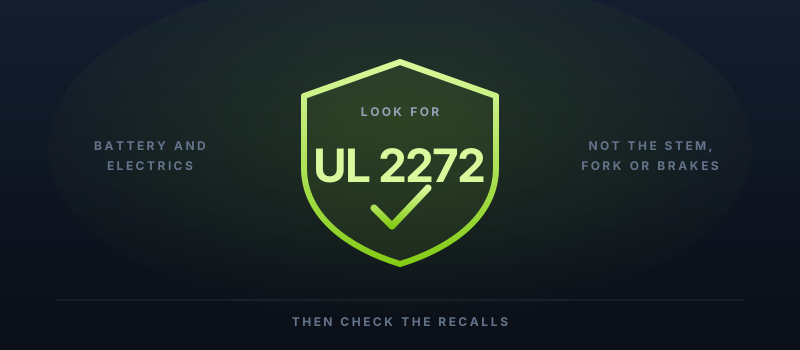
Buy an electric scooter whose maker states UL 2272 and names the lab, check the model against CPSC recalls, and charge it only with its own charger. UL 2272 covers the battery and electrical system, not the stem, fork or brakes. Of the 20 scooters we cover, 18 claim UL 2272; we could not verify any in the certifier's directory.
The short version
- UL 2272 is the fire and electrical safety standard for scooters. It does not test the folding latch, stem, fork or brakes, and most scooter recalls since 2023 were exactly those parts.
- New York City has required UL 2272 for scooters sold there since September 16, 2023, and California has required UL 2272 battery testing since January 1, 2026. A federal rule was proposed in June 2026 and is not law yet.
- A listing's UL claim is not proof: CPSC recalled Transpro scooters in 2025 for unauthorized UL labels. Check the model in UL Product iQ or the named lab's own directory.
- Charge with the scooter's own charger, plugged straight into a wall outlet, away from exits, and only while you are home and awake (CPSC and FDNY).
- CPSC estimates 79,300 emergency room visits from e-scooters in 2024, and that only an estimated 18% of injured riders were wearing a helmet.
The short answer
A safer electric scooter starts with three checks you can run before you pay. Look for a UL 2272 claim that names the lab that did the testing. Search the brand and model at cpsc.gov/Recalls. And look for an IP rating, brakes on both wheels or an electronic brake plus a mechanical one, and a maximum load that covers you and your bag.
Then the habits matter as much as the hardware. Charge with the scooter's own charger, plugged straight into a wall outlet, somewhere that does not block your way out, and only while you are home and awake. Check the folding latch and the brakes before you ride. Wear a helmet: an estimated 18% of injured e-scooter riders were wearing one, per CPSC's April 2026 report.
This guide explains what UL 2272 covers and what it does not, where the law already requires it and how to check a claim, then sets out the recent scooter recalls and warnings below and the UL status of every scooter we cover. We have not ridden these scooters; every fact below comes from a maker spec sheet, a live Amazon listing or an official source, linked where it appears.
The full guide, section by section. Tap any section to read it.
What UL 2272 certifies, and what it does not
What UL 2272 certifies, and what it does not
UL 2272 (current edition ANSI/CAN/UL 2272:2024) is the safety standard for the electrical system of stand-on personal e-mobility devices: scooters, hoverboards, e-skateboards and unicycles. It tests the battery, charger and electrical system together for fire and shock risk. Two neighboring numbers cause confusion:
| Standard | What it covers | Where you see it |
|---|---|---|
| UL 2272 | A scooter's whole electrical system, battery included | The standard New York City and California name for scooters |
| UL 2271 | A battery pack on its own | Often added to scooter listings; it does not certify the scooter |
| UL 2849 | An e-bike's whole electrical system | E-bikes only, never a scooter standard |
What UL 2272 does not test is the metal. The folding mechanism, the stem, the fork, the welds and the brakes are outside it. That gap matters, because seven of the ten CPSC actions in the recall table below were mechanical: a stem that folds, a fork or downtube that breaks, brakes that fail. A UL 2272 scooter can still be recalled for a latch.
Where UL 2272 is already required
Where UL 2272 is already required
| Where | Rule | Since |
|---|---|---|
| New York City | Local Law 39: scooters sold, leased or rented must be certified to UL 2272 by an accredited lab, with the lab's name or logo on the device, packaging or documents. Civil penalties up to $1,000 per model | September 16, 2023 |
| New York State | S154F (Chapter 195 of 2024): micromobility batteries, scooters included, must be certified to UL 2271 or UL 2272 | about October 9, 2024 |
| California | SB 1271 (Health and Safety Code 26300 to 26305): no sale of a powered mobility device, motorized scooters included, unless its battery was tested to ANSI/CAN/UL 2272 by an accredited lab, with the lab and standard shown | January 1, 2026 |
| Federal (proposed) | CPSC proposed rule (91 FR 38162, docket CPSC-2025-0012) adopting UL 2272-24 for stand-up and seated e-scooters, effective 180 days after a final rule. Oral presentations were scheduled for October 21, 2026 | not law yet |
Everywhere else in the US, UL 2272 is voluntary. CPSC asks buyers to choose devices certified to the applicable voluntary safety standards anyway.
Why a listing's claim is not proof
Why a listing's claim is not proof
Three things make a UL line on a product page weaker than it looks.
- Amazon accepts more than one standard. Amazon US reportedly accepts UL 2272 or ASTM F2641 plus a battery standard for scooters. The policy sits behind Seller Central, so a listing that passed Amazon's check has not necessarily been tested to UL 2272.
- Fake labels exist. On July 24, 2025, CPSC recalled 700 Transpro scooters that "were sold with unauthorized lithium-ion battery UL certification labels" (CPSC notice).
- Wording drifts between the maker and the listing. In our own spec files: Segway's pages say its scooters were tested to UL 2272 by TÜV Rheinland, while several Amazon titles for the same models add UL 2271. Hiboy's S2 FAQ calls the battery UL 2272 certified, though UL 2272 is the whole-scooter standard; the certificates Hiboy links are the right ones, UL 2272 for the scooter and UL 2271 for the pack. NAVEE's UL 2272 claim for the GT3 appears only on Amazon; NAVEE's own US page cites ASTM F2641 brake tests. MAXSHOT's listings for the V1 switch between "tested to" and "certified" and name no lab.
None of that means a claim is false. It means the claim is the seller's word until you find the scooter in the certifier's own records.
How to check a UL 2272 claim
How to check a UL 2272 claim
It takes five to ten minutes a model:
- Find the lab. The listing, the box or the label on the scooter should name who tested it. California now requires the lab and the standard to be shown, so it is fair to ask any seller for a photo of the label.
- Search UL Product iQ by brand, model or the file number (it starts with E) printed in the UL mark, if UL did the testing.
- Search the named lab's own directory if the lab is someone else. SGS, Intertek and TÜV Rheinland each certify to UL standards and each keeps its own records.
- Ask for the certificate or file number when you cannot find it. A seller with a real certificate can send one.
- Search cpsc.gov/Recalls for the brand and model, new or used.
A certified battery or charger does not make the scooter certified. UL 2271 on the battery is a good sign, and it is still not UL 2272 for the scooter.
The UL 2272 status of every scooter we cover
The UL 2272 status of every scooter we cover
This is what each maker's spec sheet and each Amazon listing said on October 18, 2026. Where a maker or listing states UL 2272, we could not verify it in the certifier's directory, so the last column says no for every model. The recall column records the CPSC and web searches made for our spec files on the same date.
| Scooter | Who states UL 2272 | Lab named | Verified in a directory? | CPSC recall |
|---|---|---|---|---|
| Segway Ninebot Max G2 | Segway and the listing | TÜV Rheinland (Segway) | No | None found |
| Segway Ninebot Max G3 | Segway; the listing adds UL 2271 | TÜV Rheinland (Segway) | No | None found |
| Segway Ninebot E2 Pro | Segway; the listing adds UL 2271 | TÜV Rheinland (Segway) | No | None found |
| Segway Ninebot E3 Pro | Segway; the listing adds UL 2271 | TÜV Rheinland (Segway) | No | None found |
| Segway Ninebot C2 Lite and C2 Pro (kids) | Segway; the listings add UL 2271 | TÜV Rheinland (Segway) | No | None found |
| NIU KQi 300X | NIU's store; the listing says only "UL certification" | None | No | None found |
| NIU KQi2 Pro | NIU's store only | None | No | None found |
| NAVEE GT3 | The listing only | None | No | None found |
| Hiboy S2 | Hiboy (UL 2272 and UL 2271 certificates published) and the listing | UL LLC (Hiboy); SGS (listing) | No | None found |
| Hiboy S2 Pro | Hiboy (UL 2272 and UL 2271 certificates published) and the listing | UL LLC (Hiboy and the listing) | No | None found |
| Hiboy Q2 Lite (kids) | The listing only | UL LLC (listing) | No | None found |
| Gotrax GXL V2 | Gotrax and the listing | None | No | None found |
| Gotrax SD1 | The listing only | None | No | None found |
| Gotrax GKS Mini (kids) | The listing only | None | No | None found |
| Gyroor H40 (kids) | The listing; Gyroor only in image text | None | No | None found |
| MAXSHOT V1 | The listing only | None | No | None found |
| Phantomgogo A2 | The listing only | SGS (listing) | No | None found |
| SAIMNZE A11 | The listing only | None | No | None found |
| VOLPAM Q1 | No certification stated | None | No | None found |
| Roinside UP2P | No certification stated | None | No | None found |
The count: 18 of 20 carry a UL 2272 claim, 9 name a lab, 2 state no certification at all, and 0 are verified. Segway and Hiboy are the only makers in the set that name a lab on their own sites, and Hiboy is the only one that publishes the certificates, by number; we could not check those in UL's directory, which needs a login. Two popular kids' scooters, the SIMATE S5 and the LINGTENG E8, are left out of this table and our kids' guide because neither listing states any certification, and we hold children's products to a stricter bar than adult picks. The VOLPAM Q1 and Roinside UP2P state none either; they are adult scooters, so we still cover them, labelled as stating no certification.
Recalls and warnings: recent CPSC scooter actions
Recalls and warnings: recent CPSC scooter actions
The table below is a selection of recent CPSC scooter recalls and warnings, not every one, so search cpsc.gov/Recalls for your own model too. CPSC acts in two ways. A recall is agreed with the company and comes with a remedy. A warning means there is no agreed remedy, and owners are told to stop using the product. Before you buy, new or used, check the model and serial number against the notice.
| Date | Scooter (CPSC notice) | Hazard | Units | Sold on Amazon? | Remedy |
|---|---|---|---|---|---|
| April 30, 2026 | Acer AES015 | A loose screw lets the front tube fold | about 510 | Yes | Free repair |
| July 24, 2025 | Apollo City, 2024 model | A weld can crack and the stem break | about 790 | Yes | Replacement |
| July 24, 2025 | Transpro A3, A11F Spark and R1 | Fire; unauthorized UL labels | 700 | No | Refund or replacement |
| March 20, 2025 | Segway Ninebot Max G30P and Max G30LP | The folding mechanism can fail; 68 reports, 20 injuries | about 220,000 | Yes | Free repair kit |
| November 21, 2024 | Segway Ninebot P100S, built in 2023 | The front fork can break | about 1,400 | Yes | Free repair |
| October 17, 2024 | Swagtron SG-5 Swagger 5 Boost | Fire; 7 reports | not given | Yes | Warning: stop using it |
| July 25, 2024 | Razor Icon | The downtube can separate from the deck | about 7,300 | Yes | Refund |
| July 25, 2024 | Hover-1 Dynamo | The brakes can fail | about 4,200 | No (Walmart.com) | Refund |
| October 23, 2023 | Toos Elite 60 V | Fire; two deaths in a New York City apartment | not given | No | Warning: the firm refused an acceptable recall |
| August 31, 2023 | Apollo Phantom V1, V2 and 60V | The suspension and wheel can separate | about 3,900 | No | Free repair |
Three notes that save confusion:
- The Segway Max G30P and G30LP recall does not cover the Max G2, Max G3, E2 Pro, E3 Pro or C2. They are different models. If you own a G30P or G30LP, stop riding it and contact Segway for the free repair kit; the model number is on a label on the side of the deck.
- The Apollo Phantom "V1" is not the MAXSHOT V1. They are different brands that share a model name.
- No CPSC recall since 2023 was found for Gotrax, Hiboy, NIU, NAVEE, VOLPAM or Gyroor scooters, in our search of CPSC records on October 18, 2026.
How many people get hurt, and how
How many people get hurt, and how
CPSC's April 2026 report puts the scale plainly:
- an estimated 79,300 emergency room visits from e-scooters in 2024, against about 10,600 in 2017
- 206 e-scooter deaths from 2017 through 2024, with crashes involving motor vehicles and loss of control the top hazards; 15 of the deaths came from battery fires
- an estimated 18% of injured riders were wearing a helmet and an estimated 32% were carrying or holding something while riding, per CPSC; an estimated 54% of the injuries happened on paved roads and 32% on sidewalks
The numbers point at riding, not only at batteries. A helmet, two free hands and brakes you trust do more for most riders than any certificate.
Charging and storage
Charging and storage
Battery fires are rare next to crashes, but they are the risk that reaches people who never ride. These rules come from CPSC and the FDNY:
- Use the charger that came with the scooter, or one the maker recommends, as CPSC and FDNY advise.
- Plug straight into a wall outlet. FDNY says never to charge a lithium-ion battery with an extension cord or a power strip.
- Charge away from exits and hallways, so a fire cannot block your way out.
- Be there while it charges. CPSC: "Always be present when charging" and "never charge them while sleeping or when you are not at home." Unplug it when it is full.
- Keep the area clear of anything that burns, and keep working smoke and carbon monoxide alarms nearby.
- Stop using a battery that changes. A swollen case, heat, a smell, leaking or odd noises mean stop charging and stop riding.
- If it catches fire, leave. FDNY: close the door, leave the building, call 911 from outside, and do not try to put out a battery fire yourself.
Water is the other storage risk. The scooters we cover are rated from IPX4 (Hiboy S2, Segway E2 Pro) to IPX6 (Segway Max G3), and several budget listings state no rating at all. The Gotrax GXL V2 manual says not to ride it in wet conditions, and Segway's Max G3 page says immersion damage is not covered by the warranty.
Brakes, tires and weight limits
Brakes, tires and weight limits
CPSC asks riders to check for damage to the handlebars, brakes, throttle, lights, tires, cables and frame. What you are checking differs a lot between models. From each maker's spec sheet (listing figures are marked):
| Scooter | Brakes | Tires | Max load |
|---|---|---|---|
| Hiboy S2 | Electronic + rear disc | 8.5 in honeycomb (solid) | 220 lb |
| Hiboy S2 Pro | Electronic + rear disc | 10 in honeycomb (solid) | 220 lb |
| Gotrax GXL V2 | Rear disc only | 8.5 in, air or honeycomb by color | 220 lb |
| VOLPAM Q1 | Electronic + rear drum | 8.5 in honeycomb (solid) | 264 lb |
| MAXSHOT V1 (listing) | Electronic + drum | 8.5 in honeycomb (solid) | 265 lb |
| NAVEE GT3 | Front drum + rear electronic | 10 in tubeless | 243 lb (the listing says 265) |
| Segway Ninebot E2 Pro | Front drum + rear electronic | 10 in tubeless | 265 lb |
| Segway Ninebot E3 Pro | Front drum + rear electronic | 10 in tubeless | 265 lb |
| Segway Ninebot Max G2 | Front drum + rear electronic (listing; not in Segway's G2 spec table) | 10 in self-sealing tubeless | 265 lb |
| NIU KQi 300X | Front and rear disc + regenerative | 10.5 in tubeless | 265 lb |
| Segway Ninebot Max G3 | Front and rear disc | 11 in self-sealing tubeless | 286 lb |
Three things to take from it:
- Know which lever does what. Most budget scooters pair an electronic brake with one mechanical brake, and the Gotrax GXL V2 has a single rear disc. Learn which lever works which brake before your first ride.
- Solid tires never go flat; air-filled tires need pressure. Segway prints 42 to 48 psi for the E3 Pro and Max G2. Pumping to the maker's figure is part of the pre-ride check.
- The max load includes your bag. Hiboy's manual says its 220 lb limit covers the rider and anything carried. When the maker and the listing disagree, as on the NAVEE GT3, plan on the maker's lower number.
Weight also costs range: energy use rises about 3.4% for every 10 lb of rider, which is one reason our range estimates assume a 175 to 180 lb adult.
Helmets
Helmets
CPSC's advice is short: "Always wear a bicycle helmet when riding." CPSC estimates that only 18% of injured e-scooter riders were wearing one. Some states require it: California requires a helmet for scooter riders under 18 (Vehicle Code section 21235), and NCSL counts five states that require helmets for minors. The law is the floor, not the advice.
Kids and teens
Kids and teens
Go by the maker's own age and weight limits, and where the maker and the Amazon listing disagree, use the maker's range:
| Kids' scooter | Maker's age range | Max rider weight | Top speed |
|---|---|---|---|
| Segway Ninebot C2 Lite | 6 to 10 | 110 lb | 9.9 mph |
| Segway Ninebot C2 Pro | 9 and up (the listing says up to 13) | 132 lb | 12.4 mph |
| Hiboy Q2 Lite | 5 to 8 (the listing says 4 to 10) | 110 lb | 9 mph |
| Gotrax GKS Mini | 6 to 12 (listing; no Gotrax page) | 120 lb | 7.5 mph |
| Gyroor H40 | 8 to 14 (the listing says 6 to 12) | 143 lb | 10 mph |
Adult scooters are not kids' scooters. Hiboy rates the S2 for riders 16 and up, Segway rates the E2 Pro for 16 and up, and NIU sets 14 as the minimum for the KQi 300X. On public roads, NCSL counts 15 states with a minimum age for e-scooters, mostly 16. Illinois lowers its scooter minimum from 18 to 16 on January 1, 2027, under SB 3484. Start a new rider on the slowest mode, and put the helmet on every time.
Our picks by age are in the kids' guide and the teens' guide.
Where to go next
Where to go next
- All electric scooters we cover, with the UL status and our range estimate on every page.
- Best electric scooters for adults and for commuting, where IP ratings and brakes are part of the ranking.
- Best electric scooters under $200, where the certification gaps are widest.
- Electric scooter or e-bike? if you are still choosing between the two.
Bottom line
Bottom line
Treat a UL 2272 line as the seller's word until the certifier's directory says the same, search CPSC before you buy, and remember the certificate covers the battery, not the latch. Most scooter injuries are crashes, so the helmet, the pre-ride brake check and two free hands do the most work.
Frequently asked questions
Are electric scooters safe?
They carry real risk, mostly from crashes. CPSC estimates 79,300 emergency room visits from e-scooters in 2024 and counts 206 e-scooter deaths from 2017 through 2024, with motor vehicles and loss of control the top hazards. An estimated 18% of injured riders were wearing a helmet, per CPSC. Wear one, check the brakes and folding latch before each ride, keep both hands free, and charge with the maker's charger. A scooter whose maker names its test lab, like the Segway Ninebot Max G2 (TÜV Rheinland), is a better start than one that states nothing.
What does UL 2272 mean on an electric scooter?
UL 2272 is the fire and electrical safety standard for scooters, hoverboards and other stand-on devices: it tests the battery, charger and electrical system together. It does not test the folding mechanism, stem, fork or brakes. UL 2271 is the battery-only standard, and UL 2849 is for e-bikes. So when a maker calls a battery UL 2272 certified, as Hiboy's S2 FAQ does, read it carefully: UL 2272 is meant to cover the whole scooter. Hiboy's published certificates get it right, UL 2272 for the S2's electrical system and UL 2271 for its pack.
Is UL 2272 certification required for electric scooters?
In some places, yes. New York City has required UL 2272 certification for scooters sold, leased or rented there since September 16, 2023, with civil penalties up to $1,000 per model. California has required UL 2272 battery testing for motorized scooters sold there since January 1, 2026. New York State requires micromobility batteries to be certified to UL 2271 or UL 2272. A federal CPSC rule adopting UL 2272 was proposed in June 2026 and is not law yet; elsewhere it is voluntary.
How can I tell if an electric scooter is really UL certified?
Find the lab, then check the lab's records. Search UL Product iQ by brand, model or the E file number in the UL mark, or the named lab's own directory if SGS, Intertek or TÜV Rheinland did the testing. Ask the seller for the certificate if you cannot find it. A listing line alone is not proof: CPSC recalled Transpro scooters in 2025 for unauthorized UL labels. Of the 20 scooters we cover, 18 claim UL 2272 and we could not verify any of them in the certifier's directory.
Is the Segway Ninebot Max G2 part of the Segway scooter recall?
No. CPSC's March 20, 2025 recall covers about 220,000 Segway Ninebot Max G30P and Max G30LP scooters, whose folding mechanism can fail. The Max G2, Max G3, E2 Pro, E3 Pro and C2 are different models, and we found no CPSC recall for any of them as of October 2026. If you own a G30P or G30LP, stop riding it and contact Segway for the free repair kit; the model number is on a label on the side of the deck.
Can I charge an electric scooter overnight?
No, CPSC says to never charge one while you are asleep or away from home, and to be present while it charges. Use the charger that came with the scooter, plug it straight into a wall outlet rather than an extension cord or power strip (FDNY), keep it away from exits, and unplug it when full. A Segway Ninebot E3 Pro, for example, takes about 7 hours to charge by Segway's figure, so start it when you get home, not at bedtime.
Do you need a helmet to ride an electric scooter?
You should always wear one, and some states require it. California requires a helmet for motorized scooter riders under 18, and NCSL counts five states that require helmets for minors. CPSC advises a bicycle helmet on every ride, and it estimates that only 18% of injured e-scooter riders were wearing one. A kids' scooter like the Segway Ninebot C2 Lite tops out at 9.9 mph, which is still fast enough to need one.
What is the weight limit on an electric scooter?
The adult scooters we cover are rated for 220 to 300 lb, and that limit includes what you carry. The Hiboy S2 and S2 Pro are rated for 220 lb, the Segway E2 Pro, E3 Pro and Max G2 for 265 lb, the Segway Max G3 for 286 lb, and the SAIMNZE A11 for 300 lb by its listing. Where a maker and its listing disagree, use the maker's figure: NAVEE rates the GT3 for 243 lb while its Amazon listing says 265. Kids' scooters run 110 to 143 lb.
Keep reading
Guide
Electric Scooter vs E-Bike (2026): Which to Buy
Buy an electric scooter for short, flat trips that end with stairs, a train or a small apartment;...
ReadGuide
Class 1 vs 2 vs 3 E-Bikes Explained (2026)
The US e-bike class system is actually simple: Class 1 is pedal-assist only at 20 mph, Class 2...
ReadGuide
Do You Need a License for an E-Bike? (2026)
In 49 states and Washington, DC you do not need a license, registration, or insurance to ride a...
Read
Reviewed by