E-Bikes to Avoid (2026): Red Flags and Recalls
Stay away from e-bikes under a CPSC warning or an unfixed recall, bikes with no UL 2849 or UL 2271 certification, and listings hiding rated watts or top speed. The same listing should also survive basic range arithmetic, carry a class label that matches its motor and speed, and name who in the US handles a warranty claim. Price is...
The short version
- Skip any e-bike under a CPSC warning, or with a recall you cannot confirm was fixed. Search the brand and model at cpsc.gov/Recalls before you buy, new or used.
- Skip bikes with no UL 2849 (whole bike) or UL 2271 (battery) certification, and e-bike listings that cite UL 2272, the scooter standard. New York City and California both bar selling e-bikes without that testing.
- Distrust "Class 2" or "street legal" on a bike sold at 1,000 W and up or faster than 28 mph. Above 750 W rated (1,000 W in Oregon) it is a motor vehicle under state law, whatever the listing says.
- Treat peak-only wattage, a missing top speed and impossible range as warnings. Divide battery watt-hours by 20 for realistic everyday miles.
- Buy where there is US support, written warranty terms and a return policy, and use only the maker's charger and batteries. A cheap bike can pass all of this; the one that fails it is the one to skip.

Our pick for most readers
Funhang City Cruiser 26
$330
As an Amazon Associate I earn from qualifying purchases. Ebike Oracle may also earn a commission on links to other retailers. Full disclosure.
The short answer
The e-bikes to stay away from are the ones whose listings fail checks you can run in five minutes: a CPSC warning or recall against the model, no UL 2849 or UL 2271 certification, a motor or top speed that puts the bike outside the three US e-bike classes, a range claim the battery cannot deliver, and nobody in the US to call when something breaks.
Price does not sort bikes into safe and unsafe. CPSC has recalled a premium e-bike sold through bike dealers, and it has warned about bikes and batteries sold on Amazon. What separated the good outcomes from the bad ones was what the company did next: some offered a free replacement battery or a refund, and some refused or could not pay, which left owners with an instruction to throw the battery away.
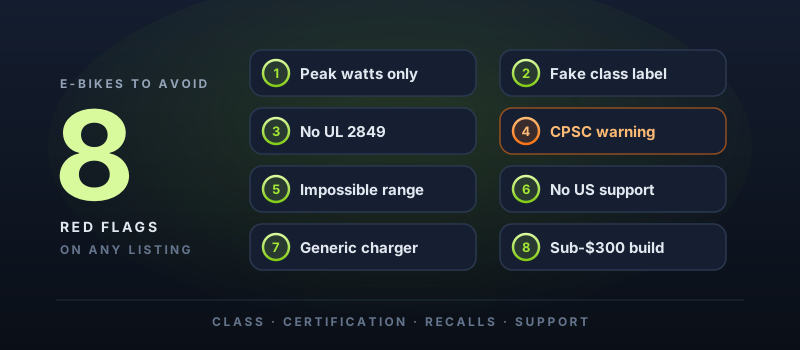
Each of the eight red flags below says why it matters and how to check it. A CPSC warning with no remedy is the one automatic no. Three more should end your interest unless the seller can fix them: no UL 2849 or UL 2271 certification, a class label the numbers contradict, and no US support. The rest are questions to put to the seller, and a vague answer is an answer.
The full guide, section by section. Tap any section to read it.
The eight red flags at a glance
The eight red flags at a glance
| Red flag | Why it matters | How to check |
|---|---|---|
| 1. Peak watts only, or no top speed | Without a rated wattage and a top speed, nobody can tell which class the bike is in or where it is legal | Look for a rated (continuous) wattage and an assisted top speed next to the class |
| 2. "Class 2" or "street legal" on a 1,000 W+ or 28 mph+ bike | Above 750 W rated (1,000 W in Oregon) or 28 mph of assist, the law treats it as a motor vehicle | Check the label against the rated watts and top speed on the same listing |
| 3. No UL 2849 or UL 2271 | Certification is the only fire-safety evidence a listing can show you, and NYC and California require it to sell | Find the standard number and the name of the lab that tested it |
| 4. A CPSC recall or warning | A warning means the company would not, or could not, fix the problem | Search the brand and model at cpsc.gov/Recalls, new or used |
| 5. Range the battery cannot cover | A seller who inflates the most-compared number deserves doubt everywhere else | Battery Wh ÷ 20 = realistic everyday miles |
| 6. No US support, returns or parts | When the brand stops answering, the warranty and the parts go with it | A US support contact, written warranty terms, a return window, spare batteries for sale |
| 7. Aftermarket chargers or batteries | UL 2849 tests the charger and battery the bike shipped with, and a substitute was never part of that test | Use the supplied charger; buy spare packs the maker approves |
| 8. A sub-$300 price | The tier where listings that fail the other seven checks gather, and where parts get cut | Hold a cheap listing to every check above |
1. Peak watts only, or no stated top speed
1. Peak watts only, or no stated top speed
The US sorts e-bikes into three classes. Class 1 is pedal assist to 20 mph, Class 2 adds a throttle and also stops at 20 mph, and Class 3 is pedal assist to 28 mph. All three are capped at a 750 W motor, and the number that counts is the rated (continuous) output. A peak figure is what the motor can reach for a few seconds on a hill (Class 1, 2 and 3 explained).
So a listing that says only "1,500 W peak" has told you nothing about its class. The motor could be rated at 500 W, well inside the federal limit, or at 1,500 W, which is not an e-bike in any state. A missing top speed hides the same thing from the other side: without it you cannot tell a Class 2 from a bike that fits no class at all. A throttle that keeps pulling past 20 mph fits none of the three.
How to check: find two numbers on the listing, a rated or continuous wattage and an assisted top speed. Good listings put both next to the class. If you ask the seller for the rated figure and get the peak figure again, that is your answer.
2. "Class 2" or "street legal" on a bike far past the limits
2. "Class 2" or "street legal" on a bike far past the limits
Some listings put a class label or the words "street legal" on bikes marketed at 1,000 to 6,000 W or 28 to 50 mph. The label does not change the law. Above 750 W rated (Oregon is the one state that allows 1,000 W) or above 28 mph of assist, a bike falls outside every e-bike class in all 51 jurisdictions we track. States treat it as a moped or motorcycle instead, which in most of them means registration, a license and insurance. As our ride check puts it: anything faster or more powerful is a motor vehicle, whatever the listing calls it.
Electric dirt bikes are the extreme case. A Sur-Ron-style machine has foot pegs instead of pedals and several thousand watts, so every state treats it as an off-road motorcycle, and adding lights and mirrors will not change that (are Sur-Rons street legal?).
Being over the limit is not a defect in itself, and some riders want exactly that bike for private land or an OHV park. The red flag is the mismatch. A seller who calls a 2,000 W, 30 mph bike "Class 2" is either wrong about the law or counting on you not to know it, and either way the rest of the spec sheet deserves less trust. The problem also grows with price: in a snapshot of our own catalog, every sub-$500 bike with a stated rating sat inside the 750 W cap, against half of the $750 to $1,000 bikes (how much does an e-bike cost?).
How to check: read the class label, then the rated watts and top speed on the same page. If they disagree, believe the numbers. Then look up where you ride on our state-by-state street-legal table or the legality checker.
3. No UL 2849 or UL 2271 certification
3. No UL 2849 or UL 2271 certification
UL 2849 tests an e-bike's whole electrical system together: battery, charger, motor and controller. UL 2271 covers the battery pack alone. UL 2272 is the standard for scooters and hoverboards, so an e-bike listing that cites only UL 2272 is quoting the wrong document (e-bike battery fire safety).
The battery is the part of an e-bike that can start a house fire, and a listing has no other way to show you it was tested. The risk is not limited to charging: CPSC's Rad Power warning records fires that started while the battery was unused and in storage. In New York City, FDNY counted 18 lithium-ion battery deaths in 2023 and six in 2024, across e-bikes and other devices.
Two jurisdictions have written certification into law:
- New York City. Since Local Law 39 took effect on September 16, 2023, it has been illegal to sell, lease or rent an e-bike in the city that is not certified to UL 2849, or a battery that is not certified to UL 2271.
- California. Since January 1, 2026, SB 1271 has barred selling or leasing an e-bike in the state unless its battery was tested by an accredited laboratory to a standard referenced in UL 2849 or EN 15194. The lab's name or mark, and the standard it tested to, must be permanently fixed to the bike or its electrical system.
At the federal level these standards are still voluntary. CPSC's own guidance asks buyers to choose devices certified to the applicable voluntary safety standards.
How to check: look for the standard number (UL 2849 for the bike, UL 2271 for the battery) and the name of the lab that did the testing. "UL certified" in a title, with no standard number and no lab, gives you nothing to verify. Because California now requires the lab's mark on the bike itself, it is fair to ask any seller for a photo of it.
4. A CPSC recall or warning
4. A CPSC recall or warning
CPSC acts in two ways. A recall is agreed with the company and comes with a remedy: a repair, a replacement battery or a refund. A warning is what CPSC publishes when there is no such agreement. In every warning below, the company had refused an acceptable recall or remedy, had not responded to CPSC, or had said it could not pay for replacements or refunds, and owners were told to stop using the product or its battery and dispose of it.
That makes a recall a smaller worry than a warning. A recalled model with the fix applied can be a perfectly good bike. A model under a warning has no fix coming, new or used.
Here is a selection of e-bike recalls and warnings CPSC published between January 2024 and June 2026. It is not a complete list, so search your own model too.
| Product (links to the CPSC notice) | CPSC action | Hazard | Remedy |
|---|---|---|---|
| Rad Power Bikes batteries RP-1304, RAD-S1304Y and HL-RP-S1304 | Warning, November 24, 2025 | Battery can ignite, especially after water or debris exposure. 31 fire reports | None for all owners. Remove the battery and dispose of it |
| Ridstar Q20 and Q20 Pro | Warning, March 19, 2026 | Batteries and wires can ignite. 11 fire reports, one burn injury | None. Remove the battery and dispose of it |
| Ridstar Q20 and Q20 Lite | Warning, June 25, 2026 | Front wheel can detach. 32 reports, 31 with injuries | None. Stop riding and dispose of the bike |
| CARBO folding e-bikes, Models X and S | Warning, June 11, 2026 | Fails the federal bicycle reflector rules; Model X has no chain guard | None. Stop riding and dispose of the bike |
| Unit Pack Power (UPP) conversion batteries U004 and U004-1 | Warning, April 15, 2024 | Overheating. 13 reports, 7 of them fires | None. Stop using and dispose of the battery |
| FENGQS F7 Pro, battery dated 2024/4/21 (warning, recall) | Warning June 18, 2025, then recall July 24, 2025 | Battery can overheat and ignite. 13 reports | Full refund |
| VIVI 36 V batteries sold with 15 VIVI models, December 2020 to November 2023 | Recall, July 17, 2025 | Battery can overheat. 14 reports, 3 fires | Free replacement battery and charger |
| Santa Cruz Heckler 9 | Recall, May 1, 2025 | Battery can overheat. 3 fire reports | Free replacement battery |
| Pacific Cycle Ascend Cabrillo and Minaret | Recall, January 25, 2024 | Charging harness assembled wrong; can overheat while charging. 3 fire reports | Full refund |
| Aventon Sinch.2 | Recall, January 4, 2024 | Controller software can cause sudden acceleration. 6 reports, no injuries | Free repair (software update) at a dealer |
If you are shopping used, Rad Power needs a note of its own. The company filed for Chapter 11 on December 15, 2025, and the brand has been under new ownership since February 27, 2026, after a court-approved asset sale to Life Electric Vehicles Holdings. Rad's own warranty page says the new owner "has no obligation to provide warranty or other service" for bikes bought before December 15, 2025; those owners have to file a Proof of Claim in the bankruptcy instead. A used Rad carrying one of the warned batteries has no recall remedy and no warranty behind it.
Both Ridstar warnings name Q20-family models only: the Q20, Q20 Pro and Q20 Lite. The same manufacturer, Huizhou Xingqishi Sporting Goods Co., Ltd., refused an acceptable recall in March and had not responded to CPSC about the wheel problem by June. We review, and earn commission on, other Ridstar models; neither notice names them.
VIVI's recall covers 36 V batteries sold with those 15 models between December 2020 and November 2023, not every VIVI bike. The notice lists the battery model numbers, so check the label on the pack itself.
How to check: search the brand and model at cpsc.gov/Recalls before you buy. Shopping used, ask the seller for the battery model number and the date on its label, because many notices identify affected units by exactly those details.
5. A range claim the battery cannot support
5. A range claim the battery cannot support
Range is arithmetic: battery watt-hours divided by the watt-hours the bike uses per mile. Real riding uses about 10 Wh per mile at best (flat ground, low assist, pedaling hard) and 25 to 30 Wh per mile on throttle, hills or a heavy load. 20 Wh per mile is a fair everyday planning number (how far can an e-bike go?).
A headline that implies much less than 10 Wh per mile is quoting a best case you will rarely ride. A 500 Wh battery sold as an "80-mile" bike is claiming about 6 Wh per mile; divide by 20 instead and you get about 25 miles. A seller who stretches the number every buyer compares is worth reading more skeptically everywhere else.
Four steps to check any range claim:
- Find the watt-hours. If the listing gives only volts and amp-hours, multiply them: 48 V × 13 Ah = 624 Wh.
- Divide by 20 for realistic everyday miles, by 10 for a best case and by 30 for a hilly, throttle-heavy worst case.
- Divide the watt-hours by the claimed miles. A result under about 10 Wh per mile means the claim assumes the lowest assist, a light rider and flat, windless ground.
- Cut the advertised figure by 20 to 30% before you plan a commute around it, and by more for hills, cold weather or throttle-only riding.
Our range calculator runs the same sum with your weight and terrain.
6. No US support, returns or parts path
6. No US support, returns or parts path
An e-bike's battery, controller and display are usually specific to the brand, so when a brand stops answering, the bike gets hard to fix. Brands and listings do disappear: of the 71 bikes from 31 brands we have tracked since May 2026, 6 stopped being buyable within three and a half months.
The CPSC warnings above show the worst case. When a company refuses a recall or runs out of money, owners are told to throw the battery or the bike away, and the cost lands on them. Rad Power told CPSC it could not offer replacement batteries or refunds to all its owners, and Ridstar's manufacturer did not respond to CPSC's requests about the Q20 wheel problem.
A retailer with a written return policy lowers that risk, because a refund from the store does not depend on the brand still answering. Before you buy, look for:
- a US support contact for warranty claims, with a phone number or address rather than only a web form
- written warranty terms that give the length of cover for the frame, motor and battery
- a return window from the retailer you are actually paying
- a replacement battery the brand sells on its own, so a worn pack does not end the bike
7. Aftermarket or mismatched chargers and batteries
7. Aftermarket or mismatched chargers and batteries
UL 2849 certifies the battery, charger, motor and controller as one system. Swap in a cheaper charger or a battery from another seller and you are riding a combination nobody tested. CPSC's guidance is direct: "Only use the charger provided with or recommended by the manufacturer," and use a replacement battery only if it "has been confirmed to be suitable for your device by the device manufacturer" (CPSC micromobility guidance).
Loose batteries carry the same risk. The Unit Pack Power warning covers packs sold on Amazon, Walmart, eBay and AliExpress to convert pedal bikes to electric. The company refused an acceptable recall, so CPSC told owners to stop using them.
How to check: the listing should say which charger ships with the bike, and whether spare batteries are sold, by whom and to what standard. For a conversion kit or a spare pack, look for UL 2271 by name. CPSC also asks owners to stay present while a battery charges and never to charge it while asleep.
8. A sub-$300 price, and what it buys
8. A sub-$300 price, and what it buys
A low price is not a red flag by itself. In our catalog the cheapest bikes are the most likely to sit inside the 750 W cap, and a few bikes near the very bottom of the market carry UL 2849 paperwork with the testing lab named (best e-bikes under $500).
The bottom tier is where listings that fail the other seven checks gather, and where the parts that make a bike pleasant to live with get cut. Expect cadence sensors rather than torque sensors, mechanical disc brakes, small batteries, and often 14-inch wheels or a single speed. Those are fair trades for the price. Missing certification, a hidden motor rating, a battery that does not come off the bike and nobody to call are not.
Under $300, hold every listing to all eight checks before you look at anything else.
What to buy instead
What to buy instead
If you want a shortlist that has already been through these checks, start here:
- Best UL-certified e-bikes for apartment living: only bikes with explicit UL 2849 evidence, for anyone charging indoors.
- Best e-bikes under $500: the floor of the market, screened for certification, stated motor ratings and written warranties.
- Best e-bikes under $600: one price band up, ranked on what each listing is willing to state: a rated motor, a top speed and a named certification lab.
- Best street-legal e-bikes: bikes that fit the US three-class framework, ranked from our scored reviews.
- Best Class 2 electric bikes: throttle bikes that stay inside the 20 mph Class 2 limit.
- E-bike laws by state: what your state allows, class by class, before you choose.
Bottom line
Bottom line
Judge the listing. The brand's home country and the price band tell you far less than four findings: a CPSC warning with no remedy is the one automatic no, and missing UL 2849 or UL 2271 certification, a class label the numbers contradict, and no US support come close behind. Everything else on this page is a reason to ask one more question before you pay.
Top-rated pick
 Amazon
Funhang
Funhang City Cruiser 26
Reading up because you're shopping? This is the highest-rated bike we've reviewed (8.6/10) with a live US listing.
As an Amazon Associate I earn from qualifying purchases. Ebike Oracle may also earn a commission on links to other retailers. Full disclosure.
Frequently asked questions
What e-bikes to stay away from?
Stay away from e-bikes under a CPSC warning or a recall you cannot confirm was fixed, bikes with no UL 2849 (whole bike) or UL 2271 (battery) certification, and listings that give only a peak wattage or no top speed, because then nobody can tell which class the bike is in or where it is legal. Also skip bikes labeled "Class 2" or "street legal" that are sold at 1,000 W or more or faster than 28 mph, range claims the battery cannot cover, and sellers with no US support or return policy. Search any model at cpsc.gov/Recalls before you buy.
What to avoid when buying an electric bike?
Avoid four things above all: a CPSC warning on the model, missing UL 2849 or UL 2271 certification, a motor or speed outside the US e-bike classes (above 750 W rated, 1,000 W in Oregon, or above 28 mph of assist), and a seller with no US support, written warranty or return window. Then check the range claim: divide the battery watt-hours by 20 for realistic everyday miles. Use only the charger and replacement batteries the maker approves, as CPSC advises.
Are cheap e-bikes worth it?
Some are. A cheap e-bike is worth it when it passes the same checks as an expensive one: UL 2849 or UL 2271 certification with the testing lab named, a stated rated wattage and top speed, a removable battery, and a written warranty from a seller you can reach. What you give up at the bottom of the market is comfort and durability: cadence sensors, mechanical brakes, smaller batteries and often small wheels. Our under-$500 guide lists the budget bikes that pass.
What is the cheapest but best e-bike?
The cheapest e-bike worth buying is the cheapest one that passes four checks: UL 2849 (bike) or UL 2271 (battery) certification with the testing lab named, a rated motor of 750 W or less with a stated top speed, a removable battery, and warranty terms in writing. Amazon prices move constantly, so we keep ranked, in-stock lists rather than a single name: see the best e-bikes under $500 and under $600.
Are Chinese ebikes any good?
Judge the listing, not the country. The CPSC actions in this guide cover bikes sold on Amazon and bikes sold through dealers, and the companies that refused or failed to offer an acceptable recall or remedy were based in China (Unit Pack Power and the maker of the Ridstar Q20), Canada (CARBO) and the US (Rad Power Bikes). What protects you anywhere is UL 2849 or UL 2271 certification with the lab named, a class label that matches the rated motor and top speed, a US support contact and a retailer return policy.
Is Amazon a good place to buy an electric bike?
It can be, if you screen the listing rather than the store. Amazon carries certified bikes with complete specs, and it has also carried products CPSC later warned about, including the FENGQS F7 Pro, the Ridstar Q20 models and Unit Pack Power conversion batteries. Check the listing for UL 2849 or UL 2271 with the lab named, a rated wattage and top speed, and a seller with US support, then search the model at cpsc.gov. Read the return terms on the listing too: a retailer return window gives you a remedy that does not depend on the brand.
Is a 3000W ebike street legal?
Not as an e-bike, in any state. The three US e-bike classes cap the motor at 750 W rated, and Oregon, the one exception, allows 1,000 W. A 3,000 W bike is a moped or motorcycle under state law, which in most states means registration, a license and insurance. A listing that calls one "Class 2" or "street legal" is wrong about the law. Check where you ride on our street-legal by state table.
Keep reading
Guide
Class 1 vs 2 vs 3 E-Bikes Explained (2026)
The US e-bike class system is actually simple: Class 1 is pedal-assist only at 20 mph, Class 2...
ReadGuide
Do You Need a License for an E-Bike? 49 States: No (2026)
In 49 states and Washington, DC you do not need a license, registration, or insurance to ride a...
ReadGuide
How Long Do E-Bike Batteries Last? Cycles & Years
Most e-bike batteries deliver 500–1,000 charge cycles before dropping below 80% of original capacity — roughly 3–5 years...
Read
Reviewed by