How Long Do E-Bike Batteries Last? Cycles & Years
Most e-bike batteries deliver 500–1,000 charge cycles before dropping below 80% of original capacity — roughly 3–5 years for a 2x/week commuter or 5–7 years for a casual rider. Premium 21700 cells (Samsung 50E, Panasonic NCR21700) reach 1,200–1,500 cycles. The single biggest lever for extending battery life: charge to 80%, not 100% unless you need the range. That alone roughly...
The short version
- Expect 500–1,000 charge cycles before a pack drops below 80% of its original capacity.
- In calendar terms: roughly 3–5 years commuting twice a week, 5–7 years riding casually.
- Premium 21700 cells (Samsung 50E, Panasonic NCR21700) reach 1,200–1,500 cycles.
- The single biggest lever: charge to 80%, not 100%, unless you need the full range that day. It roughly doubles cycle count.
- Replacement runs $300–$800 — worth pricing before you buy, because some brands do not sell packs separately.

Our pick for most readers
Funhang City Cruiser 26
$320
As an Amazon Associate I earn from qualifying purchases. Ebike Oracle may also earn a commission on links to other retailers. Full disclosure.
TL;DR — the headline number
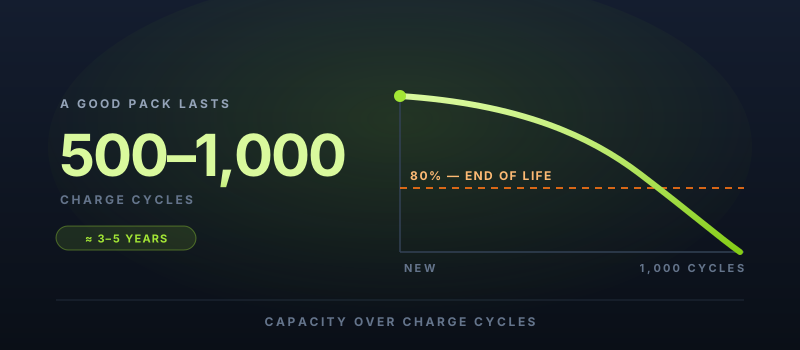
Most e-bike batteries deliver 500–1,000 charge cycles before dropping below 80% of their original capacity. For a typical commuter charging 2–3× per week, that's 3–5 years; for a casual rider charging once a week, 5–7 years. Premium cells in flagship bikes (Bosch Powertube, Specialized Turbo) reach 1,200–1,500 cycles.
The single biggest lever for extending it: charge to 80%, not 100% unless you need the range. That alone roughly doubles cycle count. The full math, the seven things that kill batteries fastest, and seven habit changes that extend life are below.
The full guide, section by section. Tap any section to read it.
What "lasts" actually means (cycles, years, capacity %)
What "lasts" actually means (cycles, years, capacity %)
When a manufacturer says "1,000 cycles," they mean to 80% of original capacity, not to zero. Three units to anchor:
- Charge cycle = one full discharge from 100% to 0%, measured cumulatively. Two 50%-to-0 partial discharges count as one cycle.
- End of life = the point at which the battery delivers ≤ 80% of its original capacity. The bike still works after this — it just gets fewer miles per charge.
- Years = depends on cycles per week × your usage pattern. A 1,000-cycle battery at 2 charges/week = 9.6 years on paper; at 5 charges/week = 3.8 years.
After end-of-life, batteries continue to degrade gradually — the curve flattens, but capacity keeps dropping. Most owners replace at 60–70% of original capacity, when the range hit becomes practical (a 50-mi bike that now does 30 mi).
Cycle count by battery chemistry
Cycle count by battery chemistry
Lithium-ion isn't one chemistry — it's a family. The cell type inside your battery pack determines its lifespan ceiling:
| Cell type | Cycles to 80% | Real-world years (2×/week) | Found in |
|---|---|---|---|
| Generic 18650 LiCoO₂ | 300–500 | 2–4 | Sub-$700 imports, no-name listings |
| 18650 NMC (LG, Samsung 35E) | 500–800 | 3–5 | Mid-tier ($800–1,500) |
| 21700 NMC (Samsung 50E, Panasonic NCR21700) | 800–1,200 | 5–7 | Premium consumer ($1,500–3,000) |
| LFP (LiFePO₄) | 2,000–3,000 | 8–12 | Specialty bikes, some Aventon, growing trend |
LFP is the longest-lasting chemistry and is showing up more in 2025–2026 cargo bikes — its only downside is a slight weight penalty per Wh vs NMC. If you can find an LFP-equipped bike at your price point, that's the lifespan winner.
The 7 things that kill an e-bike battery
The 7 things that kill an e-bike battery
Numbered list — most-impactful first. Each one shaves real cycles off your battery's life:
- Heat. Storing or charging above 40°C accelerates capacity loss. Never leave the bike in a hot car. Charge in a cool room. A summer week in a 50°C garage trunk can shave months off a battery's life.
- Deep discharge. Running below 20% repeatedly stresses cells more than any other normal-use behaviour. Plug in at 30%; don't drain to 0%. Most modern BMS systems force a hard cutoff before true 0%, but the cells still see the stress.
- Fast charging at high amperage. 4 A+ chargers are convenient but generate heat. Stick with 2 A. The "rapid charge" option that gets you to full in 90 minutes will cost you cycles long-term.
- Storage at 100% charge. Fully-charged batteries left for weeks lose capacity faster than batteries stored at 40–60%. If the bike is off-season storage, charge to 50% before storing.
- Freezing during charging. Below 0°C, charging causes lithium plating — irreversible damage. Bring the battery indoors before charging if it's been in sub-freezing temps. Riding cold is fine; charging cold is not.
- Mechanical damage. Drops, crash impact, or chassis flex through the battery cradle. Cell punctures cause thermal runaway (the fire-safety risk that makes UL certification matter — see our UL-certified apartment ebike guide).
- BMS faults. The battery management system can mis-balance cells over time. A quarterly full cycle (drain to 5%, charge slowly to 100%) helps the BMS recalibrate.
The 7 ways to extend battery life
The 7 ways to extend battery life
Each of these counters one of the killers above. Pair them — the gains compound:
- Charge to 80%, not 100%, unless you need the range. This is the single biggest lever. Most modern smart chargers have an 80% setting; if yours doesn't, unplug at 80% manually (most displays show charge state). Roughly doubles cycle count vs always-100%.
- Store at 40–60% if not riding for 2+ weeks. Most modern smart chargers have a "storage mode" button.
- Use a 2 A charger, not the fast charger. Slower, cooler, less wear.
- Keep above 20%. Set a habit of plugging in at 30%.
- Bring the battery indoors in winter. Store at room temp, charge inside, ride with the battery installed (it warms while in use).
- Quarterly full cycle for BMS calibration. Drain to 5%, charge slowly to 100%. Once every 3–4 months max — too often, and you're burning cycles.
- Original charger only. Third-party fast chargers cause most documented apartment fires (per CPSC). Use what came with the bike.
When to replace (and what it costs)
When to replace (and what it costs)
Replacement-cost ranges by tier:
- Budget bikes ($200–$400): Vivi, Razor, low-end Heybike. Third-party packs often available; OEM is recommended where the bike has firmware checks.
- Mid-tier ($500–$800): Most Heybike, Eleglide, Aventon. Third-party replacement options exist (em3ev custom packs, BMSBattery), with caveats — verify cell type + BMS compatibility before ordering.
- Premium with proprietary firmware ($900–$1,500): Bosch, Shimano STEPS, Specialized Turbo. OEM-only — proprietary firmware locks third-party batteries out.
Decision rule: if the bike's resale value is ≤ 2× the OEM battery cost, parts-out instead of replacing. A 4-year-old $1,000 commuter with a $400 OEM battery cost is at the margin; a 7-year-old $1,500 cargo bike with a $1,200 Bosch Powertube replacement is past it.
Failure modes — first-pass diagnosis
Failure modes — first-pass diagnosis
- Won't charge. Check the charger LED first (does it light when plugged into a wall outlet without the battery?). If the charger is fine, check the battery's contacts for corrosion. If both look OK, the BMS may have entered a fault state — most brands have a reset procedure (varies by model, check the manual).
- Drains within 5 miles. BMS likely showing one bad cell; the battery may be salvageable but range is shot. Worth a battery shop diagnosis before replacing.
- Swelling or heat at the case. STOP. Disconnect, store outside on a non-flammable surface, replace ASAP. This is the thermal-runaway warning sign.
- Specific error codes. Brand-specific. Heybike, Eleglide, Aventon all have service docs online with error-code lookups.
Concrete examples from our reviews
Concrete examples from our reviews
Real-world battery sizing across the catalog illustrates the cycle-count-vs-range tradeoff:
The Eleglide T1 ships with a 468 Wh battery (36V × 13Ah) and is rated for ~62 miles in PAS 1 (Class 1 EU spec, 250 W rated motor — efficient, low draw). With smart-charging habits (the seven below), expect 800–1,000 cycles before noticeable range degradation — roughly 6 years for a 2x/week commuter.
The Heybike Cityscape 2 has the same 468 Wh battery, but it's a Class 3 US-spec commuter with a 1200 W peak motor. Same cycles available, but the higher current draw means range tops out around 50 mi instead of 62. See our Cityscape 2 vs T1 comparison for the full breakdown.
The AddMotor M-81 is at the other end of the catalog at 960 Wh (tied with the Cyrusher Kommoda 3 for largest in the catalog). A bigger battery doesn't mean longer cycle life — it just means more miles per cycle. Cycle count is determined by cell chemistry + charging habits, not raw Wh.
Use our range calculator to estimate real-world range for any bike + terrain combination, and our savings calculator to model 5-year battery-replacement cost into your total cost of ownership.
Bottom line
Bottom line
A typical $1,000–$2,000 e-bike battery delivers 5+ years of useful life if you treat it well — 3 years if you don't. The seven habit changes above are free; the cost of replacing a battery is $400–$1,500. The math is straightforward: spend 10 seconds setting an 80% charge limit, save $500.
For more on safe indoor charging and which bikes carry UL 2849 fire-safety certification, see our UL-certified e-bike guide. For the regulatory class that determines how hard your motor draws on the battery in the first place, see Class 1, 2, 3 e-bikes explained.
Top-rated pick
 Amazon
Funhang
Funhang City Cruiser 26
Replacing a pack on an old bike often costs more than it's worth. If you're weighing that against starting fresh, this is the highest-rated bike we've reviewed — 374Wh.
As an Amazon Associate I earn from qualifying purchases. Ebike Oracle may also earn a commission on links to other retailers. Full disclosure.
Frequently asked questions
What's the average lifespan of an e-bike battery?
500–1,000 charge cycles for typical lithium-ion (NMC) cells, which works out to 3–5 years for a 2×/week commuter or 5–7 years for a casual rider. Premium 21700 cells reach 1,200–1,500 cycles. LFP cells (still rare in consumer e-bikes today but growing) reach 2,000–3,000 cycles — 8–12 years of useful life with normal use.
Should I charge my e-bike battery to 100%?
Only when you need the full range. Routine charging to 80% roughly doubles cycle count vs always-100%. Most modern smart chargers have an 80% setting; if yours doesn't, unplug at 80% manually (most displays show charge state). The exception: every 3–4 months, run a full 5%-to-100% cycle to let the BMS recalibrate cell balance.
How much does an e-bike battery replacement cost?
$200–$400 for budget bikes (Vivi, Razor, low-end Heybike), $500–$800 for mid-tier (most Heybike / Eleglide / Aventon), $900–$1,500 for premium with proprietary firmware (Bosch, Shimano, Specialized). OEM is recommended where firmware compatibility matters; third-party packs work for non-proprietary bikes but check warranty implications.
What kills an e-bike battery the fastest?
Five high-impact killers: (1) heat — storing or charging above 40°C, (2) deep discharge — repeatedly running below 20%, (3) storage at 100% charge for weeks, (4) charging while frozen (causes irreversible lithium plating), and (5) using a non-OEM fast charger. Avoiding these five extends life dramatically — see the seven things to avoid in the body above.
Can I store my e-bike battery in winter?
Yes, with care. Bring the battery indoors (don't leave it outside or in an unheated garage). Store at 40–60% charge, NOT at 100%. Once a month, top up if needed. Charging while frozen (below 0°C) causes lithium plating, which is permanent damage. Riding in cold weather is fine — the cells warm during use.
How long does an e-bike battery last in cold weather riding?
Real-world range drops 20–30% below freezing. The cells haven't lost capacity — the discharge curve gets worse at low temps. Range returns when the battery warms up. Don't read winter range as battery degradation; it's chemistry, not failure.
Is it safe to charge an e-bike battery in my apartment?
Only if the battery is UL 2271 / UL 2849 certified, you use the original charger, the room has a working smoke detector, and you don't leave it on a flammable surface. CPSC-cited apartment fires from e-bikes trace overwhelmingly to non-UL batteries or aftermarket fast-chargers. See our UL-certified e-bike apartment guide for picks certified to the standards NYC Local Law 39 requires for e-bike sales and many buildings ask for before indoor charging.
My e-bike battery won't charge — how do I diagnose it?
Check the charger LED first (does it light when plugged into a wall outlet without the battery?). If the charger is fine, check the battery's contacts for corrosion. If both look OK, the BMS may have entered a fault state — most brands have a reset procedure (varies by model, check the manual). If none of those work, it's likely a BMS or cell failure — replacement is usually cheaper than repair.
Keep reading
Guide
Class 1 vs 2 vs 3 E-Bikes Explained (2026)
The US e-bike class system is actually simple: Class 1 is pedal-assist only at 20 mph, Class 2...
ReadGuide
Do You Need a License for an E-Bike? (2026)
In 49 states and Washington, DC you do not need a license, registration, or insurance to ride a...
ReadGuide
Are E-Bikes Worth It in 2026? The Real Cost to Own
For most commuters, yes — an e-bike is one of the cheapest vehicles you can own. A full...
Read
Reviewed by