Do You Need a License for an E-Bike? 49 States: No (2026)
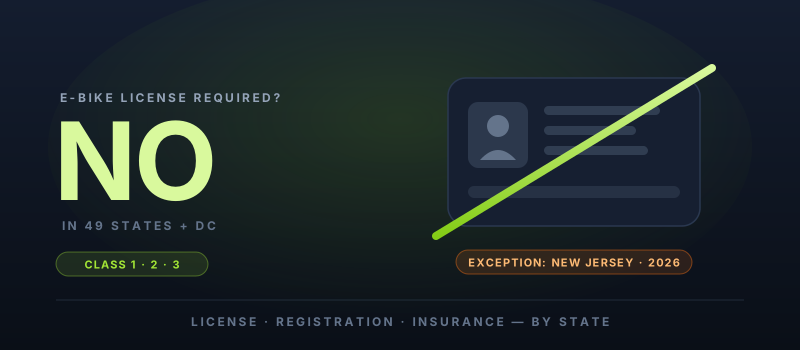
In 49 states and Washington, DC you do not need a license, registration, or insurance to ride a Class 1, 2, or 3 electric bike. New Jersey is the single exception — since July 19, 2026 every e-bike there requires a license and MVC registration — and Hawaii requires a one-time $30 registration but no license.
The short version
- 49 states + DC: no license, no registration, no insurance for a compliant Class 1 or 2 e-bike — and the same goes for Class 3 in the 44 states that recognise it.
- New Jersey is the exception. Since July 19, 2026, every e-bike in NJ needs a license (17+ driver license, or a motorized-bicycle license at 15–16) plus MVC registration (S4834/A6235).
- Hawaii requires a one-time $30 registration (HRS §249-14) — but still no license.
- Over 750W rated power or 28 mph the bike stops being an e-bike under federal law (15 USC §2085) and motor-vehicle rules — license, registration, insurance — apply almost everywhere.
- Class 3 (28 mph) bikes carry age minimums (usually 16) and helmet rules in many states — rules, but not licenses.

Our pick for most readers
Funhang City Cruiser 26
$320
As an Amazon Associate I earn from qualifying purchases. Ebike Oracle may also earn a commission on links to other retailers. Full disclosure.
The short answer
In 49 states and Washington, DC, you do not need a driver's license to ride an electric bike — and you don't need to register or insure it either. Federal law (15 USC §2085) defines a low-speed electric bicycle as having operable pedals, a motor of 750W or less, and a top assisted speed within the class limits, and nearly every state treats a bike that fits that definition as a bicycle, not a motor vehicle.
The two exceptions are easy to remember:
- New Jersey — the only state where every e-bike now needs a license and registration (details below, because this changed in 2026 and most sites haven't caught up).
- Hawaii — no license, but a one-time $30 registration (HRS §249-14).
If your bike is a Class 1 or Class 2 e-bike anywhere else in the country, you can stop worrying: no license, no plates, no insurance requirement. Class 3 (28 mph) gets the same treatment in the 44 states that recognise it — but seven jurisdictions (DC, Kentucky, Massachusetts, Montana, North Carolina, Pennsylvania, South Carolina) never adopted Class 3, and most of them treat a 28 mph e-bike as a moped or motor vehicle instead; Massachusetts explicitly requires a license and registration above Class 2.
The full guide, section by section. Tap any section to read it.
The 2026 change most sites have missed
The 2026 change most sites have missed
Search this question today and most results — including the brand blogs ranking on page one — still say "no US state requires a license for an e-bike." That has been wrong since January 19, 2026.
New Jersey's S4834/A6235, signed that day with enforcement beginning July 19, 2026, abolished the state's three-class framework entirely. Under the new law:
- Every e-bike rider needs a license — a standard NJ driver's license at 17+, or a motorized-bicycle license at 15–16.
- Every e-bike must be registered with the Motor Vehicle Commission.
- Throttle-capable e-bikes ("motorized bicycles") additionally need liability insurance and a DOT-rated helmet at any age. Pedal-assist-only bikes capped at 20 mph are exempt from the insurance rule — but not from the license and registration.
- Anything over 750W and faster than 28 mph is treated as a motorcycle.
Full state detail: New Jersey e-bike laws.
License, registration, and insurance — by the numbers
License, registration, and insurance — by the numbers
| Requirement | Where it applies | Everywhere else |
|---|---|---|
| Driver's license | New Jersey only (every e-bike, since 2026-07-19) | Not required |
| Registration | New Jersey (MVC) and Hawaii ($30 one-time, HRS §249-14) | Not required |
| Insurance | New Jersey, throttle-capable e-bikes only | Not required |
| Age minimum (Class 3) | Most class-system states: 16 (Idaho 15, Louisiana 12) | Class 1/2 usually no statewide minimum |
| Class 3 recognition | 44 states treat Class 3 as a bicycle | In DC, KY, MA, MT, NC, PA, SC a 28 mph bike falls outside the bicycle framework — moped/motor-vehicle rules can apply |
| Helmet | Varies — see below | — |
The full state-by-state table, with statute citations for all 50 states + DC, lives on our license and registration by state reference page.
When an "e-bike" does need a license — everywhere
When an "e-bike" does need a license — everywhere
The no-license rule only protects bikes that stay inside the federal definition. You're in motor-vehicle territory in almost every state the moment your bike:
- has a motor rated above 750W (peak wattage marketing is fine; the rated number is what counts),
- assists beyond 28 mph under motor power,
- has no operable pedals, or
- is a Class 3 in one of the seven jurisdictions that never adopted it (DC, KY, MA, MT, NC, PA, SC) — most treat it as a moped there, and Massachusetts explicitly requires a license and registration.
That's why a 2,000W "e-bike" that does 40 mph needs a license, registration, and insurance in most of the country — legally it's a moped or motorcycle regardless of what the listing calls it. If you're unsure what your bike counts as, our legality checker applies your state's actual rules to your bike's specs in a few seconds.
The rules that DO apply instead of a license
The rules that DO apply instead of a license
No license doesn't mean no rules. The ones that actually get riders stopped:
- Class 3 age minimums — usually 16 to operate a 28 mph bike (Idaho allows 15, Louisiana 12).
- Helmets — Connecticut requires one for every e-bike rider of any age on any class; California, Georgia, and Louisiana require one for every Class 3 rider regardless of age; roughly half the states require one for younger riders on any bike. Arkansas extends its Class 3 helmet rule to under 21.
- Where Class 3 can ride — most states keep 28 mph bikes off multi-use paths unless a local authority opts in.
- Local ordinances — cities and park districts can (and do) add their own restrictions on top of state law.
What you actually have to do
What you actually have to do
- Check the class sticker on your frame (required labeling in most class-system states). Class 1, 2, or 3 → you're license-free outside New Jersey.
- Look up your state on the license and registration table — thirty seconds, statute citations included.
- In New Jersey: bring your driver's license and register the bike with the MVC before riding; add insurance if the bike has a throttle.
- In Hawaii: do the one-time $30 registration.
- Riding something over 750W rated or faster than 28 mph? Treat it as a moped/motorcycle: license, registration, insurance, and stay off bike infrastructure.
Bottom line
Bottom line
For a compliant Class 1 or 2 e-bike, the answer is no in 49 states and DC — New Jersey (license + registration, 2026) and Hawaii (registration only) are the entire list of exceptions. Class 3 earns the same answer in the 44 states that recognise it; check the seven that don't before buying a 28 mph bike. Every bike we review states its class right in the spec table: license-free 20 mph Class 2 commuters like the Vivi MT26GUL and Vivi C26UL are bicycles in the eyes of every state but NJ, and even a 28 mph Class 3 like the Heybike Cityscape 2.0 needs age and helmet compliance — not a license — in the states that allow it.
Verified against our 51-jurisdiction statute dataset (15 USC §2085; NJ S4834/A6235; HRS §249-14) — last reviewed August 1, 2026. Laws change; for high-stakes decisions confirm with your state DMV.
As an Amazon Associate I earn from qualifying purchases. Ebike Oracle may also earn a commission on links to other retailers. Full disclosure.
Best license-free pick we rate
 Amazon
Funhang
Funhang City Cruiser 26
Class 2 is the license-free sweet spot this guide lands on — 20 mph, throttle allowed, legally a bicycle in every state except New Jersey. This is the best-rated Class 2 we've reviewed (8.6/10).
In New Jersey every e-bike now needs a license and registration, and throttle bikes add insurance.
As an Amazon Associate I earn from qualifying purchases. Ebike Oracle may also earn a commission on links to other retailers. Full disclosure.
Frequently asked questions
Do you need a license to ride an electric bike?
No — in 49 states and Washington, DC a Class 1 or 2 electric bike is legally a bicycle and needs no license, and Class 3 gets the same treatment in the 44 states that recognise it. The single blanket exception is New Jersey, where a law that took effect July 19, 2026 requires every e-bike rider to hold a license (driver license at 17+, motorized-bicycle license at 15–16).
Do electric bikes need to be registered?
Only in two places: New Jersey (MVC registration for every e-bike, since July 2026) and Hawaii (a one-time $30 registration under HRS §249-14). The other 48 states and DC require no registration for compliant e-bikes.
Do you need insurance for an electric bike?
No state requires insurance for a compliant Class 1, 2, or 3 e-bike except New Jersey, which requires liability insurance for throttle-capable e-bikes only — pedal-assist bikes capped at 20 mph are exempt from the insurance rule. Bikes exceeding 750W or 28 mph are motor vehicles and need insurance almost everywhere.
Do you need a license for an electric bike in New Jersey?
Yes — since July 19, 2026, every e-bike in New Jersey requires a license and MVC registration under S4834/A6235. Riders 17+ use a standard driver license; riders 15–16 can hold a motorized-bicycle license. Throttle-capable bikes also need liability insurance and a DOT helmet.
Do you need a license for an e-bike that goes 28 mph?
In the 44 states that recognise Class 3, no — expect an age minimum (usually 16) and, in several states, a mandatory helmet instead. But seven jurisdictions never adopted Class 3 (DC, KY, MA, MT, NC, PA, SC): most treat a 28 mph e-bike as a moped there, and Massachusetts explicitly requires a license and registration. New Jersey requires a license for every e-bike regardless of speed.
Do you need a license for a 1000W e-bike?
Usually yes — federal law caps a low-speed electric bicycle at 750W rated power (15 USC §2085). A motor rated above that makes the bike a motor vehicle in most states, which means license, registration, and insurance. Watch the wording though: many bikes advertise '1000W peak' but are rated at 750W or less, which keeps them legal e-bikes.
How old do you have to be to ride an electric bike?
For Class 1 and 2, most states set no statewide minimum age. For Class 3 (28 mph), the typical minimum is 16 — Idaho allows 15 and Louisiana 12, while some states set none. New Jersey now effectively sets a licensing floor of 15 statewide.
What happens if you ride an e-bike without a license in New Jersey?
Since enforcement began July 19, 2026, riding unlicensed or unregistered in NJ exposes you to motor-vehicle citations — the same framework that covers mopeds. The practical fix is cheap: riders 17+ already holding a driver license just need to register the bike with the MVC, and add insurance only if the bike has a throttle.
Keep reading
Guide
Class 1 vs 2 vs 3 E-Bikes Explained (2026)
The US e-bike class system is actually simple: Class 1 is pedal-assist only at 20 mph, Class 2...
ReadGuide
How to Choose an E-Bike in 2026: A Beginner's Buying Guide
Choosing an e-bike comes down to six decisions, in order: (1) the class (1, 2, or 3 —...
ReadGuide
Are E-Bike Batteries a Fire Risk? UL 2849 & Safe Charging
A quality, UL 2849-certified e-bike from a reputable brand is a very low fire risk. Nearly every documented...
Read
Reviewed by