Are Sur-Rons Street Legal? What to Ride Instead
No — a stock Sur-Ron, Talaria, or Segway electric dirt bike is street legal in almost no US state, and lights and mirrors will not change that. It fails the federal e-bike test on all three counts (no pedals, far more than 750 W, far faster than 20 mph), so every state DMV treats it as an off-road motorcycle: legal...
The short version
- In stock form a Sur-Ron is not street legal in any US state. It is an off-road electric motorcycle.
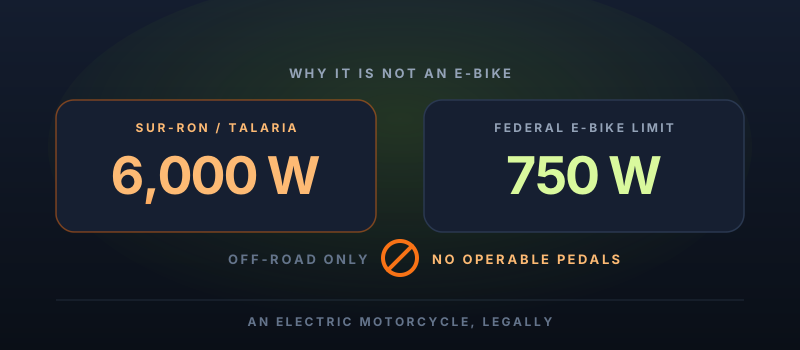
- It fails the federal e-bike test on all three counts — no pedals, several thousand watts against a 750 W cap, and 45+ mph against a 20 mph cap.
- Pedals are the deciding factor. California's SB 586 defines an e-moto as an electric two-wheeler "not equipped with pedals from the manufacturer" — the federal e-bike test run in reverse.
- Making one road-legal ranges from very hard to impossible: the blocker is the off-highway title, not the lights.
- Legal to ride on private land, designated OHV areas, and closed courses — with the sticker your state requires.

Our pick for most readers
Funhang City Cruiser 26
$309.99
Price as of · subject to change
As an Amazon Associate I earn from qualifying purchases. Ebike Oracle may also earn a commission on links to other retailers. Full disclosure.
The short answer
A stock Sur-Ron (or Talaria, or Segway) electric dirt bike is not a street-legal e-bike in almost any US state. It is an off-road electric motorcycle. You can legally ride it on private property and in designated off-highway-vehicle (OHV) areas, but riding it on public roads, bike lanes, or multi-use paths is illegal in most places — and in many states you cannot make it road-legal at all.
The reason is simple and it comes down to one word: pedals. Federal law defines a low-speed electric bicycle as a two- or three-wheeled vehicle with fully operable pedals, a motor under 750 watts, and a motor-only top speed under 20 mph (15 U.S.C. §2085). A Sur-Ron has foot pegs, not pedals. It also makes several thousand watts and does 45+ mph. It misses all three tests, and it misses the first one — pedals — before power or speed even matter.
That is not a technicality. It is the whole legal story, and it is why the "it's basically a big e-bike" assumption gets riders ticketed, and their bikes impounded.
The full guide, section by section. Tap any section to read it.
Why a Sur-Ron is not an e-bike
Why a Sur-Ron is not an e-bike
The federal e-bike definition (15 U.S.C. §2085, mirrored by the Consumer Product Safety Commission at 16 CFR §1512) sets three simultaneous requirements. A vehicle has to meet all three to be a low-speed electric bicycle:
- Fully operable pedals.
- A motor of less than 750 watts.
- A motor-only top speed under 20 mph (measured with a 170-lb rider on level ground).
One important nuance most explainers miss: that federal standard governs how a product is manufactured and sold — not whether you can ride it on the street. It is legal to sell a Sur-Ron (they are sold as off-road, closed-course machines). Failing the definition does not make the sale illegal; it removes the bike from the "bicycle" category entirely and hands the question of road use to your state (CPSC scope explainer). And every state answers the same way: not a bicycle.
Here is the cleanest proof that the pedals are the deciding factor. California's brand-new e-moto law — SB 586, which added Vehicle Code §436.1 effective January 1, 2026 — defines an "off-highway electric motorcycle" as an electric two-wheeler with handlebars, a straddle seat, and that is "not equipped with pedals from the manufacturer." That is the federal e-bike test run in reverse. Federal law says a bicycle has pedals; California says an e-moto is the electric two-wheeler that doesn't. A Sur-Ron sits on the wrong side of that line by design.
The specs, brand by brand
The specs, brand by brand
None of the popular "electric dirt bike" models have pedals, and all of them make far more than 750 watts. Figures below are approximate and vary by model year and by whether a source quotes rated or peak power — but the verdict does not: every one of them fails the e-bike test.
| Model | Approx. power | Approx. top speed | Pedals? | E-bike? |
|---|---|---|---|---|
| Sur-Ron Light Bee X | ~6 kW peak | ~45 mph | No (foot pegs) | No |
| Sur-Ron Storm Bee | ~10 kW rated | ~68–75 mph | No (foot pegs) | No — full motorcycle |
| Talaria Sting | ~3 kW rated / 6 kW peak | ~47 mph | No (foot pegs) | No |
| Segway Dirt eBike X260 | ~5 kW | ~46 mph | No (foot pegs) | No |
For scale: a legal e-bike caps out at 750 W and 20–28 mph. A Sur-Ron Light Bee makes roughly eight times the power of a legal e-bike motor and doubles the speed. The Storm Bee is a 70-mph electric motorcycle that happens to look bike-ish. Segway is blunt about it — the company markets its dirt eBikes as off-road machines and states plainly that they are not legal to ride on roadways.
What a Sur-Ron is, legally
What a Sur-Ron is, legally
Once a vehicle flunks the e-bike test, your state DMV drops it into one of three buckets, depending on the state and the machine:
- Off-highway vehicle (OHV) / off-road motorcycle — where nearly every stock e-moto lands.
- Motorcycle or motor-driven cycle — if it could theoretically be equipped to road standards.
- Moped / limited-use motorcycle — a speed-tiered category in some states.
To put any of those on a public road, you generally need registration and a title, a motorcycle (M-class) license, liability insurance, and DOT-legal equipment — headlight, brake light, turn signals, mirror, horn, DOT tires, and a road-legal VIN. Stock e-motos ship without most of that. Worse, and this is the part that traps people: they usually carry an off-highway title, not a road certificate — so in many states you cannot register them for the road at all, no matter how many lights you bolt on. The barrier is the paperwork category, not the parts.
What states are Sur-Rons legal in?
What states are Sur-Rons legal in?
None, for street use, in stock form. That is the honest answer to the most-asked version of this question, and it is not a fifty-state technicality — it follows from one fact. Street legality is decided by whether a vehicle is a bicycle or a motor vehicle, and every state uses the federal pedals-power-speed test to draw that line. A Sur-Ron fails it everywhere, so no state has a category that lets you ride one on the road the way you ride an e-bike.
What does vary by state is the bucket it lands in afterwards, and whether a conversion to road-legal motorcycle status is even available. Classification and the exact conversion path vary; the outcome does not. A few worked examples:
- California — under SB 586, an e-moto is an off-highway electric motorcycle needing a Green Sticker, ridden in OHV areas — expressly not a bicycle, moped, or street motorcycle.
- New York — the DMV defines an e-bike as under 750 W with operable pedals; a dirt bike or off-road motorcycle "cannot be registered for street use" and, at most, registers as an off-road ATV.
- Texas — the state titles off-highway motorcycles but does not register them for road use, and adding lights and mirrors cannot override an off-highway classification.
- Florida — a road conversion is theoretically possible but onerous: OHV title, DOT lighting, inspection, motorcycle insurance, and a motorcycle endorsement, with success dependent on the inspector.
- Georgia — a Sur-Ron exceeds the 750 W cap and the Class 3 ceiling, so it falls out of the e-bike statute entirely and is treated as a moped or motorcycle requiring registration and a license.
The through-line: stock e-motos are off-road-only, and making one road-legal ranges from very difficult to effectively impossible depending on your state. Check your own state on the state law hub before assuming a conversion is even available.
Can you make a Sur-Ron street legal?
Can you make a Sur-Ron street legal?
Sometimes, rarely, and never easily. In a handful of states with a workable conversion path, you would need to add full DOT equipment, pass an inspection, obtain motorcycle insurance and an M-class endorsement, and — the hard part — get the machine titled and registered for road use despite its off-highway origin. In states like California, where the off-highway classification is statutory, that road is essentially closed: the bike is defined as off-highway, full stop.
Anyone selling you a "street legal Sur-Ron kit" is selling lights and mirrors. Those solve the equipment problem. They do not solve the registration problem, which is the one that actually keeps the bike off the road.
The enforcement reality
The enforcement reality
"But everyone rides them on the road" is true and irrelevant. Enforcement is real and escalating. New York City runs the most documented crackdown in the country: the NYPD seized 18,430 illegal motorized vehicles in 2023, a 128% jump over the prior year, and the city reports over 100,000 illegal vehicles removed since 2022. (Those totals cover every category of illegal motorized vehicle — mopeds, scooters, ATVs, dirt bikes — not Sur-Rons specifically; no agency breaks out a Sur-Ron line item.) The US Forest Service has issued its own notices requiring OHV registration for e-motorcycles on trails.
A seized bike is expensive to recover and sometimes crushed. An uninsured rider in a crash is personally liable. Neither risk goes away because the bike looks like a bicycle.
Where you can ride one legally
Where you can ride one legally
A Sur-Ron is a genuinely good machine in the place it belongs:
- Private property you own or have permission to ride.
- Designated OHV parks and trails (with the OHV registration or sticker your state requires).
- Motocross tracks and closed courses.
Ridden there, it is exactly what it was built to be. The legal problem only appears when a machine designed for the dirt gets ridden on the street.
One rule follows you into all three: helmets. Every state that regulates OHV use requires a helmet for riders under 18, and many require one for every rider regardless of age — and unlike the road rules, this one is enforced on the trail by the same agency that sells you the sticker. At 45+ mph on loose surface it is not really a legal question anyway.
What to ride instead, if you want the road
What to ride instead, if you want the road
If what you actually want is something quick that you can ride legally on roads and bike lanes — no plate, no licence, no OHV sticker — that is a Class 3 e-bike, capped at 28 mph with pedals. It is slower than a Sur-Ron and it is legal, which on a public road is the only comparison that matters. We rank the ones that clear the federal test in the best street-legal e-bikes. If you want the dirt-bike or moped shape specifically rather than a commuter, street-legal electric dirt bikes is the narrower list: same legal test, applied to the bikes that look the part. And if you're in one of the seven states that don't allow Class 3 at all, the state law pages name the 20 mph models that are legal where you live.
Bottom line
Bottom line
A Sur-Ron is not a fast e-bike. It is an electric dirt bike — an off-road motorcycle in the eyes of every US DMV — and it is street legal almost nowhere in stock form. If you want a bike you can legally ride on roads and bike lanes without a license or registration, you want a real e-bike: pedals, 750 W or less, capped at 20–28 mph. If you want the dirt-bike performance, ride it where it's legal. Just don't let the word "bike" convince you the street rules apply — they don't, and the state-by-state e-bike laws spell out exactly where the line is drawn.
As an Amazon Associate I earn from qualifying purchases. Ebike Oracle may also earn a commission on links to other retailers. Full disclosure.
A street-legal alternative
 Amazon
Funhang
Funhang City Cruiser 26
A Sur-Ron is a motorcycle almost everywhere in the US — over the 750W federal cap, so no bike lanes, no bike paths, and registration and a licence where it's allowed at all. If you want the ride without the paperwork, this is the highest-rated street-legal bike we've reviewed.
Price as of · subject to change
As an Amazon Associate I earn from qualifying purchases. Ebike Oracle may also earn a commission on links to other retailers. Full disclosure.
Frequently asked questions
Are Sur-Rons street legal in the US?
In stock form, in almost no state. A Sur-Ron has no pedals, makes several thousand watts, and does 45+ mph, so it fails the federal e-bike definition (15 U.S.C. §2085) on all three counts. Every US state therefore treats it as an off-road electric motorcycle — legal on private land and in OHV areas, not on public roads without registration, a motorcycle license, and insurance that most of these bikes can't obtain.
Why is a Sur-Ron not considered an e-bike?
Because it has no operable pedals. Federal law requires a low-speed electric bicycle to have fully operable pedals, a motor under 750 W, and a motor-only top speed under 20 mph. A Sur-Ron has foot pegs instead of pedals and blows past the power and speed limits too. California's 2026 e-moto law even defines these vehicles by that exact trait — an electric two-wheeler "not equipped with pedals from the manufacturer."
Can you make a Sur-Ron street legal?
Rarely, and never easily. In the few states with a conversion path you would add DOT lights, mirrors, and a horn, pass inspection, get motorcycle insurance and an M-class license, and title the bike for road use. The blocker is usually the title: e-motos carry an off-highway title, and many states will not register an off-highway vehicle for the road no matter what equipment you add. In California, SB 586 defines them as off-highway by statute, which effectively closes the road entirely.
Do you need a license to ride a Sur-Ron?
Not to ride one on private land or in an OHV area — but you do need a motorcycle (M-class) license, plus registration and insurance, to ride any e-moto legally on a public road, in the rare case a state lets you register one at all. Because most Sur-Rons cannot be road-registered, the practical answer is that they are off-road-only regardless of what license you hold.
What's the difference between a Sur-Ron and an electric bike?
A legal e-bike has working pedals, a motor of 750 W or less, and a cap of 20–28 mph depending on class — so it can be ridden like a bicycle, usually with no license or registration. A Sur-Ron has no pedals, makes roughly 6,000+ watts, and does 45+ mph. It is an electric off-road motorcycle. They look similar and both are electric, but legally they are in completely different categories: one is a bicycle, the other is a motor vehicle.
Are Talaria and Segway electric dirt bikes street legal?
No, same as the Sur-Ron. The Talaria Sting and Segway Dirt eBike X-series also lack pedals and make 3,000–5,000+ watts at 45+ mph, so they fail the federal e-bike test and are classified as off-road electric motorcycles. Segway markets its dirt eBikes as off-road machines and states they are not legal on roadways.
Where can I legally ride a Sur-Ron?
On private property you own or have permission to use, on designated OHV (off-highway-vehicle) parks and trails with the sticker or registration your state requires, and on closed courses like motocross tracks. That is where these bikes are built to be ridden and where they are fully legal.
What happens if I get caught riding a Sur-Ron on the road?
Depending on the state and city, an unregistered, uninsured off-road motorcycle on a public road can be ticketed and impounded, and some jurisdictions crush seized vehicles. New York City alone reports removing over 100,000 illegal motorized vehicles since 2022. If you crash while riding uninsured, you are also personally liable for any damage. The risks are real even though enforcement is uneven.
Keep reading
Guide
Class 1 vs 2 vs 3 E-Bikes Explained (2026)
The US e-bike class system is actually simple: Class 1 is pedal-assist only at 20 mph, Class 2...
ReadGuide
Do You Need a License for an E-Bike? (2026)
In 49 states and Washington, DC you do not need a license, registration, or insurance to ride a...
ReadGuide
Are E-Bikes Worth It in 2026? The Real Cost to Own
For most commuters, yes — an e-bike is one of the cheapest vehicles you can own. A full...
Read
Reviewed by