Are Electric Bikes Reliable? 71 Bikes Tracked
The mechanical parts of an electric bike are ordinary bicycle parts and fail in ordinary bicycle ways. The parts that actually strand owners are the battery, the controller and the brand itself — and the last one is the one nobody measures. We have tracked 71 bikes across 31 brands since May 2026 with a stock sync running every three...
The short version
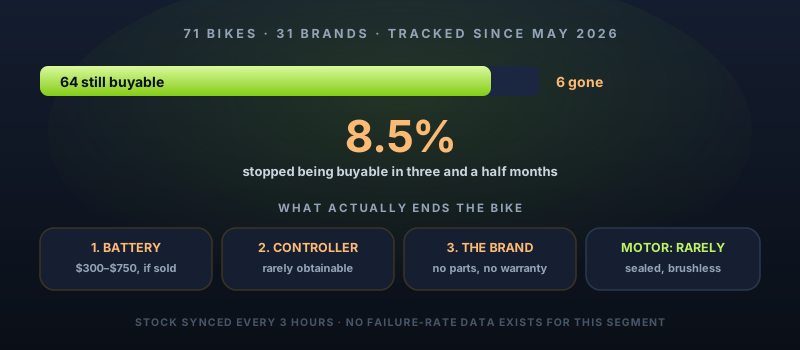
- 8.5% of the bikes we track stopped being buyable in 3.5 months — 6 of 71, across 31 brands. Brand availability is the underrated failure mode.
- The battery is the part that ends a bike's life, not the motor. Replacement is $300–$750, and only if the brand still sells it.
- Hub motors are the reliable bit — brushless, sealed, few moving parts, and rarely the thing that fails.
- Warranties are short, and most are silent: only 34 of the 78 bikes we cover state a warranty at all. 29 mention a one-year term, 18 a two-year, and one five.
- We have no failure-rate data for this segment and neither does anyone else. Treat any site quoting a percentage with suspicion.

Our pick for most readers
Funhang City Cruiser 26
$320
As an Amazon Associate I earn from qualifying purchases. Ebike Oracle may also earn a commission on links to other retailers. Full disclosure.
Are electric bikes reliable?
Mostly yes, but the question is usually asked about the wrong parts. An electric bike is a bicycle with a sealed brushless hub motor, a lithium battery and a controller bolted to it. The bicycle parts fail the way bicycle parts always have, through wear on tyres, pads, cables and chains, and they are cheap and universal to replace. The motor is the most reliable electrical component on the bike, because a brushless hub motor has almost nothing in it that touches anything else. What actually takes an e-bike out of service is one of three things: the battery degrading past usefulness, the controller or display failing, or the brand that sold you a proprietary battery and controller ceasing to supply them. That third one is the failure mode nobody quantifies and the one we can measure. Across 71 bikes from 31 brands tracked since 3 May 2026 with a stock check running every three hours, six stopped being buyable at all within three and a half months. Reliability in this market is as much about who you buy from as what you buy.
The full guide, section by section. Tap any section to read it.
What actually fails on an electric bike?
What actually fails on an electric bike?
In rough order of how likely it is to end the bike rather than annoy you.
The battery, and it is not close. Lithium cells lose capacity with every charge cycle. A pack that delivered 30 miles when new will deliver perhaps 24 after a few hundred cycles, and the decline is gradual rather than sudden. That is normal and expected. What turns it from maintenance into a write-off is availability: a replacement is $300 to $750, and only if the brand still sells one that fits. See how long e-bike batteries last for the cycle-life detail.
The controller and display. These are the least standardised parts on the bike and the most likely to be unobtainable in three years. A dead controller on a proprietary system is frequently the end of the bike.
Brakes and drivetrain, but only as wear. Mechanical disc brakes on a 60–80 lb bike wear pads faster than you expect and need cable adjustment as routine work, not occasional. This is maintenance, not failure, though it is the maintenance most new owners skip.
The motor, rarely. A brushless hub motor is a sealed unit with bearings and windings and no brushes to wear out. Motors do fail, usually through water ingress at the cable entry or a stripped internal gear on a geared hub, but they are well down this list.
🔴 The failure nobody measures: the brand disappearing
🔴 The failure nobody measures: the brand disappearing
This is the part of the reliability question that budget e-bike buying turns on, and we are in an unusual position to answer it because we track stock rather than just publishing reviews.
Since 3 May 2026 we have carried 71 published bikes across 31 brands, with a price-and-availability sync against the retailer running every three hours. As of 18 August 2026:
| Status | Bikes |
|---|---|
| Still in stock and buyable | 64 |
| Discontinued or delisted | 6 |
| On backorder | 1 |
Six of seventy-one bikes stopped being buyable in three and a half months — about 8.5%. Extrapolating a 3.5-month window to an annual rate would be bad arithmetic and we are not going to do it, but the direction is clear enough to act on: in the budget direct-order segment, models vanish routinely.
That matters because of what disappears with them. A discontinued bike from a brand with no dealer network means no replacement battery, no controller, no display and no warranty counterparty. The bike still rides until the pack degrades, and then it is scrap. This is a materially different risk from buying a bicycle, where a 15-year-old frame still takes current parts.
The practical defence is boring and effective: prefer a bike whose battery is a currently-sold standard part, prefer brands with more than one model in the market, and treat a two-year warranty from a company founded last year as worth less than the same warranty from one that has been shipping for a decade.
How do you tell a reliable e-bike from a risky one before buying?
How do you tell a reliable e-bike from a risky one before buying?
Five checks, in the order we would run them, and none of them is motor wattage.
1. Is the battery certified? Look for UL 2849 on the whole electrical system and UL 2271 on the pack. This is the single most useful reliability signal available to a buyer, because certification means an accredited laboratory tested the system rather than the brand asserting it was fine, and it is the only third-party check that exists in this segment at any price. It is also increasingly the law rather than a preference. New York City has required UL certification for any e-bike sold, leased or rented in the city since Local Law 39 of 2023, effective 16 September 2023. Colorado went further with HB 25-1197, signed 28 May 2025 and effective 6 August 2025, which requires UL 2849, UL 2271 or EN 15194, adds labelling provisions from 1 January 2027, and carries penalties of up to $20,000 per violation for mislabelling. A growing number of apartment buildings, universities and workplaces now refuse to allow an uncertified battery to charge indoors at all, which can make an uncertified bike unusable where you live regardless of how well built it is. We name UL 2849 or UL 2271 in 53 of the 78 bikes we cover, because at this price point it separates the bikes worth considering from the ones that are not.
2. Can you buy the battery separately, today? Search the brand's own store for a replacement pack for the exact model. If there is not one listed, you are buying a bike with a fixed lifespan.
3. How long is the warranty, and from whom? Of the 78 bikes we cover, only 34 state a warranty at all. Twenty-nine mention a one-year term and eighteen a two-year one, and thirteen state both, because cover is usually split by component — commonly a year on the battery and two on the frame. One states five. Two years on the electrics is the good end of this market, not the norm, and silence is the most common answer of all. And a warranty is only worth the company behind it.
4. Are the brakes hydraulic or mechanical? Not strictly reliability, but it is the specification that most affects whether a heavy bike stops properly in the wet, and mechanical discs need far more frequent adjustment.
5. What do owners complain about, specifically? Read past the star rating to what the one-star reviews describe. In this segment the recurring theme is almost never "it broke immediately" — it is support and parts availability when something needs replacing. That is the same risk as item 2, reported by people who already hit it.
Are cheap electric bikes less reliable?
Are cheap electric bikes less reliable?
Less well-equipped, certainly. Less reliable, not as clearly as you would expect, and the honest answer has two halves.
Cheap bikes use simpler systems. A 350–500 W geared hub, a cadence sensor and mechanical brakes have fewer things to go wrong than a torque-sensing mid-drive with hydraulics. Simplicity is genuinely a reliability advantage, and it is why a $400 bike is not automatically a worse bet than a $1,200 one.
What you do give up is margin for error and parts support. Cheaper packs use cheaper cells with shorter cycle life, mechanical brakes need more attention, and the brands are younger and likelier to vanish. Our own price data shows the trade in another direction too: value per watt-hour is best at the bottom of the market, at roughly $0.77 per watt-hour under $500 against $1.61 over $1,000, so you are not paying for durability when you spend more, you are paying for components. See how much an e-bike costs for the full breakdown.
The one place cheap is unambiguously better is legality: every sub-$500 bike we track stays inside the 750 W legal cap, which is not true of the dearer bands.
What we cannot tell you
What we cannot tell you
We have no failure-rate data, no mean-time-between-failures, and no warranty-claim statistics, for our catalogue or for the segment. Neither does anybody else. No manufacturer in this bracket publishes them, there is no equivalent of an automotive recall database for budget e-bikes, and the sample any single reviewer sees is far too small to generalise from.
So if you find a page confidently telling you that a given percentage of e-bikes fail in year two, that number was invented. What can be stated honestly is what we have stated here: what actually breaks, in what order, what the certification landscape requires, what the warranties actually say, and how often the bikes we track stop being buyable. The last of those is a real measurement, and it points at the risk most buyers never consider.
Last verified 18 August 2026 against 71 tracked bikes.
Top-rated pick
 Amazon
Funhang
Funhang City Cruiser 26
Reading up because you're shopping? This is the highest-rated bike we've reviewed (8.6/10) with a live US listing.
As an Amazon Associate I earn from qualifying purchases. Ebike Oracle may also earn a commission on links to other retailers. Full disclosure.
Frequently asked questions
Are electric bikes reliable?
The mechanical parts are ordinary bicycle parts and fail in ordinary ways. The hub motor is the most reliable electrical component — sealed, brushless, few moving parts. What actually ends an e-bike is the battery degrading, the controller failing, or the brand ceasing to supply either. That last one is real and measurable: of 71 bikes across 31 brands we have tracked since May 2026, 6 stopped being buyable within 3.5 months. Buy on replaceable parts, certification and warranty rather than motor wattage.
What is the most common problem with electric bikes?
Battery capacity loss, and it is not close. Lithium cells decline gradually with charge cycles, so a 30-mile bike becomes a 24-mile bike over a few hundred charges. That is expected maintenance rather than failure. It becomes terminal when a replacement pack ($300–$750) is no longer sold for your model. After the battery, the controller and display are the next most likely to be unobtainable, and brakes and drivetrain need more frequent attention than owners expect on a 60–80 lb bike.
How long do electric bikes last?
The frame and motor will typically outlast the electronics by years. The limiting component is the battery, which loses usable capacity over a few hundred to around a thousand charge cycles depending on cells and care. So the practical lifespan of the bike is "as long as you can still buy a battery for it" — which is why brand longevity matters more than build quality in this segment. See how long e-bike batteries last.
Are cheap electric bikes reliable?
More than their price suggests, for one counterintuitive reason: simpler systems have fewer failure points. A 350–500 W geared hub with a cadence sensor and mechanical brakes has less to go wrong than a torque-sensing mid-drive with hydraulics. What you give up is cell quality, brake maintenance intervals and, most importantly, parts support from younger brands more likely to disappear. Cheap bikes are also, in our data, more likely to be street legal — 100% of sub-$500 bikes stay inside the 750 W federal cap against 50% at $750–$1,000.
How do I know if an e-bike brand is trustworthy?
Run four checks. Can you buy a replacement battery for that exact model on their site today? If not, the bike has a fixed lifespan. Is it UL 2849 and UL 2271 certified? That means an accredited lab tested it, and NYC and Colorado now require it by law. How long is the warranty? In our catalogue only 34 of 78 state one at all — 29 mention a one-year term, 18 a two-year, and cover is usually split by component. Two years on the electrics is the good end. What do the one-star reviews describe? In this segment the recurring complaint is almost always support and parts availability, not immediate breakage.
Do electric bike motors burn out?
Rarely. A brushless hub motor is a sealed unit with bearings and windings and no brushes to wear away, which makes it the most reliable electrical part on the bike. When motors do fail it is usually water ingress at the cable entry or a stripped internal gear on a geared hub rather than the windings burning. Sustained full-throttle hill climbing on a single-speed bike with no gears to help is the condition that stresses a motor most, because the motor is doing all the work unaided.
Keep reading
Guide
Class 1 vs 2 vs 3 E-Bikes Explained (2026)
The US e-bike class system is actually simple: Class 1 is pedal-assist only at 20 mph, Class 2...
ReadGuide
Do You Need a License for an E-Bike? (2026)
In 49 states and Washington, DC you do not need a license, registration, or insurance to ride a...
ReadGuide
Are E-Bikes Worth It in 2026? The Real Cost to Own
For most commuters, yes — an e-bike is one of the cheapest vehicles you can own. A full...
Read
Reviewed by