Review · Kingbull
mountain7.8/10Kingbull Ranger Vintage Moped-Style E-Bike
Spec-verified against the manufacturer listing
Our verdict
The Ranger is the bike Kingbull is actually selling, and for $899 (as of Oct 1, 11:46 AM EDT, subject to change) it pairs a large battery with a bench seat designed to take two adults. In August 2026 it carried the "Best Seller" flag on Kingbull's own navigation, it was the model in their site-wide banner, and it had 278 owner reviews on the merchant's own listing. The battery is 864 Wh, the rear rack is rated to 150 lb, and the footrest pegs come in the box. Two things temper that. Kingbull's spec table lists a fork and no rear shock even though its marketing copy says "full suspension", and its Brakes row does not name a caliper at all on an 88 lb bike rated to 28 mph. A second Amazon listing for the same model claims full suspension and dual hydraulic discs, so the sources disagree.
- Best for
- Riders who want the vintage moped look for under $1,000
As an Amazon Associate I earn from qualifying purchases. Ebike Oracle may also earn a commission on links to other retailers. Full disclosure.
Free 30-day returns via Amazon
Not sold on this one? See every ranked pick in our guide to the best e-bikes under $900 on Amazon.
Ranked #6 in Best Fat Tire E-Bikes Under $1,000 (2026).

At a glance
Run this in our range calculator →The numbers
Kingbull Ranger Vintage Moped-Style E-Bike is a Class 3 electric mountain bike that scores 7.8/10 on our editorial rubric, last verified on August 17, 2026. Amazon listed it at $899 as of October 1, 2026. Prices change often, so treat that as a snapshot. On Amazon it currently ranks #66 Best Seller in Electric Fat Bikes. It pairs a 750 W hub motor and a 864 Wh battery, good for a claimed range of up to 36 miles and assisted speeds up to 28 mph. As a Class 3 e-bike it assists to 28 mph, and several states restrict where Class 3 can ride or set a minimum rider age, so it is worth checking your state law before buying. The bike weighs 88 lb and is rated to carry 350 lb of rider and cargo. It best suits riders who want the vintage moped look for under $1,000.
Pros
- + 864 Wh battery for $899 (as of Oct 1, 11:46 AM EDT, subject to change), more than the 720 Wh in the Hunter 2.0 and Rover 2.0
- + Genuinely built for two: bench seat, 150 lb rear rack rating and footrest pegs in the box
- + Turn signals, dual-tone horn, IPX6 sealing and a lockable 80mm dual-crown fork are all standard
- + Class 3 by default with Class 2 selectable in the display, so it can be made legal in the seven no-Class-3 states
- + 2-year warranty on motor, battery, controller, sensors, wiring and frame
- + Kingbull's own best seller, launched February 2026, with 278 owner reviews on the merchant's listing (August 2026)
Cons
- - Kingbull calls it "full suspension" but its spec table lists a fork and no rear shock (a second Amazon listing claims full suspension, so confirm before buying)
- - Kingbull's Brakes row names no caliper, rotor or brake type at all, on an 88 lb bike rated to 28 mph (a second Amazon listing claims dual hydraulic discs)
- - Cadence sensor rather than the torque sensor Kingbull fits to the Trekker, Voyager and Rover
- - High-carbon steel frame puts it at 88 lb, the heaviest bike in the range
- - The saddle is a fixed design and cannot be adjusted for rider height
- - Labelled "UL Certificated by SGS", which is not the UL 2849 system certification that NYC and California ask for
Who is this for?
- Riders who want the vintage moped look for under $1,000
- Two-up riding within the 150 lb rear rack limit
- Buyers who value battery capacity over sensor sophistication, since 864 Wh at $899 (as of Oct 1, 11:46 AM EDT, subject to change) is the best Wh-per-dollar here
The 30-second verdict
The Kingbull Ranger costs $899 (as of Oct 1, 11:46 AM EDT, subject to change), down from its earlier list price, and it is strong value on the numbers that matter most. Its 48V / 18Ah battery works out at 864 Wh, which is more capacity than the 720 Wh in Kingbull's Rover 2.0, and it arrives with turn signals, a dual-tone horn, IPX6 sealing and a lockable 80mm dual-crown fork already fitted. The long bench seat, the 150 lb rear rack rating and the footrest pegs in the box mean two adults is a designed use rather than an improvisation, which is unusual under $1,000. What you give up is precision. Pedal assist runs off a cadence sensor, not the torque sensor Kingbull fits to its dearer bikes, so power arrives in steps rather than in proportion to your effort. The frame is high-carbon steel rather than aluminium, which is why it weighs 88 lb. The saddle is fixed and cannot be raised or lowered. And Kingbull's specification sheet declines to say what the brakes are.
The full review, section by section. Tap any section to read it.
The two claims that do not survive the spec sheet
The two claims that do not survive the spec sheet
Kingbull's product description says the Ranger's "robust build and full suspension smooths rough trails even for heavy riders". The technical specification table on the same page lists exactly one suspension component: a dual-crown hydraulic-spring fork, tapered steerer, lockable, 80mm of travel. There is no Shock row. The Rover 2.0 product page does have one, and it names the part (a DNM DV-22AR oil-spring unit with adjustable damping). The Ranger's product photography shows a rigid welded rear triangle with the bench seat carried on the rack. On Kingbull's own evidence, treat this as a front-suspension bike. The sources do not all agree, though: a second Amazon listing for the same model (Model Name "Ranger", model number BK20) describes it as full suspension with dual hydraulic disc brakes. Kingbull's table names neither, so check the photos on the listing you buy from and ask the seller before relying on a rear shock. The fat tires at 25 to 28 PSI do the rest of the absorbing, but that is not what "full suspension" means.
The second gap is the brakes. Kingbull publishes caliper part numbers for its other models: the Rover and Voyager both list "ZOOM HB-875-E, hydraulic brakes, power-off brake lever, 2 pistons, 180mm x 2.3mm disc", and the Trekker lists a four-piston Tektro. The Ranger's Brakes row reads, in full, "Left & right power cut-off brake levers". That describes the motor cut-off switch, not the stopping hardware. On a bike that weighs 88 lb before a rider, is rated to 350 lb of total load and will do 28 mph, the caliper specification is not a detail. The second Amazon listing mentioned above says dual hydraulic discs; Kingbull's own table does not say. Ask the seller to confirm it in writing before you order.
Range: 864 Wh, and what it really buys
Range: 864 Wh, and what it really buys
Kingbull advertises up to 80 miles under ideal conditions. Run the arithmetic. The battery is 48V x 18Ah, so 864 Wh. A 20 x 4.0 fat-tyre bike weighing 88 lb, with a cadence sensor and a rider who will mostly use the throttle, consumes somewhere between 20 and 28 Wh per mile in mixed riding.
864 ÷ 24 ≈ 36 miles. The honest band runs from 864 ÷ 28 ≈ 31 miles to 864 ÷ 20 ≈ 43 miles. So 31 to 43 miles of ordinary riding, and closer to 25 if you sit at 28 mph on the throttle. The 80-mile figure would require 10.8 Wh per mile, which is roughly half what a bike of this shape and mass can achieve. Ignore it. What matters is that 864 Wh is a large battery for $899 (as of Oct 1, 11:46 AM EDT, subject to change), and 31 to 43 real miles is more than most bikes at this price deliver.
Riding two up, and the numbers that govern it
Riding two up, and the numbers that govern it
The Ranger is one of the few bikes under $1,000 built for a passenger rather than merely tolerating one. The bench seat runs the length of the top tube, the box includes a set of rear footrest pegs, and Kingbull sells a Ranger rear seat cushion as an accessory. The governing figures are a 350 lb maximum payload and a 150 lb rear rack load limit, and the second is the one that binds. A 150 lb passenger is at the rack's ceiling, so two large adults is outside the specification even though the total stays under 350 lb.
Two other constraints matter if a second person is the reason you are buying. The saddle is a fixed design and cannot be adjusted, so rider fit is whatever the frame gives you within Kingbull's stated 5'0" to 6'3" range. And carrying a passenger on an e-bike is regulated separately from the bike itself in several states, which is a rule about the machine rather than the load. Check your state before you plan around it.
Legality: 750W and Class 3
Legality: 750W and Class 3
The Ranger is rated at 750 watts, which sits exactly at the federal ceiling. 16 CFR § 1512.2 defines a low-speed electric bicycle as having a motor of less than 750 watts, and the states that adopted the three-class framework kept that number. The 1300W figure Kingbull markets is peak output, which no statute regulates. This is the ordinary, legal configuration, unlike the 2000W and 4000W machines sold by Ridstar and others.
The speed side needs a decision from you. The Ranger ships Class 3 by default, with Class 2 selectable, and Class 3 means 28 mph pedal assist. Seven states do not recognise Class 3 at all: DC, Kentucky, Massachusetts, Montana, North Carolina, Pennsylvania and South Carolina. (North Carolina changes on 1 December 2026.) In those places, set the bike to Class 2 in the display menu, which caps assist at 20 mph and puts it inside the definition. Several other states allow Class 3 on roads but bar it from shared-use paths. Find your state and set the bike accordingly before the first ride, not after.
Certification, warranty and the returns maths
Certification, warranty and the returns maths
The specification table labels the Ranger "UL Certificated by SGS". SGS is a testing laboratory, and that phrasing is not the same claim as UL 2849, the system-level standard for the complete electrical system that NYC Local Law 39 of 2023 turns on, and that California SB 1271 requires from 1 January 2026 and Colorado HB 25-1197 has required since 6 August 2025. Kingbull states UL 2849 explicitly on the Trekker, Voyager 2.0 and Rover 2.0 and does not state it here. None of those three had a listing we could link in September 2026, so if your building or your state asks for that certificate, choose a bike whose seller states it, such as the Heybike Cityscape 2.0, which Heybike lists as UL 2849 certified.
Kingbull's published warranty runs 2 years on the motor, battery, controller, sensors, wiring and frame, which is good at this price. Read the rest of the table though: the display and the fork are 1 year, the charger is 6 months, and the brake system and tires are 3 months. Returns depend on where you buy. Our link goes to the Amazon listing, so Amazon's return policy for that listing applies; check the return window shown on the listing before you order. The strict terms on Kingbull's own webstore (a 15-day window, with a processing fee and return freight charged after shipping) cover direct orders only.
Who should buy it
Who should buy it
Buy the Ranger if you want the moped look, if two-up riding is part of the plan, and if 31 to 43 real miles covers you. For $899 (as of Oct 1, 11:46 AM EDT, subject to change) it brings 864 Wh, turn signals and a horn. Kingbull's Trekker lists better hardware (a torque sensor, four-piston Tektro brakes, an eight-speed drivetrain, 960 Wh and a stated UL 2849 certification) and the Rover 2.0 lists a named rear shock, but neither had a listing we could link in September 2026. If you want a conventional mountain frame rather than a bench seat, look at the Hunter 2.0, $969 (as of Oct 1, 11:46 AM EDT, subject to change).
Ready to buy?
See current pricing at Amazon
We update prices as the listing changes, and the final price is set by the retailer at checkout.
Frequently asked questions
How fast does a Kingbull Ranger go?
The Ranger ships as a Class 3 bike with a 28 mph pedal-assist ceiling, and the display menu lets you switch it to Class 2, which caps assist at 20 mph. Do that switch if you live in one of the seven states that do not recognise Class 3 at all: DC, Kentucky, Massachusetts, Montana, North Carolina, Pennsylvania and South Carolina. North Carolina changes on 1 December 2026. Check your state first.
What is the price of the Kingbull Ranger?
$899 (as of Oct 1, 11:46 AM EDT, subject to change) on Amazon at our last check, down from its earlier list price. That buys an 864 Wh battery, which is more capacity than the 720 Wh Kingbull puts in the Rover 2.0 or the Hunter 2.0. Amazon prices move, so check the listing for the current figure.
Is the Kingbull Ranger full suspension?
Not on the evidence Kingbull publishes, though the sources disagree. Kingbull's marketing description says "full suspension", but the technical specification table on the same page lists a single suspension component, a dual-crown hydraulic-spring fork with 80mm of travel, and no rear shock. The Rover 2.0 does list a rear shock by part number (DNM DV-22AR). The Ranger's own product photography on Kingbull's site shows a rigid welded rear triangle. A second Amazon listing for the same model does describe full suspension, so check the photos on the listing you buy from and plan on front suspension only unless the seller confirms a rear shock.
Can two people ride a Kingbull Ranger?
Yes, and it is designed for it. The bench seat runs the length of the top tube, rear footrest pegs are included in the box, and Kingbull sells a rear seat cushion for it. The limits are a 350 lb maximum payload and a 150 lb rear rack load limit, and the rack figure is the binding one, so two large adults is outside the specification. Carrying a passenger is also regulated separately in some states, so check your state page.
Are Kingbull ebikes reliable?
We have not ridden one, so we will only report what is checkable. Kingbull publishes a 2-year warranty on motor, battery, controller, sensors, wiring and frame, which is longer than most budget brands offer, but the same table drops to 1 year on the display and fork, 6 months on the charger and 3 months on the brake system and tires. Bought through our Amazon link, the Amazon listing's return policy applies; the stricter terms on Kingbull's own webstore cover direct orders only. On certification, the Trekker, Voyager 2.0 and Rover 2.0 state UL 2849; the Ranger is labelled only "UL Certificated by SGS", which is a different claim.
Bottom line
Is the Kingbull Ranger Vintage Moped-Style E-Bike for you?
Check the live price + availability before deciding.
If this isn't the one

mountain
Likebike UM1
Save $50
A 20x4 fat-tyre e-bike with a 960 Wh battery, full suspension, IPX6 waterproofing and, unusually at this price,...
Read the review
mountain
ASKGO S9
The ASKGO S9 is a high-volume fat-tire e-bike that carries a 960 Wh battery for , which is...
Read the review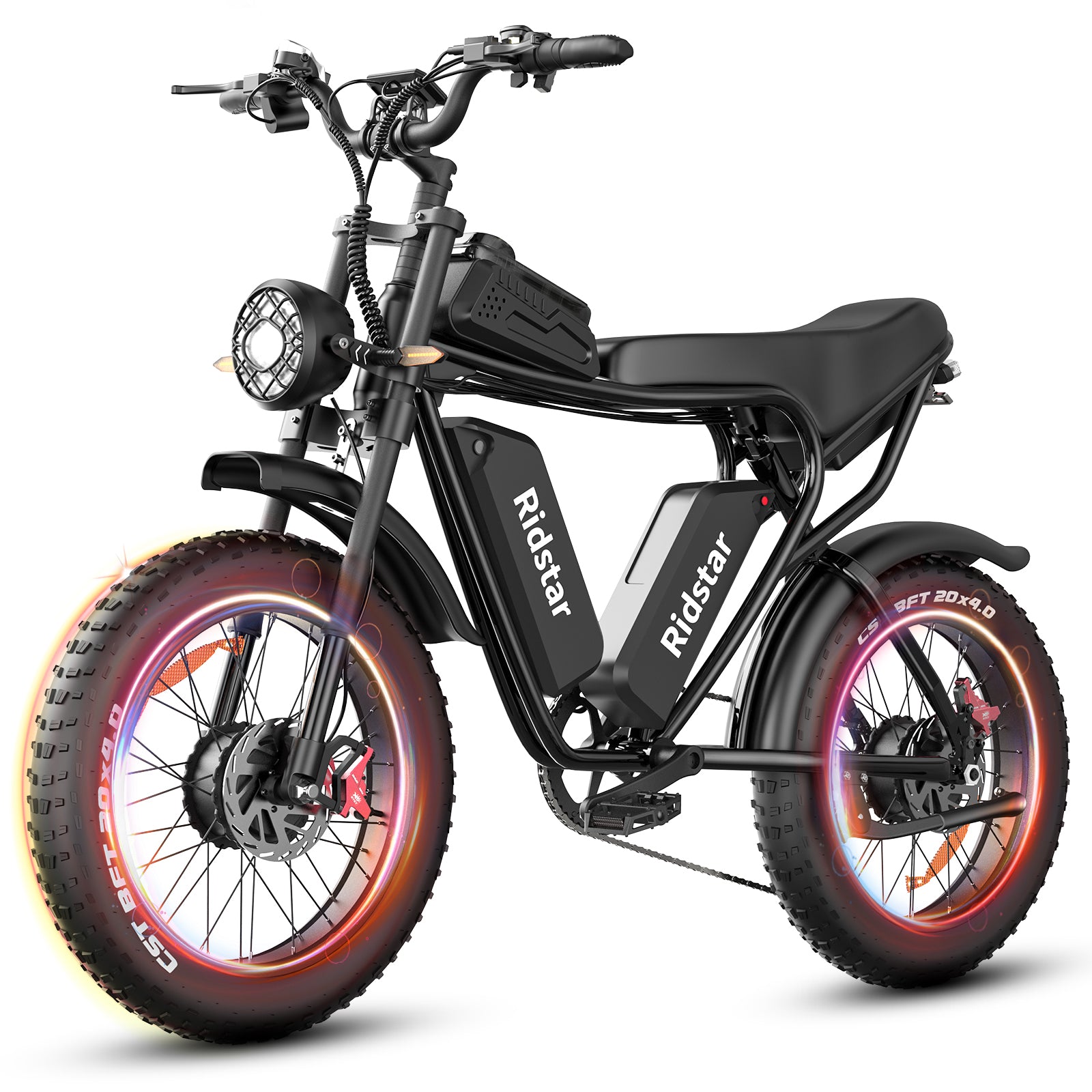
mountain
Ridstar Q30 Pro 4000W Dual Motor E-Bike
Two hub motors making a combined 4000W, two 52V 20Ah batteries totalling 2,080 Wh, hydraulic brakes and full...
Read the review
