Review · Kingbull
commuter8.3/10Kingbull Trekker Step-Through Electric City Bike
Spec-verified against the manufacturer listing
Our verdict
The Trekker is the bike to buy if you want the best hardware Kingbull sells rather than the one they advertise. It is the only model in the range with four-piston Tektro hydraulic brakes, the only one with an eight-speed drivetrain, and it carries the largest battery of the lot at 960 Wh. It is also UL 2849 certified, ships Class 2 by default, and costs $1,099, which is $100 less than the Rover 2.0 it out-specifies almost everywhere. It is the quiet pick in the range: Kingbull markets the Ranger, but this is the better-built bike.
- Best for
- Daily commuters who want hydraulic four-piston brakes and a torque sensor at close to $1,000
The listing we reviewed has been removed by the retailer. Here's the bike we'd buy instead: same class, verified in stock.

Vivi ACE07 750W Fat-Tire Step-Through
7.5/10 Amazon
The ACE07 is Vivi's most utility-shaped frame, on its biggest motor tier: a 26x4.0 fat-tire step-through with a 750W rated hub (1500W...
As an Amazon Associate I earn from qualifying purchases. Ebike Oracle may also earn a commission on links to other retailers. Full disclosure.

At a glance
Run this in our range calculator →The numbers
Kingbull Trekker Step-Through Electric City Bike is a Class 2 step-through commuter e-bike that scores 8.3/10 on our editorial rubric, last verified on August 17, 2026. It carries a $2,099 list price. It pairs a 750 W hub motor and a 960 Wh battery, good for a claimed range of up to 38 miles and assisted speeds up to 20 mph. As a Class 2 e-bike it adds a throttle while keeping assistance capped at 20 mph, which keeps it street-legal in nearly every US state without a licence or registration. The bike weighs 79 lb and is rated to carry 450 lb of rider and cargo. It best suits daily commuters who want hydraulic four-piston brakes and a torque sensor at close to $1,000.
Pros
- + Tektro HD-E3940 four-piston hydraulic brakes, the only four-piston caliper in the Kingbull range
- + 960 Wh is the largest battery Kingbull fits to any bike, and the arithmetic supports 32 to 48 real miles
- + Eight-speed Shimano drivetrain where every other model in the range gets seven
- + TROG-1B torque sensor, so assist scales with pedalling effort instead of switching on and off
- + UL 2849 certified as a system, with UL 2580 cells, which satisfies NYC, California and Colorado rules
- + Ships Class 2 at 20 mph by default and adjusts up to 28, so it is legal out of the crate in all 50 states
- + Costs $1,099, which is $100 less than the Rover 2.0 it out-specifies nearly everywhere
Cons
- - Front suspension only, so the Rover 2.0 is the more comfortable bike on genuinely rough ground
- - Advertised 80-mile range would need 12 Wh per mile, which no 79 lb fat-tyre bike achieves
- - One colourway only, Honeydew Green
- - 78.7 inches long and 79 lb, so storage and lifting both need planning
- - Saddle adjusts over only about three inches despite a stated 5'3" to 6'6" rider range
- - Brake system and tyres carry just 3 months of warranty, and the charger 6 months
- - Returns run 15 days and cost a 10% fee plus $150 freight after shipping, about $260 on this bike
Who is this for?
- Daily commuters who want hydraulic four-piston brakes and a torque sensor at close to $1,000
- Riders in NYC, California or Colorado who need a stated UL 2849 certificate for a building manager or a state or city sales rule
- Step-through buyers who want a genuinely low stand-over without dropping to a smaller battery
The 30-second verdict
Line up Kingbull's catalogue by component quality rather than by price and the Trekker comes out on top, which is not where its marketing puts it. It is the only bike in the range fitted with Tektro HD-E3940 four-piston hydraulic calipers where every other model gets two-piston ZOOM units. It is the only one with an eight-speed Shimano drivetrain rather than seven. Its 48V / 20Ah battery is 960 Wh, more than the Ranger at 864 Wh and a third more than the Rover 2.0 and Voyager 2.0 at 720 Wh. It uses a TROG-1B torque sensor, so assist scales with how hard you pedal instead of switching on and off. It runs Samsung INR21700-50G cells, it is UL 2849 certified as a complete system, and it sits on Kenda K-1188 puncture-resistant fat tyres. All of that costs $1,099, which is less than the Rover. The one real trade against the dearer Rover 2.0 is suspension: the Trekker has a lockable 80mm fork and no rear shock, so on genuinely broken ground the Rover rides better for $100 more. On road, path and gravel the Trekker is the stronger bike.
The full review, section by section. Tap any section to read it.
Why the brakes are the headline
Why the brakes are the headline
A four-piston caliper is not a marketing upgrade on a bike like this. The Trekker weighs 79 lb empty and is rated to a 450 lb maximum payload, so a fully loaded bike is over 500 lb of moving mass. Four pistons spread clamping force across a longer pad, which means more consistent bite and, more importantly, far less fade when you brake repeatedly down a long descent or in stop-start traffic. The rest of the range uses ZOOM HB-875-E two-piston calipers on the same 180mm rotors, and the Ranger does not publish its caliper at all.
The Tektro units use power-off levers, so pulling either lever cuts the motor before the pads engage. That is standard across Kingbull and it matters most on the heavier bikes. The rotors are 180mm front and rear, the same as everything else in the range, so the gain here is entirely in the caliper.
Range: 960 Wh, and the maths
Range: 960 Wh, and the maths
Kingbull advertises up to 80 miles in ideal conditions. The battery is 48V x 20Ah, so 960 Wh. A 26 x 4.0 fat-tyre bike weighing 79 lb, running a torque sensor rather than a cadence sensor, uses roughly 20 to 30 Wh per mile in ordinary commuting.
960 ÷ 25 ≈ 38 miles. The band runs from 960 ÷ 30 = 32 miles to 960 ÷ 20 = 48 miles. So 32 to 48 miles of real commuting, and the torque sensor genuinely helps at the efficient end because it stops the motor delivering full power when you only wanted a nudge. The 80-mile claim would need 12 Wh per mile, which no 79 lb fat-tyre bike achieves. What is fair to say is that 960 Wh is the largest battery Kingbull fits to anything, and 32 to 48 miles is a genuinely useful commuting range.
Class 2 by default is the quiet advantage
Class 2 by default is the quiet advantage
Every other bike in this range arrives set to Class 3. The Trekker arrives set to Class 2, capped at 20 mph, and the display lets you raise the assist ceiling anywhere from 5 to 28 mph. Throttle output stays capped at 20 mph regardless.
That default matters more than it sounds. Seven states do not recognise Class 3 at all: DC, Kentucky, Massachusetts, Montana, North Carolina, Pennsylvania and South Carolina. North Carolina changes on 1 December 2026. In those places a Class 3 bike out of the box is a bike you have to reconfigure before it is legal, and plenty of buyers never open that menu. A bike that is compliant the moment it leaves the crate, and can be raised deliberately if you move somewhere that permits it, is the right way round. The motor is rated at 750 watts, which sits at the federal ceiling in 16 CFR § 1512.2, so the wattage side is compliant everywhere except that it is exactly at the line. Check your state for the shared-use-path rules, which are separate from the class rules.
UL 2849, and why it is the reason to pay $1,099
UL 2849, and why it is the reason to pay $1,099
The Trekker is certified to UL 2849, the system-level safety standard that covers the battery, charger and controller working together rather than the cell alone. Its cells are separately certified to UL 2580 and the charger is UL-certified.
That certificate is increasingly the difference between a bike you can own and one you cannot. NYC Local Law 39 of 2023 bans the sale, lease or rental of uncertified e-bikes in the city. California SB 1271 is operative from 1 January 2026. Colorado HB 25-1197 has applied since 6 August 2025. A growing number of apartment buildings and insurers now ask for the paperwork directly. The Ranger is labelled only "UL Certificated by SGS", which is not the same claim, so if certification is a requirement where you live the Trekker is one of three Kingbulls that satisfy it.
Fit, warranty and the returns cost
Fit, warranty and the returns cost
The step-through frame is aluminium with a removable integrated battery and internal cable routing. Kingbull states a rider height range of 5'3" to 6'6", with the saddle adjustable from 33.5" to 36.6", which is a narrower adjustment span than the number suggests. Total length is 78.7", so it is a long bike to store. The rear rack is aluminium and rated to 150 lb, and the maximum payload is 450 lb.
Warranty is 2 years on motor, battery, controller, sensors, wiring and frame, dropping to 1 year on the display and fork, 6 months on the charger and 3 months on the brake system and tyres. Returns are the weak point across the whole brand: a 15-day window, and after shipping a 10% processing fee plus $150 of return freight, so roughly $260 to change your mind on this bike.
Who should buy it
Who should buy it
Buy the Trekker if you are commuting, if you want the best components Kingbull fits to anything, and if you would rather have four-piston brakes and 960 Wh than a name people recognise. It is the sensible pick in the range and the one we would ride. Buy the Ranger if $300 matters more than the sensor and the calipers, or if you want the moped styling and a passenger seat. Buy the Voyager 2.0 if you are hauling cargo rather than commuting, since its 180 lb welded rack and thumb throttle are built for that job. Buy the Rover 2.0 only if you need real rear suspension, because on every other measure the Trekker beats it for $100 less.
Frequently asked questions
Is the Kingbull Trekker UL certified?
Yes. Kingbull states the Trekker is certified to UL 2849, the system-level standard covering the battery, charger and controller together, with UL 2580 cells and a UL-certified charger. That is the certificate NYC Local Law 39 of 2023 turns on for e-bike sales, that California SB 1271 requires from 1 January 2026, and that Colorado HB 25-1197 has required since 6 August 2025. The cheaper Ranger is labelled only "UL Certificated by SGS", which is not the same claim.
What is the real range of the Kingbull Trekker?
The battery is 48V x 20Ah = 960 Wh, and a 79 lb fat-tyre bike with a torque sensor uses roughly 20 to 30 Wh per mile. 960 ÷ 25 ≈ 38 miles, with a realistic band of 32 to 48 miles. Kingbull advertises up to 80 miles, which would need 12 Wh per mile. No fat-tyre bike of this weight achieves that. Plan around 38.
What class is the Kingbull Trekker?
It ships as Class 2, capped at 20 mph, and the display lets you set the assist ceiling anywhere from 5 to 28 mph, which makes it Class 3 at the top. Throttle output stays capped at 20 mph either way. Shipping as Class 2 means it is legal out of the crate in the seven states that do not recognise Class 3: DC, Kentucky, Massachusetts, Montana, North Carolina, Pennsylvania and South Carolina. Check your state before raising it.
Should I buy the Kingbull Trekker or the Rover 2.0?
The Trekker, unless you specifically need rear suspension. It costs $100 less than the Rover 2.0 and beats it on the battery (960 Wh against 720 Wh), the brakes (four-piston Tektro against two-piston ZOOM) and the drivetrain (eight speeds against seven). The Rover's advantage is a genuine DNM rear shock plus a 100mm fork, which matters on rough trails and nowhere else. For road and path riding the Trekker is the better bike for less money.
If this isn't the one

commuter
Funhang City Cruiser 26
The most honestly specified bike on our Amazon budget shelf: 500 W rated rather than peak-only, 20 mph,...
Read the review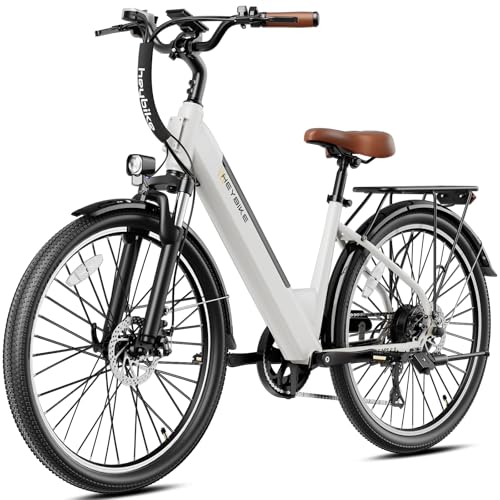
commuter
Heybike Cityscape 2.0
The Heybike Cityscape 2.0 is a value-tier Class 3 commuter on Amazon US: 1200 W peak (750 W...
Read the review
commuter
Funhang EB-C2
The Funhang EB-C2 is a Class 2 step-through commuter on paper, with a 500 W rated motor, a...
Read the review