Are E-Bikes Worth It in 2026? The Real Cost to Own
For most commuters, yes — an e-bike is one of the cheapest vehicles you can own. A full charge costs about $0.10–$0.20 (under 1¢ per mile of electricity), annual running costs land around $85–$530, and a battery lasts 3–5 years before a $300–$800 replacement. Against a car — which AAA puts at roughly $11,577 a year to own and operate...
The short version
- A full charge costs $0.10–$0.20 — under 1¢ per mile of electricity.
- All-in running costs land around $85–$530 a year, including a tune-up and consumables.
- AAA puts car ownership at roughly $11,577 a year. An e-bike that replaces car trips typically pays for itself in 6–18 months.
- Budget $300–$800 for a replacement battery at the 3–5 year mark, and price it *before* you buy.
- It is not worth it if every trip is 30+ miles each way, or you have nowhere safe to store and charge it.

Our pick for most readers
Funhang City Cruiser 26
$320
As an Amazon Associate I earn from qualifying purchases. Ebike Oracle may also earn a commission on links to other retailers. Full disclosure.
Are e-bikes worth the money?
For anyone replacing short car trips or a transit pass, an e-bike is almost always worth it, and the arithmetic is lopsided enough that it is not really a close call. The median in-stock e-bike we track costs $634.50, with half the market between $499.50 and $899.50 and a working floor at $199. Electricity runs under 1¢ per mile, a full charge is about $0.10 to $0.20, and total annual running cost lands around $85 to $530 including consumables and a tune-up. Even counting a $300 to $800 battery every three to five years, you are spending a small fraction of what a car costs: AAA puts the average new car at roughly $11,577 a year to own and operate. So a $635 median e-bike that takes over a commute typically pays for itself in three to nine months, and a $1,500 one inside eighteen. The purchase is not the risky part. The risk is buying a bike whose battery you cannot replace in three years, which is why certification and parts availability matter more than motor wattage.
It is not worth it if your trips are mostly 30+ miles each way, you have nowhere safe to store or charge it, or your climate keeps you off the bike most of the year. For everyone else, it is one of the highest-return purchases in personal transport.
The full guide, section by section. Tap any section to read it.
What does an e-bike cost upfront?
What does an e-bike cost upfront?
Sticker price by tier (2026, verified against our catalog):
| Tier | Price | What you get | Catalog example |
|---|---|---|---|
| Budget | $300–$700 | Entry commuter/folding, smaller battery — still buy UL-certified | Jasion EB5 ($199 as of Oct 5, 11:10 AM EDT, subject to change), Gotrax Nano ($341.99 as of Oct 5, 11:10 AM EDT, subject to change) |
| Mid-range | $800–$1,300 | The value sweet spot — 500 Wh+, hydraulic brakes, UL 2849 | Mid-tier spec is currently selling below its own band: the Vivi ACE01 ($689.99 as of Oct 5, 11:10 AM EDT, subject to change) and the Heybike Cityscape 2 ($479 as of Oct 5, 11:10 AM EDT, subject to change) both carry it |
| Premium / cargo | $1,000–$1,600 | Cargo/family capability, big or dual batteries, hydraulic brakes | Cyrusher Kommoda 3.0 ($1,599 as of Oct 5, 11:10 AM EDT, subject to change), the dearest bike we stock |
Good news for 2026: prices have fallen. A safe, UL-certified commuter now starts under $500, and the $800–$1,300 band gets you everything most riders need. See what an e-bike actually costs for the full price-by-price breakdown from 64 live bikes, and how to choose an e-bike for matching the spec to your use.
What does an e-bike cost to run?
What does an e-bike cost to run?
This is where e-bikes win decisively. Annual ownership cost, broken down:
| Cost | Typical amount | Notes |
|---|---|---|
| Electricity | $10–$30 / year | A full charge is ~$0.10–$0.20 at the US average ~18¢/kWh |
| Tune-ups | $100 each, 1–2× / year | Brakes, gears, bolts; casual riders need it less often |
| Wear parts | tires $30–$70 each, brake pads $15–$30 / set | Roughly yearly for daily riders |
| Battery (amortized) | ~$60–$160 / year | $300–$800 every 3–5 years |
| Total | ~$85–$530 / year | Casual riders under $200; daily commuters $400+ |
A worked example: charging for a 10-mile daily commute, 5 days a week, costs only a few dollars a year in electricity. The biggest line item over time is the battery — and good charging habits (charge to 80%, store at 40–60%) push replacement toward the 5-year end of the range. See how long e-bike batteries last.
Is an e-bike cheaper than a car per mile?
Is an e-bike cheaper than a car per mile?
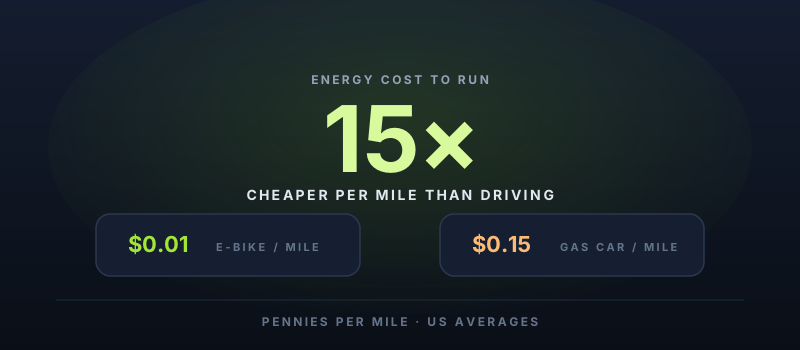
Per mile, on energy alone:
| Vehicle | Energy cost per mile | Source basis |
|---|---|---|
| E-bike | ~$0.004 (under 1¢) | ~18¢/kWh, ~15–20 Wh/mi |
| Electric car | ~$0.05 | Home charging, US average |
| Gas car | ~$0.11 | Average gas sedan, fuel only |
On energy alone an e-bike is roughly 25–30× cheaper than a gas car. But fuel is the smallest part of car ownership — insurance, registration, parking, depreciation, and maintenance dwarf it. AAA's 2025 figure of ~$11,577/year for a new car is the real comparison. An e-bike avoids nearly all of those costs.
Model your own numbers — fuel saved, electricity used, and payback — with the savings calculator, and estimate your real range with the range guide.
When is an e-bike not worth it?
When is an e-bike not worth it?
Worth it if you:
- Replace short car trips or a transit pass (the commute is the payback engine).
- Have a commute roughly under 15–20 miles each way (comfortably inside real range).
- Can store and charge it safely (ideally a UL 2849 bike indoors — see fire safety).
- Want to ride more without arriving sweaty, or need help with hills/headwinds/cargo.
Probably not worth it if you:
- Only travel 30+ miles each way (range and saddle time make it impractical).
- Have no secure, dry place to park or charge.
- Live where weather keeps you off a bike most of the year.
- Already bike comfortably and don't need assist (a regular bike is cheaper).
How does an e-bike pay you back?
How does an e-bike pay you back?
- Fuel + maintenance you stop spending on a car — the single biggest line.
- Skipping a second car entirely — insurance, registration, and depreciation avoided ($1,300–$6,000+/year in many households).
- Parking and tolls you no longer pay downtown.
- Health — replacing sedentary commutes with light exercise has real, if harder-to-price, value.
- Resale + longevity — a well-maintained, UL-certified e-bike holds value far better than a cheap uncertified one.
So should you buy one?
So should you buy one?
For commuters and errand-runners, an e-bike is one of the best-value vehicles available in 2026: pennies per mile to run, ~$85–$530 a year all-in, and payback in well under two years against a car that costs five figures annually. Buy a UL 2849-certified bike, check a replacement battery is actually on sale for it, treat the pack well, and the maths takes care of itself. You do not need to spend $1,000 to get there: the cheapest watt-hours in this market are at the bottom of it, and every sub-$500 bike we track stays inside the 750 W legal cap, which is not true of the dearer bands. If your trips are long-haul or you can't store it safely, it's the wrong tool — be honest about that before you buy.
Next: model your savings in the savings calculator, pick the right bike with how to choose an e-bike, and keep running costs low with e-bike maintenance.
The one we would buy
 Amazon
Funhang
Funhang City Cruiser 26
If the maths convinced you: this is the highest-rated bike we've reviewed, at $320. Our savings calculator will tell you how fast it pays back on your own commute.
As an Amazon Associate I earn from qualifying purchases. Ebike Oracle may also earn a commission on links to other retailers. Full disclosure.
Frequently asked questions
Are e-bikes worth the money?
For most commuters, yes. Electricity costs under 1¢ per mile, total running costs are roughly $85–$530 a year, and an e-bike that replaces car trips typically pays for itself in 6–18 months against a car AAA puts at ~$11,577/year. It is not worth it for 30+ mile commutes, riders with nowhere safe to charge, or climates that keep you off the bike most of the year.
How much does it cost to charge an e-bike?
About $0.10–$0.20 for a full charge at the US average rate of 18¢/kWh — a 500 Wh battery uses 0.5 kWh, so roughly 9¢. Over a year that is typically just $10–$30 in electricity, even for daily riders. Per mile, e-bikes cost under 1¢ in electricity ($0.004/mi).
How much does an e-bike cost per year to run?
Roughly $85–$530 a year all-in: $10–$30 electricity, $100 per tune-up (1–2× a year), wear parts (tires $30–$70 each, brake pads $15–$30 a set), and an amortized battery (~$60–$160/year). Casual riders spend under $200; daily commuters $400+.
Is an e-bike cheaper than a car?
Dramatically. On energy alone an e-bike is ~25–30× cheaper than a gas car (under 1¢/mile vs ~11¢/mile), but the bigger savings are insurance, registration, parking, and depreciation. AAA puts average new-car ownership at ~$11,577/year; an e-bike runs a few hundred. Replacing even some car trips saves $1,300–$6,000+ a year for many households.
How long until an e-bike pays for itself?
For most commuters, 6–18 months. A $1,000–$2,000 e-bike that replaces daily car trips recoups its price in fuel and maintenance savings alone within a year or two; households that drop a second car see payback even faster. Use our savings calculator to model your exact timeline.
How much does it cost to replace an e-bike battery?
Typically $300–$800 depending on size and brand, every 3–5 years. Good charging habits (charge to 80%, store at 40–60%, avoid heat) push that toward the 5-year end. Budget roughly $60–$160 a year amortized. See how long e-bike batteries last.
When is an e-bike NOT worth it?
When your trips are mostly 30+ miles each way (range and ride time make it impractical), when you have no secure, dry place to store or charge it, when weather keeps you off the bike most of the year, or when you already cycle comfortably without assist (a regular bike is cheaper). For short-to-medium commutes and errands, though, the value is hard to beat.
Do e-bikes hold their value?
Reasonably well if they are from a reputable brand, UL 2849-certified, and well maintained — those sell far better used than cheap uncertified bikes, which many buyers (and apartments/insurers) now avoid. Keeping the battery healthy and service records helps resale most.
Keep reading
Guide
Class 1 vs 2 vs 3 E-Bikes Explained (2026)
The US e-bike class system is actually simple: Class 1 is pedal-assist only at 20 mph, Class 2...
ReadGuide
Do You Need a License for an E-Bike? (2026)
In 49 states and Washington, DC you do not need a license, registration, or insurance to ride a...
ReadGuide
How to Choose an E-Bike in 2026: Buying Guide
Choosing an e-bike comes down to six decisions, in order: (1) the class (1, 2, or 3 —...
Read
Reviewed by