Review · Ridstar
mountain7.6/10Ridstar Q50 Lite 1000W Fat Tire E-Bike
Spec-verified against the manufacturer listing
Our verdict
The Q50 Lite is the same frame, tyres and suspension as the Q50 with half the motor and three-quarters of the battery, for $100 less. That sounds like a bad trade until you look at the law. 1000W is legal in Oregon and nowhere else, while 2000W is legal nowhere at all, so the Lite is the closest thing Ridstar sells to a road-legal bike, and it is the one to buy if you will ever ride it in public. The saving is not the point. The specification is.
- Best for
- Oregon riders, where a 1,000W motor is within the state definition
As an Amazon Associate I earn from qualifying purchases. Ebike Oracle may also earn a commission on links to other retailers. Full disclosure.
Not sold on this one? See every ranked pick in our guide to the best e-bikes under $600 on Amazon.

At a glance
Run this in our range calculator →The numbers
Ridstar Q50 Lite 1000W Fat Tire E-Bike is a electric mountain bike that scores 7.6/10 on our editorial rubric, last verified on August 17, 2026. Ridstar listed it at $599 as of October 1, 2026. Prices change often, so treat that as a snapshot. It pairs a 1,000 W hub motor with 70 Nm of torque and a 749 Wh battery, good for a claimed range of up to 30 miles and assisted speeds up to 28 mph. The bike weighs 82 lb and is rated to carry 330 lb of rider and cargo. It best suits oregon riders, where a 1,000W motor is within the state definition.
Pros
- + At 1000W it is legal in Oregon and only 250W over the ceiling elsewhere, the smallest legal gap in the Ridstar range
- + Advertised 30-mile electric range actually survives the arithmetic, which is rare in this segment
- + Same frame, 20 x 4.0 fat tyres, reinforced fork and rear hydraulic shock as the dearer Q50
- + 749 Wh removable battery, easy to carry indoors to charge
- + Full accessory package as standard: LCD, LED head and tail light, phone holder, storage box
- + 330 lb load rating and IP5 water resistance
Cons
- - Mechanical disc brakes, not hydraulic. The Q50 gets hydraulics for $100 more, and on an 82 lb bike that matters
- - Still over the 750W federal ceiling everywhere except Oregon
- - Advertised 60-80 mile pedal-assist range would need 9-12 Wh/mile; no fat-tyre bike does that
- - No UL 2849 / 2271 certification stated, which rules it out for NYC buyers under Local Law 39 and for buildings that ask for certification
- - 82 lb and non-folding
- - Returns cost $150 freight plus a 10% cancellation fee unless the item is defective
Who is this for?
- Oregon riders, where a 1,000W motor is within the state definition
- Buyers who want the Ridstar platform with the smallest possible legal gap
- Anyone whose riding fits inside 30 miles and who would rather carry a lighter battery indoors
The 30-second verdict
At $649 the Q50 Lite is $100 cheaper than the full-fat Q50 and gives up half the motor (1000W against 2000W) and about a fifth of the battery (749 Wh against 960 Wh). On paper that is a thin trade. In practice it is the more sensible bike, for one reason: 1000W is a number that at least one US state allows, and 2000W is not. Oregon permits 1,000W e-bikes. Every other state that has adopted the three-class system holds the line at 750W. So the Lite sits one step outside the law in most places rather than three, and in Oregon it is genuinely legal. You also give up the hydraulic brakes, because the Lite ships mechanical discs, and that is the one downgrade we would think hard about. Everything else carries over: the 20 x 4.0 fat tyres, the reinforced front fork and rear hydraulic shock, the Shimano 7-speed drivetrain, the LCD, the LED lighting, the 330 lb load rating and the removable battery.
The full review, section by section. Tap any section to read it.
1000W, and what it buys you
1000W, and what it buys you
A 1000W rear hub with around 70 Nm is roughly the output of a well-specified Class 3 commuter with headroom on top. It climbs the 35° gradient Ridstar claims with the rider working, holds speed up moderate hills without overheating, and pulls away from a stop briskly rather than violently. If you have ridden a 750W fat-tyre bike, this feels like the same bike with the ceiling lifted, which is exactly what it is.
Ridstar quotes "28+++ mph", the same phrasing it uses on the 2000W bike, and we treat it the same way: plan around 28 mph and understand that everything past it depends on rider weight, tyre pressure and gradient. The practical difference between this and the Q50 is not top speed on the flat, it is how quickly you get there and how well the motor holds up under sustained load.
Range: 749 Wh, and the maths
Range: 749 Wh, and the maths
The battery is 48V x 15.6Ah = 749 Wh. Ridstar advertises up to 30 miles in pure-electric mode and 60-80 miles in pedal-assist. A 1000W motor on fat tyres is meaningfully more efficient than the 2000W version, call it 20-28 Wh per mile.
749 Wh ÷ 24 Wh/mi ≈ 31 miles. The band runs from 749 ÷ 28 ≈ 27 miles to 749 ÷ 20 ≈ 37 miles. So 27-37 miles of mixed riding is the honest figure, and the advertised 30-mile throttle claim is, unusually, about right. The 60-80 mile pedal-assist figure is not. That would need 9-12 Wh per mile, which no fat-tyre bike achieves. Plan for 30 miles.
🔴 Legality: the one bike here where the detail matters
🔴 Legality: the one bike here where the detail matters
Federal law defines a low-speed electric bicycle as having a motor of less than 750 watts (16 CFR § 1512.2). Most states have adopted the three-class framework and kept that 750W ceiling. Oregon is the single exception: it permits e-bikes up to 1,000 watts.
That makes the Q50 Lite a genuinely different proposition depending on where you live. In Oregon, a 1000W motor is within the state definition. Everywhere else it is 250W over, a much smaller and more defensible gap than the Q50's 1,250W or the Q30 Pro's 3,250W, but still over. The assisted-speed side is a separate question. 28 mph is within Class 3 where Class 3 exists, but seven states do not recognise Class 3 at all: DC, Kentucky, Massachusetts, Montana, North Carolina, Pennsylvania and South Carolina. Check your state's page for both numbers.
If you want a bike you can ride in a bike lane without an argument, buy a 750W Class 2 or Class 3 machine. If you want the Ridstar platform and the smallest possible legal gap, this is that bike.
The brake downgrade, and whether it matters
The brake downgrade, and whether it matters
The Lite ships mechanical (cable-actuated) disc brakes where the Q50 has hydraulics. Mechanical discs need more lever effort, fade sooner under repeated hard braking, and lose bite in the wet. On an 82 lb bike that will do 28 mph, that is a real difference, and if legality is not your constraint it is the strongest argument for spending the extra $100 on the standard Q50.
Everything else is the same bike. The reinforced front fork and rear hydraulic shock are carried over, the 20 x 4.0 tyres are the same, the frame is the same, and the accessory package (LCD, phone holder, storage box, LED head and tail light) is identical. IP5 water resistance is stated, and the load rating is 330 lb.
What is missing at $599 (as of Oct 1, 8:40 AM EDT, subject to change)
What is missing at $599 (as of Oct 1, 8:40 AM EDT, subject to change)
No UL 2849 or UL 2271 certification is stated for this model. That is a live problem in a growing number of places: NYC Local Law 39 of 2023 bans the sale, lease or rental of uncertified e-bikes in the city, California SB 1271 is operative from 1 January 2026, and Colorado HB 25-1197 has applied since 6 August 2025. If your building asks for the paperwork, this bike will not satisfy it.
It is also 82 lb and does not fold, the warranty is one year on motor, battery and charger, and Ridstar charges the buyer $150 in return freight plus a 10% cancellation fee on non-defect returns. Read the return terms before ordering, not after.
Who should buy it
Who should buy it
Buy the Q50 Lite if you are in Oregon, or if you are anywhere else and want the smallest legal gap you can get on this platform. Buy it if 30 miles of range covers your riding and you would rather have a battery you can lift. Buy the Q50 instead if legality is not your constraint and you want hydraulic brakes and a bigger battery for $100 more. On pure hardware that is the better bike.
Ready to buy?
See current pricing at Ridstar
We update prices as the listing changes, and the final price is set by the retailer at checkout.
Frequently asked questions
Is a 1000W e-bike legal in the US?
Only in Oregon. Federal law defines a low-speed electric bicycle as having a motor of less than 750 watts (16 CFR § 1512.2), and nearly every state that adopted the three-class system kept that ceiling. Oregon is the single state that permits 1,000W. Everywhere else the Q50 Lite is 250W over the line, a far smaller gap than the 2000W and 4000W bikes in the same range, but a gap. Check your state.
Should I buy the Ridstar Q50 or the Q50 Lite?
On hardware, the Q50: $100 more buys you double the motor (2000W vs 1000W), a bigger battery (960 Wh vs 749 Wh) and hydraulic brakes instead of mechanical. On legality, the Lite: 1000W is permitted in Oregon and is only 250W over elsewhere, while 2000W is legal in no state at all. If you will only ever ride on private land, buy the Q50. If the bike will see public roads or paths, buy the Lite.
What is the real range of the Ridstar Q50 Lite?
The battery is 48V x 15.6Ah = 749 Wh, and a 1000W fat-tyre bike uses roughly 20-28 Wh per mile. 749 ÷ 24 ≈ 31 miles, with a realistic band of 27-37 miles. Ridstar advertises "up to 30 miles" on throttle, which is unusually honest for the segment. The 60-80 mile pedal-assist claim is not achievable. It would require 9-12 Wh per mile.
Does the Ridstar Q50 Lite have hydraulic brakes?
No. It ships mechanical (cable-actuated) disc brakes. The standard Q50 at $749 gets hydraulic calipers. Mechanical discs need more lever effort, fade under repeated hard stops and lose bite in the wet, which is worth weighing on an 82 lb bike that will reach 28 mph. It is the single most meaningful downgrade between the two models.
Bottom line
Is the Ridstar Q50 Lite 1000W Fat Tire E-Bike for you?
Check the live price + availability before deciding.
If this isn't the one

mountain
Likebike UM1
Save $50
A 20x4 fat-tyre e-bike with a 960 Wh battery, full suspension, IPX6 waterproofing and, unusually at this price,...
Read the review
mountain
ASKGO S9
The ASKGO S9 is a high-volume fat-tire e-bike that carries a 960 Wh battery for , which is...
Read the review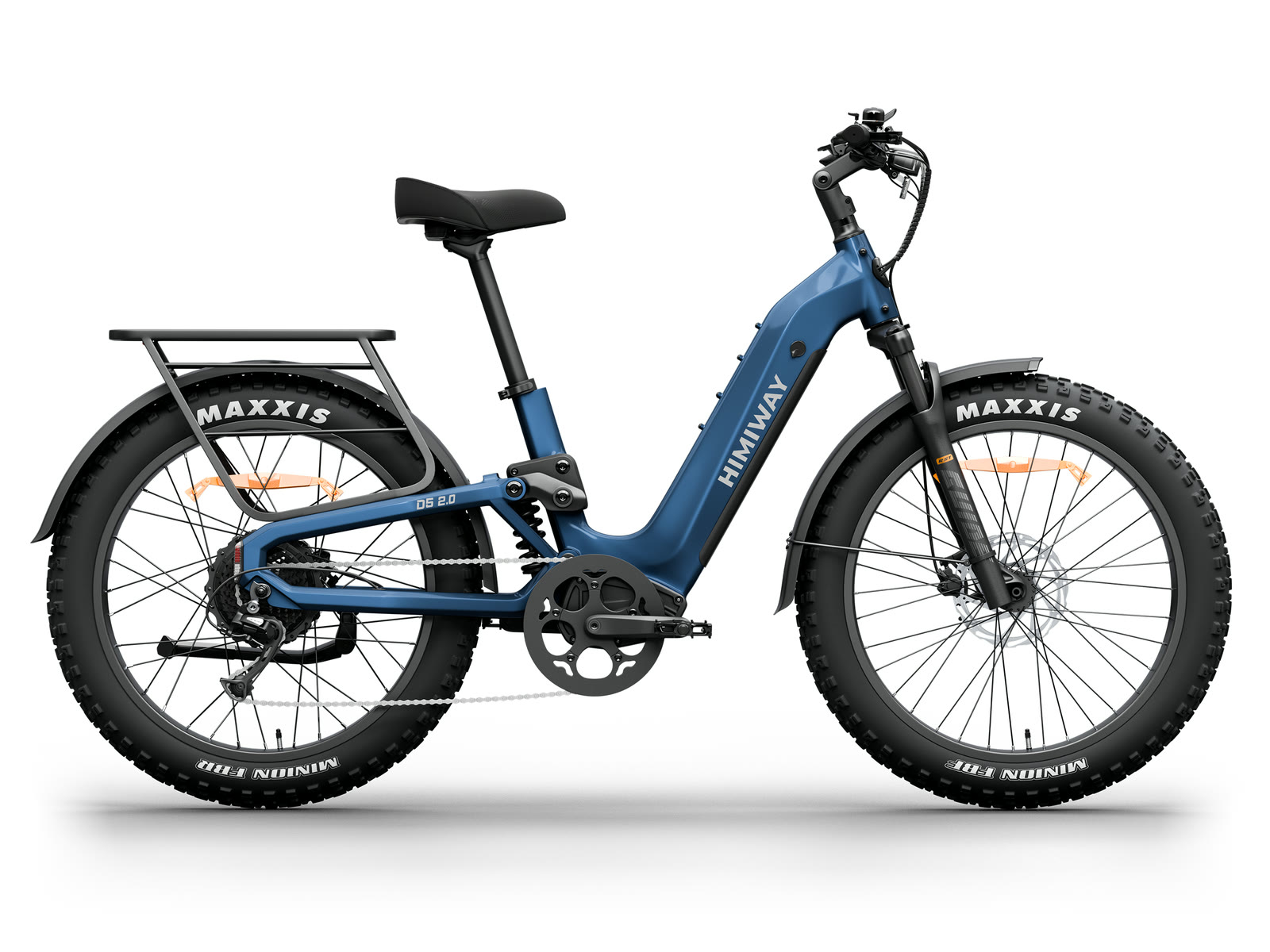
mountain
Himiway D5 2.0 Full-Suspension Fat Tire eBike
Save $400
The D5 2.0 is the rare budget-adjacent fat bike that is actually built to the class rules rather...
Read the review
