Ebike Oracle
Buyer guide

Street-Legal Electric Dirt Bikes (2026): Which Ones Actually Are

Most bikes sold as "electric dirt bikes" are not street legal anywhere in the United States, and the listings rarely say so. The line is the federal e-bike definition: a motor rated at 750 W or less and assistance that stops at 20 mph (Class 2) or 28 mph on pedal-assist (Class 3). Above that a bike is a moped...

Ranked from our scored reviews

As an Amazon Associate I earn from qualifying purchases. Ebike Oracle may also earn a commission on purchases made through links to other retailers, at no extra cost to you. Full disclosure.

Best overall

7.6/10

Best overall. A 500 W, 20 mph Class 2 with the silhouette of a small motorbike:...

Check price at Amazon

Free 30-day returns via Amazon

Compare the picks

Street-Legal Electric Dirt Bikes (2026): Which Ones Actually Are: US e-bike class and key specs for each pick, with where to buy
PickPriceClassTop speedMotor (listed)BatteryMax loadWeightFrame
#1Macfox X1S Commuter Electric BikeClass 220 mph500 W500 Wh220 lb65 lbStandard
#2Kingbull Hunter 2.0 1200W Fat-Tire Mountain E-BikeClass 328 mph750 W720 Wh330 lb76 lbStandard
#3Jasion EB5 MAX 1500W Fat-Tire Performance E-BikeClass 328 mph750 W720 Wh330 lb78 lbStandard
#4Cyrusher Kommoda 3.0Class 328 mph1500 W960 Wh350 lb83 lbStep-through
#5Macfox M16 Youth Electric BikeClass 220 mph500 W499 Wh220 lb66 lbStandard
#6Razor Rambler 16Class 216 mph350 W360 Wh220 lb56 lbStep-through

Prices are subject to change, and the buy links always fetch the live price. Motor is the figure the listing quotes, which is often a peak rather than a rated number; US e-bike classes are set on rated output. “Not stated” means neither the listing nor our review gives a figure.

Detailed picks

Macfox X1S Commuter Electric Bike
Amazon
Pick #17.6/10

Macfox X1S Commuter Electric Bike

Macfox
Check price at Amazon

Free 30-day returns via Amazon

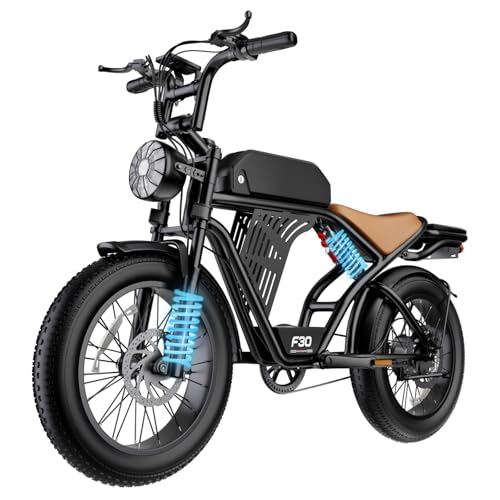
Best overall. A 500 W, 20 mph Class 2 with the silhouette of a small motorbike: 20-inch wheels, fat tires and hydraulic disc brakes, which on a 65 lb bike is the upgrade worth paying for. Our review calls it "an adult bike wearing a moped's clothes" — the look people shop this category for, attached to a class every state recognises as a bicycle. The trades are a 33-inch seat height with a 5'3" minimum rider, a single-speed drivetrain, and a 28-mile range claim that needs 17.9 Wh per mile and is optimistic.

Kingbull Hunter 2.0 1200W Fat-Tire Mountain E-Bike
Amazon
Check price at Amazon

Free 30-day returns via Amazon

Best for trail and road, and as much bike as the class system allows: 750 W rated (1200 W peak), Class 3 at 28 mph, a 720 Wh battery, hydraulic brakes, front suspension and 26x4-inch fat tires. The rated figure keeps it legal in the 49 states that cap at 750 W. Best-finished bike on this page — our review rates the welds, cable routing and component spec closer to the direct-to-consumer tier than the Amazon-import tier, with a US service team in California. 76 lb, 36-mile claim. Check your state first: Class 3 is not recognised in seven jurisdictions.

Jasion EB5 MAX 1500W Fat-Tire Performance E-Bike
Amazon
Check price at Amazon

Free 30-day returns via Amazon

Best budget pick, and the same legal position as the Kingbull for meaningfully less: 750 W rated (the 1500 W in the title is the peak), Class 3, 28 mph, 720 Wh, a 38-mile claim, 78 lb. The cheapest fast bike here that needs no registration. Finish and support sit a tier below the Kingbull, and the 1500 W peak in the product title is exactly the number that makes a buyer think the bike is illegal when the rated figure says otherwise, so keep the listing.

Cyrusher Kommoda 3.0
Amazon
Pick #47.6/10

Cyrusher Kommoda 3.0

Cyrusher
Check price at Amazon

Free 30-day returns via Amazon

Closest to a real moped. New Atlas's reviewer called it "basically an e-moped that just happens to have pedals": low step-over, upright posture, twist-grip throttle and enough motor to hold 28 mph. The largest battery in our catalogue at 960 Wh, 750 W rated / 1500 W peak, 85 Nm, hydraulic discs and front air suspension. Two cautions from its own review: 83 lb with no fold and a 350 lb payload limit, and a 1500 W peak that flirts with state class limits — the rated figure is what the statutes measure, but keep the specification sheet with the bike.

Macfox M16 Youth Electric Bike
Amazon
Pick #57.4/10

Macfox M16 Youth Electric Bike

Macfox
Check price at Amazon

Free 30-day returns via Amazon

The mini-moto shape at 20 mph Class 2, and UL 2849 certified, which most bikes in this shape are not. Macfox recommends it for riders 3'11" and up — read that against the two numbers our review leads with, because neither is the motor: a fixed 28.7-inch seat height against the roughly 21-inch inseam of a 47-inch-tall child, and mechanical disc brakes on a 65.7 lb bike. Measure your rider against the seat height first. Sound as a light adult or teen moped; the wrong shape for a seven-year-old whatever the size chart says.

Razor Rambler 16
Amazon
Pick #67.0/10

Razor Rambler 16

Razor
Check price at Amazon

Free 30-day returns via Amazon

The lowest-friction buy: the moped shape from a household US brand, fast shipping and an Amazon return policy. A 350 W Class 2 capped at about 15.5 mph, 360 Wh, a real-world 12 miles in our review, 56 lb. It is the slowest and shortest-range bike here by a wide margin and you give up both against direct-to-consumer competition at twice the price. What you buy instead is confidence, which for a first e-bike is worth more than a spec sheet.

The short answer

An electric dirt bike is street legal only if it is not, legally speaking, a dirt bike. Federal law (15 U.S.C. §2085) defines a low-speed electric bicycle as having fully operable pedals and a motor under 750 W, and states then sort those into three classes:

Class Motor helps Assistance stops at
Class 1 Only while you pedal 20 mph
Class 2 Throttle, no pedalling needed 20 mph
Class 3 Only while you pedal 28 mph

750 W is the line, and it is the RATED figure that counts, not the peak number in the product title. Most state statutes write the cap as 750 W; several (Idaho, Iowa, Maine, New Hampshire and Wyoming among them) word it as a strict "less than 750 W", so a bike sitting exactly on 750 W rated is compliant almost everywhere and worth checking in those states. Oregon alone permits 1,000 W. A bike rated above the cap, or one whose throttle pushes past 20 mph, falls out of the e-bike rules entirely and is treated as a moped or a motorcycle: registration, a plate, insurance and in most states a licence or endorsement. Class 3 is not recognised at all in seven jurisdictions — DC, Kentucky, Massachusetts, Montana, North Carolina, Pennsylvania and South Carolina — though North Carolina becomes a three-class state on 1 December 2026. Check your own state on our state law pages.

That is the whole test, and almost every "4000W electric dirt bike" on Amazon fails it by a factor of five.

Two neighbouring questions have their own pages. For the brand everyone asks about, see are Sur-Rons street legal — the short answer is no, and that page explains why a conversion almost never works. For street-legal e-bikes generally, rather than the dirt and moped shapes ranked here, see the best street-legal e-bikes.

The full guide, section by section. Tap any section to read it.

Our method in brief

A pick has to clear two tests. First, it has to look the part: this page is for people shopping for a dirt bike, a moto or a moped, not a step-through commuter. Second, it has to sit inside the US three-class system on its own listing, as recorded in its full review on this site — a motor at or under 750 W rated, and assistance stopping at 20 mph or, for Class 3, 28 mph on pedal-assist. A listing that gives only a peak figure over 750 W with no rated figure beside it fails. We did not rely on a seller's class label, or on our own catalogue's class field, because either can be wrong: several bikes here carry a peak figure in the product title that is double the rated one. Every pick was in stock at our last check. We have not ridden any of these bikes — every figure is the seller's claim or our arithmetic on it. Prices move constantly, so the buy buttons always fetch the live number.

TL;DR: six that stay legal

  1. Macfox X1S, $1,399 at our last check. Best overall. A 500 W, 20 mph Class 2 with hydraulic disc brakes on 20-inch wheels. Its own review calls it "an adult bike wearing a moped's clothes".
  2. Kingbull Hunter 2.0, $899 at our last check. Best for trail and road. 750 W rated (1200 W peak), Class 3, 28 mph, 720 Wh, hydraulic brakes, 26x4-inch fat tires.
  3. Jasion EB5 MAX, $549 at our last check. Best budget pick. The same legal position as the Kingbull — 750 W rated, Class 3, 28 mph, 720 Wh — for a lot less money.
  4. Cyrusher Kommoda 3.0, $1,599 at our last check. Closest to a real moped. 750 W rated (1500 W peak), 960 Wh, full suspension, twist throttle, 28 mph.
  5. Macfox M16, $1,099 at our last check. The mini-moto shape, UL 2849 certified, Class 2 at 20 mph. Check the 28.7-inch fixed seat height before anything else.
  6. Razor Rambler 16, $588.99 at our last check. Best-known brand, lowest friction. A 350 W Class 2 moped shape capped at about 15.5 mph, from a household US name.

The six, side by side

Bike Motor, as the listing states it Class Assistance stops at Battery
Macfox X1S 500 W Class 2 20 mph 500 Wh
Kingbull Hunter 2.0 750 W rated, 1200 W peak Class 3 28 mph 720 Wh
Jasion EB5 MAX 750 W rated, 1500 W peak Class 3 28 mph 720 Wh
Cyrusher Kommoda 3.0 750 W rated, 1500 W peak Class 3 28 mph 960 Wh
Macfox M16 500 W Class 2 20 mph 499 Wh
Razor Rambler 16 350 W Class 2 about 15.5 mph 360 Wh

Which one should you buy?

1. Macfox X1S: best overall

The X1S is the cleanest answer on this page to "I want a moped and I do not want paperwork". It is a 500 W, 20 mph Class 2 — a bicycle in every state — with the silhouette of a small motorbike: 20-inch wheels, a long saddle, fat tires and hydraulic disc brakes, which on a 65 lb bike is the upgrade worth paying for. Our review of it is blunt about what it is: "an adult bike wearing a moped's clothes".

The trades are real. The seat height is 33 inches and Macfox sets a 5'3" minimum rider, so it does not fit everyone. It is single-speed, so you are riding the motor, not the gearing. And the 28-mile range claim needs 17.9 Wh per mile from the ~500 Wh pack, which our review calls optimistic — plan on less. At $1,399 it is the most expensive pick here, and it is the one you buy when the look matters and the registration paperwork must not. Read the full Macfox X1S review.

2. Kingbull Hunter 2.0: best for trail and road

If you want the legal ceiling rather than the moped look, this is it: 750 W rated / 1200 W peak, Class 3 at 28 mph, a 720 Wh battery, hydraulic brakes, front suspension and 26x4-inch fat tires. That is as much bike as the class system allows, and the rated figure keeps it inside the federal definition in all 49 states that cap at 750 W.

It is also the best-finished bike on this page. Our review rates Kingbull's frame welds, cable routing and component spec closer to the direct-to-consumer tier than the Amazon-import tier, and there is a real US service team in California rather than an Amazon-only badge. It weighs 76 lb and the claimed range is 36 miles. The one thing to check first is your own state: Class 3 is not recognised in seven jurisdictions, so in DC, Kentucky, Massachusetts, Montana, Pennsylvania or South Carolina you would be riding it limited to 20 mph. At $899 it is the best value on the page. Read the full Kingbull Hunter 2.0 review.

3. Jasion EB5 MAX: best budget pick

The EB5 MAX holds the same legal position as the Kingbull — 750 W rated (the 1500 W in the title is the peak), Class 3, 28 mph, 720 Wh — for meaningfully less money. Its claimed range is 38 miles and it weighs 78 lb. If the question is "what is the cheapest fast bike I can ride on the road without registering it", this is the answer on this page.

You are paying less for a reason: the finish and the support are a tier below the Kingbull, and the 1500 W peak in the product title is exactly the kind of number that makes a buyer think the bike is illegal when the rated figure says otherwise. Keep the listing. At $549 it is the budget pick. Read the full Jasion EB5 MAX review.

4. Cyrusher Kommoda 3.0: closest to a real moped

New Atlas's reviewer described the Kommoda as "basically an e-moped that just happens to have pedals", and that is the right framing: a low step-over, an upright riding position, a twist-grip throttle and enough motor to hold 28 mph. It carries the largest battery in our catalogue at 960 Wh, runs 750 W rated / 1500 W peak with 85 Nm of torque, and has hydraulic disc brakes and front air suspension.

Two cautions, both from its own review. It weighs 83 lb and does not fold, with a 350 lb payload limit. And the 1500 W peak flirts with state e-bike class limits — the rated figure is what the statutes measure, but a peak that high is the sort of number an officer reads off a sticker, so keep the specification sheet with the bike. At $1,599 it is the most expensive way to get the moped experience legally. Read the full Cyrusher Kommoda 3.0 review.

5. Macfox M16: the mini-moto shape

The M16 is the small-moto silhouette at 20 mph, Class 2, and it is UL 2849 certified, which most bikes in this shape are not. Macfox recommends it for riders 3'11" and up.

Read that recommendation against the two numbers our review leads with, because they decide the purchase and neither is the motor. The seat height is a fixed 28.7 inches against the roughly 21-inch inseam of a 47-inch-tall child, and it has mechanical disc brakes on a 65.7 lb bike. Measure your rider against the seat height before you consider anything else on the spec sheet. As a light adult or teen moped at $1,099 it is sound; as a bike for a seven-year-old it is the wrong shape whatever the size chart says. Read the full Macfox M16 review.

6. Razor Rambler 16: the lowest-friction buy

The Rambler is the moped shape from a household US brand, and that is most of its value: it ships fast, it is returnable through Amazon, and Razor has been making powered two-wheelers for decades. It is a 350 W Class 2 capped at about 15.5 mph, with a 360 Wh battery and a real-world range our review puts at 12 miles, at 56 lb.

It is the slowest and shortest-range bike on this page by a wide margin, and against direct-to-consumer competition at twice the price you are giving up both. What you buy instead is confidence: a name you recognise and a return policy that works, which for a first e-bike is worth more than a spec sheet. At $588.99 it is the lowest-risk way in. Read the full Razor Rambler 16 review.

What is NOT street legal, including bikes we sell

We review and earn commission on the bikes below. Not one of them is a street-legal e-bike in any US state, and we would rather say so here than let a listing imply otherwise. Amazon shelves several of them under "Electric Road Bikes", which is a categorisation error, not a legal opinion.

Bike What it claims Why it fails
GAMVIRE V7 PRO 6000 W peak, 47 mph Faster than most state moped ceilings; heads toward motorcycle rules
ASKGO Dirt 5500 5500 W peak, 40 mph 40 mph is not a bicycle in any US state
Ridstar Q30 Pro 4000 W, 38 mph Outside every US class by roughly five times on power
ASKGO S9 2500 W peak; 36 mph in the bullets, 28 mph in the title Either figure fails once the throttle is added
Xathquia Dirt 20 2500 W peak, 36 mph 36 mph is outside the class system

This does not mean you cannot buy one. It means you cannot ride it on a public road, bike lane or multi-use path as an e-bike. Private land, and trails that explicitly permit motorised use, are where these belong. If you ride one on the street, you are riding an unregistered motor vehicle: the exposure is not a ticket so much as your insurer declining a claim. Our e-bikes to avoid guide covers the wider version of this problem, including recalls and certification gaps.

The tell to look for. A product title that advertises a big peak wattage and a speed over 28 mph, with no rated figure anywhere on the page, is a bike outside the class system. When a rated figure at or under 750 W does appear next to the peak — as on the Kingbull, the Jasion and the Cyrusher above — the bike is legal and the peak is marketing.

Where you can ride a legal one

Clearing the class test settles registration, not access. A Class 2 is allowed on roads and bike lanes almost everywhere and on most multi-use paths. Class 3 is the one to check: many states keep it off shared-use paths by default, and it carries helmet and 16-plus age rules in far more states than Class 2 does. Natural-surface trails are a separate question again, usually decided by the land manager rather than the state.

Our Ride Check tool answers this for a specific bike in a specific state across five riding surfaces, and the state law pages carry the statute citations behind each answer.

Also considered

Near misses, and the reason each one missed. Where a mention is the better buy for a specific rider, it says so.

  • GAMVIRE V7 PRO 6000W Dual Motor Fat Tire E-Bike product photo

    Not street legal, and listed here so nobody buys it by mistake. A dual-motor fat-tire bike claiming 6000 W peak and 47 mph with a 1,664 Wh pack, at $999 checked. At 47 mph it is not a Class 1, 2 or 3 e-bike in any US state, and it is faster than the ceiling most states put on mopeds, which pushes it toward motorcycle rules: registration, insurance and an endorsement. The hardware is genuinely remarkable for the money. Buy it for private land or motorised trails, not to ride to work.

  • ASKGO Dirt 5500 product photo

    Not street legal. A 5500 W peak, 40 mph dirt bike with a 1,440 Wh pack, hydraulic rear brake, 7-speed drivetrain and a three-year warranty at $599.99 checked. As off-road hardware per dollar it is remarkable; as an e-bike it does not exist, because 40 mph is not a bicycle in any US state. Amazon shelving it under Electric Road Bikes is a categorisation error, not a legal opinion.

  • Ridstar Q30 Pro 4000W Dual Motor E-Bike product photo

    Ridstar Q30 Pro 4000W Dual Motor E-Bike

    $1,269as of Sep 13, 5:40 AM EDT

    Not street legal. Two hub motors making a combined 4000 W, two 52V packs totalling 2,080 Wh, hydraulic brakes and full suspension at $1,269 (as of Sep 13, 5:40 AM EDT, subject to change). On raw specification nothing near the price comes close: this is a small electric motorcycle with pedals attached, and 4000 W with a marketed 38 mph puts it outside every US class by roughly five times on power. Buy it for private land or motorised trails with your eyes open.

  • ASKGO S9 product photo

    ASKGO S9

    $499.99

    Not street legal, and its own listing cannot agree with itself: 36 mph in the bullets, 28 mph in the title. A 960 Wh battery for $499.99 checked is roughly double the pack most bikes at this price ship with, on 20x4 tires with a 2500 W peak motor. Either speed figure puts it outside the US three-class system once you add the throttle. A fast private-land and trail bike, not a compliant commuter.

  • Xathquia Dirt 20 product photo

    Not street legal. A 2500 W peak dirt-style bike with a 1,104 Wh battery, full suspension, NFC and password keyless start and cruise control at $529.99 checked. The battery is among the largest in its batch and the 100-mile claim is one of the few big range numbers that is arithmetically defensible. At 36 mph it is not a bicycle under US law.

Frequently asked questions

Are electric dirt bikes street legal?

Almost never as sold. An electric dirt bike is street legal only if it meets the e-bike definition: fully operable pedals, a motor rated at 750 W or less (1,000 W in Oregon), and assistance that stops at 20 mph or, on pedal-assist Class 3, 28 mph. Most bikes marketed as electric dirt bikes are 2,000-6,000 W and 35-47 mph, which puts them outside every US class. Those are mopeds or motorcycles in the eyes of the law, needing registration, a plate, insurance and usually a licence. Six bikes on this page have the dirt or moped look and stay inside the e-bike definition, starting with the Macfox X1S.

What is the fastest street-legal electric dirt bike?

28 mph is the ceiling, and that is Class 3 on pedal-assist only. On this page the Kingbull Hunter 2.0, Jasion EB5 MAX and Cyrusher Kommoda 3.0 all reach it with a 750 W rated motor. Nothing legal goes faster: a throttle that works above 20 mph, or a motor rated over 750 W, takes a bike out of the e-bike rules whatever its top speed. Be careful with "fastest" lists — they are usually ranking bikes that are not street legal at all. Class 3 is also not recognised in seven jurisdictions, so check the Class 3 laws by state page.

Do you need a licence for an electric dirt bike?

For a compliant e-bike, no — in 48 states a Class 1, 2 or 3 e-bike needs no licence and no registration. New Jersey is the exception that now requires a licence and MVC registration for every e-bike, and Hawaii requires a one-time registration. For a non-compliant electric dirt bike — anything rated over 750 W or assisting past 28 mph — yes: it is a moped or a motorcycle, so expect registration, a plate, insurance and a licence or endorsement, and expect it to be refused registration if it was never built to meet federal motor vehicle standards. Check your own state on our state law pages.

Can you ride an electric dirt bike on the road?

Only if it is inside the e-bike classes. A Class 2 like the Macfox X1S rides on roads and bike lanes almost everywhere with no paperwork. A Class 3 rides on roads everywhere it is recognised, but many states keep it off shared-use paths and add helmet and 16-plus rules. A 4,000 W, 38 mph machine like the Ridstar Q30 Pro is an unregistered motor vehicle on a public road, and the real exposure is not the ticket, it is your insurer declining a claim. Our Ride Check tool answers this for a specific bike in a specific state.

Is a 2000W ebike street legal?

It depends entirely on whether 2000 W is the rated figure or the peak figure, and the listing often will not say. Rated is what the motor sustains and is what the statutes measure; peak is a brief surge. A bike rated 750 W that peaks at 2000 W is legal. A bike rated at 2000 W is not, in any state but Oregon (which allows 1,000 W). The tell: if the page advertises a big peak wattage and a speed above 28 mph with no rated figure anywhere, treat it as outside the class system. Ask the seller for the rated wattage in writing before you buy.

What is the difference between an electric dirt bike and an e-bike?

Legally, pedals and power. An e-bike has fully operable pedals and a motor under 750 W that stops assisting at 20 or 28 mph; it is a bicycle. An electric dirt bike usually has neither limit and often no useful pedals, so it is a motor vehicle. The confusion is deliberate on some listings: fitting token pedals to a 4,000 W machine does not make it a bicycle, because the power and speed caps still apply. A useful shorthand is that if the bike would be embarrassing to pedal home with a flat battery, it is probably not an e-bike.

Where can I ride a non-street-legal electric dirt bike?

Private land with the owner's permission, and trails or OHV areas that explicitly permit motorised use. Those are usually managed by a state OHV programme, the Bureau of Land Management or the Forest Service, and many require the machine to be registered as an off-highway vehicle with a sticker, plus a spark arrestor and a sound limit. Multi-use paths and rail trails are not motorised use, and neither are most national park trails. Check the land manager's own rules rather than the state vehicle code, because access is their decision.

Reviewed by

John Weeks
Founder and editor