Review · Ridstar
folding7.0/10Ridstar H20 1000W Folding Fat Tire E-Bike
Spec-verified against the manufacturer listing
Our verdict
At $600 (as of Oct 1, 11:46 AM EDT, subject to change) the H20 is the cheapest bike Ridstar sells to a US buyer, and it is a lot of hardware for the money: a folding aluminium frame, 20 x 4.0 fat tyres, front and rear suspension, a 720 Wh removable battery and a Shimano 7-speed drivetrain. The catch is that Ridstar's own listing states two different motor outputs in the same sentence, 1000W and 1500W, and those two numbers sit on opposite sides of Oregon's legal ceiling. Ask before you order.
- Best for
- Buyers with a hard $600 (as of Oct 1, 11:46 AM EDT, subject to change) ceiling who want a folding fat-tyre bike rather than a rigid one
As an Amazon Associate I earn from qualifying purchases. Ebike Oracle may also earn a commission on links to other retailers. Full disclosure.
Not sold on this one? See every ranked pick in our guide to the best e-bikes under $600 on Amazon.

At a glance
Run this in our range calculator →The numbers
Ridstar H20 1000W Folding Fat Tire E-Bike is a folding e-bike that scores 7.0/10 on our editorial rubric, last verified on August 17, 2026. Ridstar listed it at $600 as of October 1, 2026. Prices change often, so treat that as a snapshot. It pairs a 1,000 W hub motor and a 720 Wh battery, good for a claimed range of up to 30 miles and assisted speeds up to 28 mph. The bike is rated to carry 330 lb of rider and cargo. It best suits buyers with a hard $600 (as of Oct 1, 11:46 AM EDT, subject to change) ceiling who want a folding fat-tyre bike rather than a rigid one.
Pros
- + The cheapest bike Ridstar sells to a US buyer at $600 (as of Oct 1, 11:46 AM EDT, subject to change), with a folding aluminium frame included
- + 720 Wh removable battery, so you carry the pack indoors rather than the bike
- + Front and rear suspension with a lockable, preload-adjustable fork
- + Advertised 35-mile throttle range is roughly defensible against the arithmetic
- + Shimano 7-speed drivetrain, 330 lb load rating, LCD, lighting and a horn as standard
- + Ships 90% assembled with a stated one-year parts replacement policy
Cons
- - The listing states 1000W and 1500W in the same sentence, and those land on opposite sides of Oregon's legal ceiling
- - It also names both "dual disc brakes" and "dual hydraulic disc brakes", so the braking hardware is unconfirmed
- - Even at 1000W it is legal only in Oregon; every other state caps at 750W
- - Advertised 60-mile pedal-assist range would need 12 Wh per mile, which fat tyres cannot do
- - No UL 2849 or UL 2271 certification stated, which rules it out for NYC buyers under Local Law 39 and for buildings that ask for certification
- - No published weight or folded dimensions, and $210 to send it back if you change your mind
Who is this for?
- Buyers with a hard $600 (as of Oct 1, 11:46 AM EDT, subject to change) ceiling who want a folding fat-tyre bike rather than a rigid one
- Flat and apartment dwellers who need the battery to come indoors separately from the bike
- Oregon riders, where a 1,000W rated motor is within the state definition
The 30-second verdict
The H20 is Ridstar's entry price in the United States and it undercuts almost everything comparable. Six hundred dollars buys a 6061 aluminium folding frame, 20 x 4.0 fat tyres, lockable and adjustable front suspension with a rear shock, a 48V 15Ah battery that works out to 720 Wh, a Shimano 7-speed drivetrain, dual disc brakes, a 330 lb load rating, an LCD, a headlight, a brake light and a horn. Ridstar ships it 90% assembled and states a 4-6 hour charge. It is genuinely good value, and there is one thing wrong with it that no amount of hardware compensates for. The listing does not tell you what motor is in the bike. That is worth taking seriously rather than glossing over, because on this particular bike the difference decides where you may legally ride it.
The full review, section by section. Tap any section to read it.
🔴 The motor: 1000W or 1500W?
🔴 The motor: 1000W or 1500W?
The first bullet on Ridstar's product page reads, verbatim: "Our adult electric bike has a 1000W (1500W) motor and a 48V 15Ah removable battery." Both figures appear in the same sentence, the second in bold. Elsewhere on the page the copy settles on "1000W Powerful Motor" and a "1000W motor and a 48V 15Ah removable battery". The rest of the listing never resolves it.
The usual explanation for a pair like that is rated against peak: a motor rated at 1000W continuous can often peak near 1500W under load. If that is what Ridstar means, the number that matters legally is 1000W, because statutes regulate rated output, not peak. But Ridstar does not say that, and a buyer reading the page has no way to know which figure is which.
The practical consequence is sharp. 1000W is legal in Oregon and nowhere else. 1500W is legal in no US state at all. Those two numbers land on opposite sides of the only state ceiling in the country that this bike could possibly sit under. Before ordering, email support@ridstar.net and ask for the rated continuous wattage in writing. Keep the reply.
Range: 720 Wh, and the arithmetic
Range: 720 Wh, and the arithmetic
The battery is 48V x 15Ah = 720 Wh. A 20 x 4.0 fat-tyre bike at this power uses roughly 20-30 Wh per mile.
720 Wh ÷ 25 Wh/mi ≈ 29 miles. The honest band runs from 720 ÷ 30 = 24 miles of hard throttle riding to 720 ÷ 20 = 36 miles ridden gently. Ridstar advertises 35 miles on throttle and up to 60 miles on pedal assist. The throttle figure sits at the optimistic edge of the arithmetic and is roughly defensible. The 60-mile pedal-assist claim needs 12 Wh per mile, which fat tyres do not deliver. Plan for 28 miles and treat anything past 35 as a good day.
The pack is removable, which is the feature that makes a folding bike liveable in a flat: you carry 720 Wh upstairs rather than the whole bike.
🔴 Legality: even the smaller number is over the line
🔴 Legality: even the smaller number is over the line
Federal law defines a low-speed electric bicycle as a two- or three-wheeled vehicle with fully operable pedals and a motor of less than 750 watts (16 CFR § 1512.2). Most states adopting the three-class framework kept that ceiling. Oregon is the single state that permits 1,000 watts.
So on the 1000W reading, the H20 is legal in Oregon and 250W over everywhere else, which is the smallest gap available on a Ridstar bike other than the Q50 Lite. On the 1500W reading it is over the line in all fifty states. This is why the question above is not pedantry.
The speed side is separate. Ridstar quotes "28++ mph". Class 3 caps assisted speed at 28 mph where states recognise it, and seven do not recognise Class 3 at all: DC, Kentucky, Massachusetts, Montana, North Carolina, Pennsylvania and South Carolina. Check your state for both the wattage and the speed rules.
Brakes and suspension: another thing the listing cannot settle
Brakes and suspension: another thing the listing cannot settle
One bullet says "Reliable dual disc brakes". A later paragraph says "The dual hydraulic disc brake system ensures quick and smooth stops". Those are different components at different prices, and again the listing does not resolve which is fitted. At $600, cable-actuated discs would be the ordinary expectation, and the dearer H20 Pro explicitly names hydraulics as one of its upgrades. Assume mechanical unless Ridstar confirms otherwise, and add it to the same email.
Suspension is better documented: a lockable and adjustable front fork with a rear shock, described as a full-suspension arrangement. Locking the fork on tarmac is worth doing, since throttle bob on a heavy fat bike wastes both comfort and battery.
The fold, and what it is for
The fold, and what it is for
The frame folds at the down tube and the stem drops. Ridstar publishes no folded dimensions and no weight for this model, so measure your space against a 20 x 4.0 wheelbase before assuming it fits a car boot. Bikes of this type usually land between 60 and 70 lb, which makes the fold a storage feature rather than a portability one. Ridstar recommends riders between 5'3" and 6'3".
What is missing at $600 (as of Oct 1, 11:46 AM EDT, subject to change)
What is missing at $600 (as of Oct 1, 11:46 AM EDT, subject to change)
No UL 2849 or UL 2271 certification is stated. That matters where it is now written into law: NYC Local Law 39 of 2023 bans the sale, lease or rental of uncertified e-bikes in the city, California SB 1271 is operative from 1 January 2026, and Colorado HB 25-1197 has applied since 6 August 2025.
The warranty is one year, and Ridstar states a year of free replacement parts. Non-defect returns cost $150 in freight plus a 10% cancellation fee, which on a bike at $600 (as of Oct 1, 11:46 AM EDT, subject to change) is $210 to change your mind. On a purchase this cheap that return policy is a bigger share of the price than it looks.
Who should buy it
Who should buy it
Buy the H20 if $600 is your ceiling, you want a folding fat-tyre bike with a removable battery, and you have emailed Ridstar and had the rated wattage confirmed. Buy the H20 Pro at $799 if you can stretch, because $199 buys a second motor, 1,104 Wh instead of 720, and hydraulic brakes that are actually named as such. Buy the Q50 Lite if you want the clearest legal position Ridstar offers.
Ready to buy?
See current pricing at Ridstar
We update prices as the listing changes, and the final price is set by the retailer at checkout.
Frequently asked questions
Is the Ridstar H20 a 1000W or a 1500W bike?
Ridstar's listing says both. The opening bullet reads "a 1000W (1500W) motor", with the second figure in bold, and the rest of the page settles on 1000W without ever resolving the pair. The usual reading is 1000W rated and 1500W peak, and statutes regulate rated output, not peak, but Ridstar does not say so. Email support@ridstar.net for the rated continuous figure in writing before ordering, because 1000W is legal in Oregon and 1500W is legal in no state at all.
Is the Ridstar H20 street legal?
Only possibly, and only in one state. Federal law caps a low-speed electric bicycle at less than 750 watts (16 CFR § 1512.2). Oregon is the single state permitting 1,000W, so on the 1000W reading the H20 is legal there and 250W over everywhere else. On the 1500W reading it is outside the definition in all fifty states. Confirm the rated figure with Ridstar first, then check your state.
What is the real range of the Ridstar H20?
The battery is 48V x 15Ah = 720 Wh, and a 20 x 4.0 fat-tyre bike at this power uses roughly 20-30 Wh per mile. 720 ÷ 25 ≈ 29 miles, with an honest band of 24-36 miles. Ridstar advertises 35 miles on throttle, which sits at the optimistic edge but is defensible. The 60-mile pedal-assist claim would need 12 Wh per mile and is not achievable on fat tyres.
Does the Ridstar H20 have hydraulic brakes?
The listing is not consistent. One bullet says "dual disc brakes" and a later paragraph says "dual hydraulic disc brake system". At $600, cable-actuated discs are the ordinary expectation, and the dearer H20 Pro names hydraulics explicitly as an upgrade. Assume mechanical unless Ridstar confirms otherwise in writing.
Ridstar H20 or H20 Pro?
The H20 Pro costs $199 more at $799 and adds a second hub motor for two-wheel drive, a 1,104 Wh battery instead of 720 Wh, hydraulic brakes that are explicitly named, and turn signals. The H20 is the cheaper folding frame with one motor. If the extra $199 is available, the Pro is the better bike by a wide margin. If it is not, the H20 is still a lot of hardware at $600.
Bottom line
Is the Ridstar H20 1000W Folding Fat Tire E-Bike for you?
Check the live price + availability before deciding.
If this isn't the one

folding
URLIFE Mini 14
Save $14
The URLIFE Mini 14, #3 in Amazon's Electric Folding Bikes (September 2026), is a 14-inch mini that costs...
Read the review
folding
Askmy Mini 14
A 14-inch folding e-bike at carrying a stated 480 Wh, in line with the better-equipped 14-inch minis we...
Read the review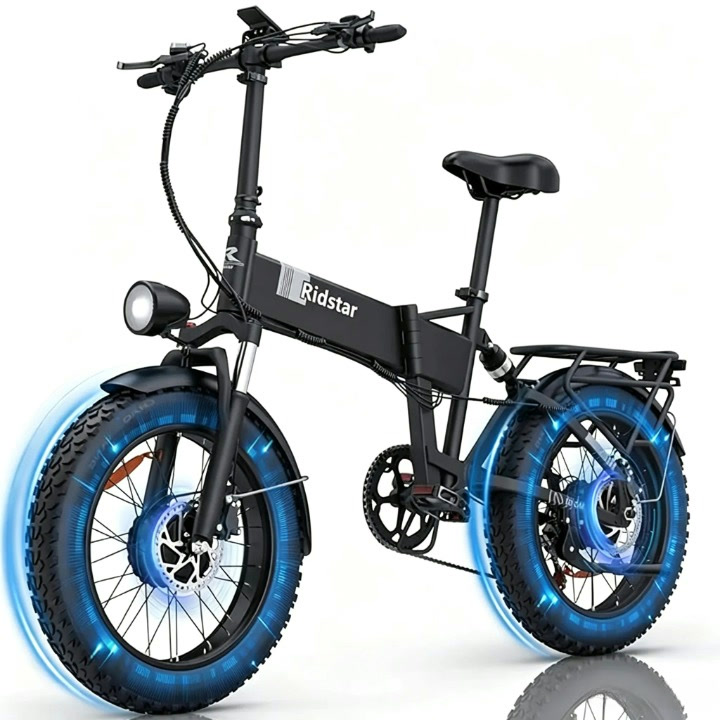
folding
Ridstar H20 Pro 2000W Folding Fat Tire E-Bike
Save $1,201
Two hub motors, a 1,104 Wh battery, hydraulic brakes at both ends, front and rear suspension and a...
Read the review
