Review · QNUT
commuter6.4/10QNUT Victor 4.0
Spec-verified against the manufacturer listing

Our verdict
The QNUT Victor 4.0 puts a full-size 26-inch, 20 mph steel e-bike within reach at $229.99 (as of Oct 30, 8:10 AM EDT, subject to change), with seven gears, a front suspension fork, front and rear disc brakes and a removable battery. The catch is a small 281 Wh battery: plan on about 15 miles a charge, not the 40 the listing claims. Its paperwork is thin too. Amazon quotes a 1000 W peak motor while QNUT's own site says 350 W, neither labels a rated figure, and the UL 2849 claim names no laboratory. For a short, flat commute on a tight budget it is a reasonable buy.
- Best for
- Budget buyers who want a full-size 26-inch e-bike with gears
Save $40down from $270 at Amazon
As an Amazon Associate I earn from qualifying purchases. Ebike Oracle may also earn a commission on links to other retailers. Full disclosure.
Free 30-day returns via Amazon
Not sold on this one? See every ranked pick in our guide to the best e-bikes under $300 on Amazon.
At a glance
Run this in our range calculator →The numbers
QNUT Victor 4.0 is a commuter e-bike that scores 6.4/10 on our editorial rubric, last verified on October 28, 2026. Amazon listed it at $229.99 as of October 30, 2026. Prices change often, so treat that as a snapshot. On Amazon it currently ranks #20 Best Seller in Electric Mountain Bikes. It pairs a 281 Wh battery, good for a claimed range of up to 15 miles and assisted speeds up to 20 mph. The bike is rated to carry 308 lb of rider and cargo. It best suits budget buyers who want a full-size 26-inch e-bike with gears.
Pros
- + Full-size 26-inch steel frame with 1x7 gearing, a front suspension fork and front and rear mechanical disc brakes
- + Removable 36 V battery you can carry indoors to charge
- + States a 20 mph top speed, the Class 2 ceiling, and a 308 lb (140 kg) maximum rider weight
- + QNUT's warranty covers the frame and fork for the original owner's lifetime, plus one year on battery, motor, controller and display
- + Listing states UL 2849 and IP54 water resistance
Cons
- - Small 281 Wh battery: plan on about 15 miles a charge, not the 40 claimed
- - Motor figures disagree (1000 W peak on Amazon, 350 W on QNUT's site) and no rated figure is labelled, so no class can be confirmed
- - The UL 2849 claim names no laboratory or certificate number, and QNUT's own product page does not mention it
- - Owner and video reports summarised by BikeRide: throttle works only once rolling, delayed assist, rough fork, puncture-prone tires, early battery or motor failures
- - No published bike weight, and no fenders or rack listed
Who is this for?
- Budget buyers who want a full-size 26-inch e-bike with gears
- Short, flat commutes of a few miles each way
- Riders who need to take the battery indoors to charge
The 30-second verdict
The QNUT Victor 4.0 is a full-size e-bike with gears at a budget price: a 26-inch steel frame, a seven-speed derailleur, a front suspension fork, front and rear mechanical disc brakes, a removable 36 V battery and a 20 mph top speed, for $229.99 (as of Oct 30, 8:10 AM EDT, subject to change). The catch is the battery. At 36 V and 7.8 Ah it holds about 281 Wh, so plan on roughly 15 miles a charge rather than the 40 the listing claims, which suits a short, flat commute and not much more. The paperwork has gaps as well. The Amazon listing quotes a 1000 W peak motor while QNUT's own site says 350 W, and neither labels a rated figure, so we cannot place it in a class even though its 20 mph cap has the Class 2 shape. The listing states UL 2849 but names no laboratory. Owner and video reports summarised by BikeRide add early battery and motor failures and slow support. For a rider with a commute of a few miles each way and a tight budget, it is a reasonable buy. Anyone who needs range or a documented certificate should spend a little more.
The full review, section by section. Tap any section to read it.
Which QNUT is this?
Which QNUT is this?
Amazon sells this bike as a "26-inch commuter e-bike" with no model name in the title. QNUT's own store, qnutbike.com, sells the same bike as the Victor 4.0: the 36 V 7.8 Ah battery, the black frame with red graphics and the single-chainring seven-speed drivetrain all match, and QNUT's studio render of the black Victor 4.0 is the same bike as the Amazon listing photo. QNUT files it as an electric mountain bike, and so does Amazon's chart: it was #14 in Amazon's Electric Mountain Bikes on October 28, 2026. The listing title calls it a commuter. BikeRide's review summary says the Victor line is not suited to mountain biking despite the marketing, so we review it as what the specification supports: a 26-inch bike for paved roads, bike paths and gravel.
The Victor comes in three builds, and QNUT's October 2026 comparison of them is useful. The Victor 2.0 PRO has an aluminum frame, fenders, an adjustable stem, a 36 V 10.4 Ah battery and 3x7 gearing. The Victor 3.0 has a steel frame, the same 10.4 Ah battery and 3x7 gearing. The Victor 4.0, this one, has a steel frame, the smaller 7.8 Ah battery and 1x7 gearing, and is the cheapest of the three. QNUT says all three share a 350 W motor and a 20 mph top speed. If you see a Victor listing with a 10.4 Ah battery for a little more, that is the 3.0 or 2.0 PRO, and it is the better choice if range matters.
QNUT's own store charged noticeably more for the Victor 4.0 than this Amazon listing when we checked in late October 2026, so Amazon is the cheaper place to buy it.
1000 W peak or 350 W? The motor figures disagree
1000 W peak or 350 W? The motor figures disagree
The Amazon title and first bullet advertise a "Peak 1000W" brushless motor. QNUT's product page and its Victor comparison article list the motor as 350 W, with no word on whether that is rated or peak. The two are not necessarily in conflict: a peak figure is the brief maximum a motor draws when accelerating, and it is always higher than the continuous rating. But nobody states the rated figure in so many words, and that is the number the law uses.
Our arithmetic favours the smaller number as the everyday one. Drawing 1,000 W from a 36 V battery takes about 28 amps (1,000 / 36 = 27.8 A). For a 7.8 Ah pack that is a 3.6C discharge (27.8 / 7.8), a hard load for a battery this small. A 350 W motor at 36 V draws under 10 A, a far lighter 1.2C load. A 1000 W burst may be possible for a moment, but expect the everyday behaviour of a 350 W-class hub motor: fine on flat ground and gentle hills, slower on steep ones. BikeRide's summary includes one tester climbing a 10% grade on the throttle alone.
The same summary adds three behaviours worth knowing before you buy. The throttle only works once the bike is already moving. Both the throttle and the pedal assist engage after a short delay, about one second for the throttle and 1.5 pedal revolutions for assist. And the five assist levels give the same power with different speed cut-offs, rather than progressively more push.
Is the QNUT Victor 4.0 street legal?
Is the QNUT Victor 4.0 street legal?
On speed it has the Class 2 shape. The listing and QNUT's site both state a 20 mph top speed, and the bike has a throttle. Class 2 allows a throttle up to 20 mph, and most states treat a Class 2 e-bike like a bicycle, including the states that ban Class 3 outright. The open question is the motor rating. The federal definition of a low-speed electric bicycle in 15 U.S.C. § 2085 requires a motor of less than 750 W, and state class laws follow it; both are written around the motor's rated, continuous output. The Amazon listing gives only a 1000 W peak figure, and QNUT's site gives 350 W without labelling it. If 350 W is the rating, as the number suggests, the bike is comfortably inside the limit. Neither source says so in those words, so we do not assign a class, and you have no rated figure on paper to point to if anyone asks.
In practice, a 20 mph bike of this size is the kind most states treat as a bicycle. A few states add registration or other paperwork for any e-bike, and path and sidewalk rules vary by city, so check your state. Our Class 1, 2 and 3 explainer covers what each class allows.
How far does the QNUT Victor 4.0 go? Plan on about 15 miles
How far does the QNUT Victor 4.0 go? Plan on about 15 miles
The battery is 36 V x 7.8 Ah = 281 Wh. The listing prints 285 Wh, which does not match its own voltage and capacity. It claims up to 40 miles with pedal assist and up to 20 miles on the throttle. A 26-inch e-bike with a rider aboard typically uses 15-30 Wh per mile, depending on assist level, hills, wind and rider weight:
- 281 Wh / 30 Wh per mile = 9.4 miles (throttle only, hills, heavy rider)
- 281 Wh / 18 Wh per mile = 15.6 miles (mixed pedal assist, our planning figure)
- 281 Wh / 15 Wh per mile = 18.7 miles (light rider, low assist, flat ground)
- 281 Wh / 40 miles = 7.0 Wh per mile, what the 40-mile claim requires
- 281 Wh / 20 miles = 14 Wh per mile on throttle alone, what the 20-mile throttle claim requires
Seven watt-hours per mile is only reachable at the lowest assist level with the rider doing most of the work, and 14 Wh per mile on throttle alone is optimistic for a 26-inch bike at 20 mph. There is an outside check. BikeRide's summary reports a tester getting 22.2 miles from the larger 10.4 Ah (374 Wh) battery on the Victor 3.0 or 2.0 PRO. That is about 16.9 Wh per mile, and at the same rate the 4.0's 281 Wh gives 16-17 miles. Plan on about 15 miles, which covers a commute of up to 6-7 miles each way with some margin. Our range guide explains what moves the number.
The battery is removable, so you can carry it inside to charge, and QNUT's FAQ says its battery management system includes over-current protection and an automatic sleep mode. For charging habits that cut fire risk indoors, see our battery fire safety guide.
Is the QNUT Victor 4.0 UL certified? Stated, with no laboratory named
Is the QNUT Victor 4.0 UL certified? Stated, with no laboratory named
The Amazon title ends "UL 2849", and the second bullet calls the bike "UL 2849 certified for added safety" in the same sentence as the removable battery. UL 2849 is the standard for an e-bike's complete electrical system: battery, charger, motor and controller tested together. The battery-only standard, UL 2271, is not mentioned. The listing does not name a testing laboratory or give a certificate number, and QNUT's own Victor 4.0 page does not mention UL certification at all.
That matters more than it sounds. New York City's Local Law 39 of 2023 bans the sale, lease or rental of e-bikes not certified to UL 2849, and more apartment buildings ask to see a certificate before they allow an e-bike indoors. If either applies to you, ask QNUT for the certificate and the laboratory's name before buying, then look the certificate up in that laboratory's public directory. Two bikes we review name the laboratory on their own listings: the Funhang City Cruiser 26 and the sixblues EB3S, both certified to UL 2849 and UL 2271 by SGS.
What owners and video reviewers report
What owners and video reviewers report
We found no measured review of the Victor 4.0 from an established e-bike outlet. The closest is BikeRide's summary of the Victor line, published July 28, 2026, which pools owner comments with video reviews from channels including Trail Tested, E-bikeguy and Calthecool. It covers all three Victor builds together, so not every point is specific to the 4.0.
On the positive side, reviewers in that summary describe the handling as nimble, the display as bright and easy to read, assembly as easy, and the power delivery as smoother than the price suggests. On the negative side, BikeRide reports owners describing the suspension fork as rough (one says it leaked), the tires as puncture-prone despite the "puncture-resistant" wording on the listing, a cluttered cockpit, customer service that can be hard to reach and, more seriously, batteries or motors failing shortly after purchase. Reviewers also felt the frame suits riders under about 5 ft 8 in best.
None of this is unusual at this price, and none of it is something we have seen for ourselves. It is still the reason to read QNUT's warranty terms before you order.
Warranty and the rest of the sheet
Warranty and the rest of the sheet
QNUT's warranty policy is better than the listing's "12-month warranty" line suggests. It covers the frame and fork against manufacturing defects for the lifetime of the original owner, and the battery, motor, controller and display for one year from delivery, with other original parts also at one year. Two conditions matter. You must register the bike within 30 days of delivery, because the warranty period starts at registration. And QNUT says it will not replace anything without first seeing photos or video of the fault. Shipping for replacement parts can fall on the owner, so keep the box and record a short video of any problem.
The rest of the specification, from the listing unless noted: a steel frame (QNUT's comparison article), 26-inch tires described as puncture-resistant, a front suspension fork, front and rear mechanical disc brakes, a seven-speed derailleur on a single chainring, a backlit LCD showing speed, battery level and riding data, IP54 water resistance (splashes and rain, not a hose), a 308 lb (140 kg) maximum rider weight, and delivery 90% pre-assembled with tools. QNUT's FAQ adds a level 0 setting with no motor assist, brake-lever motor cutoffs, thermal protection for the motor and error codes on the display. Neither source states the bike's weight, and no fenders or rack are listed for the 4.0 (the dearer 2.0 PRO has fenders).
Who should buy it (and who should skip)
Who should buy it (and who should skip)
Buy it if your budget stops under $300, your rides are short and mostly flat (a few miles each way), and you want a full-size 26-inch bike with gears and a battery you can take indoors. The stated 308 lb rider limit and the lifetime frame warranty count in its favour.
Skip it if you need more than about 15 miles a charge, if you need a documented UL certificate for your building or for New York City, or if you are tall: reviewers suggest the frame fits riders under about 5 ft 8 in best. For range, the sixblues EB3S at $309.99 (as of Oct 30, 8:11 AM EDT, subject to change) carries a 540 Wh battery, nearly twice this one, and names its UL laboratory. For the cleanest legal paperwork, the Funhang City Cruiser 26 at $369.99 (as of Oct 30, 8:10 AM EDT, subject to change) states a 500 W rated motor and both UL standards. The AYOLNY 26-inch at $299.99 (as of Oct 30, 8:10 AM EDT, subject to change) is another popular 26-inch option with a 374 Wh battery. For more choices, see our best e-bikes under $300 and best commuter e-bikes.
Ready to buy?
Save $40 at Amazon right now
We update prices as the listing changes, and the final price is set by the retailer at checkout.
Frequently asked questions
Is the QNUT Victor 4.0 street legal?
On speed it has the Class 2 shape: a throttle and a 20 mph top speed, which most states treat like a bicycle. The motor rating is the open question. The federal definition in 15 U.S.C. § 2085 and the state class laws use a limit of 750 W of rated output. The Amazon listing gives only a 1000 W peak figure, and QNUT's site says 350 W without saying rated or peak. If 350 W is the rating it is well inside the limit, but neither source says so, so we do not assign a class. Check your state's rules.
How far does the QNUT Victor 4.0 go on one charge?
Plan on about 15 miles. The battery is 36 V x 7.8 Ah = 281 Wh, and a 26-inch e-bike uses roughly 15-30 Wh per mile, which gives 9-19 miles depending on throttle use, hills and rider weight. The listing's 40-mile pedal-assist claim needs about 7 Wh per mile, a best case at the lowest assist level. A tester quoted by BikeRide got 22.2 miles from the Victor 3.0's larger battery; scaled to this one, that is about 16-17 miles.
Is the QNUT Victor 4.0 UL certified?
The Amazon listing says it is UL 2849 certified, but it names no testing laboratory and gives no certificate number, and QNUT's own product page does not mention UL. UL 2271, the battery standard, is not stated. If you need proof for a building or for New York City's Local Law 39, ask QNUT for the certificate and check it in the issuing laboratory's directory before you buy.
How fast does the QNUT Victor 4.0 go?
20 mph, on both the Amazon listing and QNUT's site, which is the Class 1 and Class 2 ceiling. Reviews summarised by BikeRide say the five assist levels share the same power with different speed cut-offs, and that the throttle only engages once the bike is moving.
QNUT Victor 4.0 vs Victor 3.0: which should I buy?
QNUT says both have a 350 W motor, a 20 mph top speed and a steel frame. The Victor 3.0 has a larger 36 V 10.4 Ah (374 Wh) battery and 3x7 gearing; the Victor 4.0 has a 7.8 Ah (281 Wh) battery, simpler 1x7 gearing and a lower price. The 3.0 carries a third more battery, worth about 5 extra miles a charge, so pick it if range matters and the 4.0 if price and simple shifting matter more.
Bottom line
Is the QNUT Victor 4.0 for you?
Check the live price + availability before deciding.
If this isn't the one

commuter
Funhang City Cruiser 26
The most honestly specified bike on our Amazon budget shelf: 500 W rated rather than peak-only, 20 mph,...
Read the review
commuter
Heybike Cityscape 2.0
The Heybike Cityscape 2.0 is a value-tier Class 3 commuter on Amazon US: 1200 W peak (750 W...
Read the review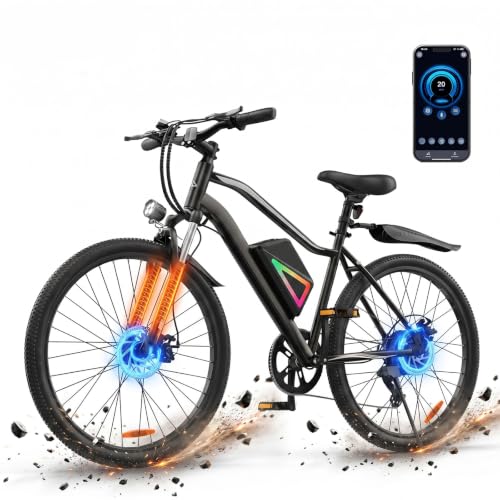
commuter
RNNSNN Commuter 26
The cheapest bike we have found that documents BOTH UL 2849 for the complete bike and UL 2271...
Read the review