Ebike Oracle
Buyer guide

Best Electric Bikes for Teenagers (2026): Fit, Speed and the Law

The best e-bike for a teenager is almost never the one with the best specification — it is the one they can hold up at a stop, lift off the ground, and legally ride where you live. Two numbers decide it and neither is the motor: weight (our picks run 31 lb to 66 lb — a 2× spread) and...

Ranked from our scored reviews

As an Amazon Associate I earn from qualifying purchases. Ebike Oracle may also earn a commission on purchases made through links to other retailers, at no extra cost to you. Full disclosure.

Best overall

7.0/10

Razor Rambler 16

Best overall. A 16 mph ceiling instead of 20 is the single most useful safety feature...

$588.99

Check price at Amazon

Free 30-day returns via Amazon

Detailed picks

Razor Rambler 16
US
Pick #17.0/10

Razor Rambler 16

Razor
Check price at Amazon

Free 30-day returns via Amazon

Best overall. A 16 mph ceiling instead of 20 is the single most useful safety feature you can buy for a teenager, and Razor has been building youth ride-ons for twenty years — the pedigree is real, not marketing. 350 W, 360 Wh, a stated 12 miles of range and 56 lb. The range is the weakest number here, so treat it as a neighbourhood and school-run bike rather than a distance machine. Class 2, so it is legal in every state without an age argument in all but three.

Macfox M16 Youth Electric Bike
US

Best certified pick, and the only one purpose-built for this rider. Macfox markets the M16 as a teen bike and it is the only one here carrying UL 2849 certification for the complete electrical system — which matters if the battery charges in your house, and is now a legal requirement for sale in New York City. Biggest battery of the group at 499 Wh and a genuine 25-mile range. 🔴 Check fit before anything else: Macfox lists a fixed 28.7-inch seat height, and a child at their stated 3'11" minimum has roughly a 21-inch inseam — nearly 8 inches short of the saddle. At 66 lb it is also the heaviest bike here by 10 lb. Right for a taller teenager, wrong for a small one.

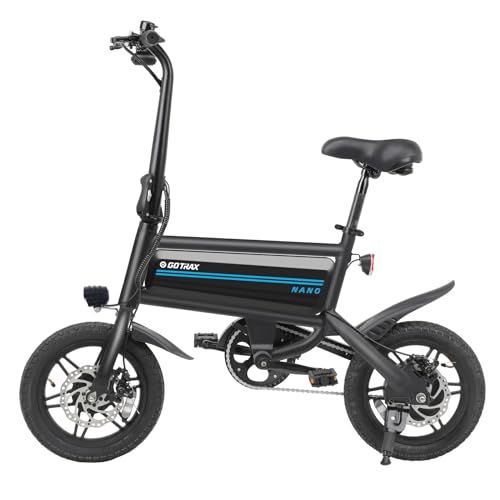
Gotrax Nano 14" Mini Folding E-Bike
US
Save $50
Check price at Amazon

Free 30-day returns via Amazon

Best for the youngest or smallest rider — and ranked above its own score for a reason. It scores lower than the bikes below it on our general rubric, and for this specific rider it is still the right bike: 31 lb (less than half the M16), 16 mph, and Class 1 — no throttle at all, so there is no lever to open by accident. A 14-inch mini-fold with 250 W and 230 Wh, so a stated 14 miles and genuinely limited hills. If your rider cannot comfortably pick a bike up off the ground, nothing else on this list matters, and this is the only one most of them can.

Bodywel 14" Mini Foldable Electric Bike
US
Save $39
Check price at Amazon

Free 30-day returns via Amazon

Best budget. $239.98 buys 350 W, 374 Wh and a stated 20 miles at 45 lb — a better battery than the Nano at two-thirds the price and only 14 lb heavier. It is Class 2 with a throttle and a 20 mph ceiling, so it asks more judgement of the rider than the two 16 mph bikes above. A sensible first e-bike where the budget is firm and the rider is old enough to be trusted with a throttle.

Jasion EB5 26" 500W Hardtail Commuter
US
Check price at Amazon

Free 30-day returns via Amazon

Cheapest, and the one for a full-sized teenager. At $199 with a 500 W motor and a 330 lb payload rating on a full-size 26-inch frame, this is the pick for a 16- or 17-year-old who has finished growing and would look absurd on a 14-inch mini. 360 Wh and a stated 16 miles. The trade-off is that a 26-inch frame has a high standover — measure it against their inseam exactly as you would the M16.

We ranked on fit and law first, specification second — the reverse of most lists, and deliberately so. Weight, top speed, class and payload are read from the live product data behind each review and re-checked against the retailer listing; the legal rules come from the same verified 51-jurisdiction statute table that drives our 52 state law pages, so nothing here can drift from the rest of the site. We have not ridden these bikes and do not claim to have. Where a bike is ranked above a higher-scoring one, the reason is stated in the entry rather than hidden. Prices were checked on 18 August 2026 and change often.

What actually decides which e-bike suits a teenager?

Almost every "best e-bike for teens" list ranks on motor wattage and range. For an adult commuter that is reasonable. For a fourteen-year-old it is close to useless, because the two specifications that decide whether the bike works are weight and top speed, and most lists do not print either prominently.

Weight. Our five picks span 31 lb to 66 lb — a factor of two. That range is the difference between a teenager who can pick the bike up when it falls, lift it onto a rack, or walk it up a kerb, and one who cannot. A bike a rider cannot physically manage gets left where it fell, or worse, dropped on them. The Gotrax Nano at 31 lb and the Macfox M16 at 66 lb are both good bikes; they are not both good bikes for the same person.

Top speed. Three of these are capped at 20 mph and two at 16 mph. Sixteen is not a marketing number — it is roughly 36% less kinetic energy in a crash than twenty, and it meaningfully shortens stopping distance. For a first e-bike, the 16 mph cap on the Razor Rambler 16 and the Nano is a feature you are buying, not a limitation you are accepting.

Is a throttle safe for a teenager?

A Class 1 e-bike assists only while you pedal. A Class 2 adds a throttle that moves the bike without pedalling. Both stop assisting at 20 mph. For an adult this is a preference; for a young or inexperienced rider it is a safety decision.

A throttle can be opened accidentally — while mounting, while turning, or while startled. It is the mechanism behind a lot of first-ride incidents. Only the Nano here is Class 1, and for a nervous parent or a first-time rider that is the single strongest argument in its favour, ahead of any specification on the sheet.

That said, a throttle is genuinely useful for pulling away safely at a junction or restarting on a hill, which is why four of our five picks have one. The honest framing is: a throttle is a capability with a cost, and the cost is highest for the youngest riders.

What age can a teenager legally ride an e-bike?

The most common misconception in this whole category is that there is a national minimum age for e-bikes. There is not, and for the bikes on this page there usually is not a state one either.

For Class 1 and Class 2 — every bike on this list — most US states set no minimum riding age at all. The age rules that exist in the three-class framework were written against Class 3 (28 mph), where 41 of 51 jurisdictions set a floor, 32 of them at 16. None of the bikes here is Class 3.

Three states break that pattern and are worth knowing before you order:

  • Utah — nobody under 8 may operate any e-bike, and riders under 14 require adult supervision. From 6 May 2026 (HB 381) a helmet is required for all riders under 21 on roads.
  • Hawaii — from 15 July 2026, under-16s may not operate a Class 2 without direct parent or guardian supervision. Hawaii also requires a one-time $30 registration.
  • Louisiana — sets an explicit minimum operating age of 12, the lowest in the country.

Helmet law is what will actually apply to your rider, and it is stricter than age law nearly everywhere. Twelve jurisdictions require a Class 3 helmet at any age; Connecticut requires one for every rider on every class regardless of age, Rhode Island for every rider under 21 on any class, Maine under 16 on all classes, West Virginia under 15, and New Mexico under 18.

The full breakdown for all fifty states and DC is in our electric bike age limits by state guide, and your own state page is at /laws. Check your city too — Florida sets no statewide minimum but Sanibel has set 16, and local ordinances are where most of the real restrictions live.

How do I know the bike will actually fit?

This is the check that prevents the most expensive mistake in this category, and it takes ten seconds.

A rider needs to be able to put at least one foot flat on the ground while seated — ideally both toes. So compare the bike's seat height to your rider's inseam, not their overall height. Inseam runs roughly 45% of standing height in a child or young teenager, so a 4'8" (56 inch) rider has about a 25-inch inseam.

Manufacturer height guidance is not a substitute for this. The M16 is the clearest example on our own list: Macfox recommends it from 3'11" — a 47-inch child, so about a 21-inch inseam — against a published, apparently fixed 28.7-inch seat height. That is a gap of nearly 8 inches, and a rider at the stated minimum could not touch the ground at all. The bike is not badly made; the height guidance is simply optimistic, and it is the kind of thing only arithmetic catches.

Does a teenager's e-bike need UL certification?

For a bike that will charge inside your home, UL 2849 (the whole electrical system) and UL 2271 (the battery) are worth paying for. Only the M16 on this list states UL 2849.

This is shifting from a nice-to-have to a legal requirement. New York City has required UL certification for e-bikes sold, leased or rented in the city since Local Law 39 of 2023 took effect on 16 September 2023. Colorado went further with HB 25-1197, effective 6 August 2025, requiring UL 2849, UL 2271 or EN 15194, with labelling rules from 1 January 2027 and penalties up to $20,000 for mislabelling. A growing number of apartment buildings, schools and universities will not allow an uncertified battery to charge indoors at all.

If the bike lives in a garage and the battery charges there, this matters less. If it charges in a bedroom, it matters a great deal — and it is worth reading our e-bike battery fire safety guide before the first charge either way.

What we would actually buy

For a typical 13-to-16-year-old, the Razor Rambler 16. The 16 mph cap does more for safety than any spec upgrade at this price, and the range limitation is real but rarely binding on the rides teenagers actually do.

For a smaller or younger rider, the Gotrax Nano, and without hesitation despite the modest specification. 31 lb and no throttle beat every number on the sheet for that rider.

For a taller teenager, where the battery charges indoors, the Macfox M16 — provided you have measured the inseam against 28.7 inches first.

And if the budget is genuinely fixed, the Bodywel 14" Mini at $239.98 is a more capable bike than its price suggests. The one thing we would not do is buy on motor wattage: 500 W does nothing for a 90 lb rider that 250 W does not, and it adds weight they have to manage.

Frequently asked questions

What age can a kid ride an electric bike?

For Class 1 and Class 2 bikes — the 20 mph kind on this page — most US states set no minimum age at all. The age rules in the three-class framework were written for Class 3 (28 mph), where 41 of 51 jurisdictions set a floor, usually 16. Three states are exceptions that reach the 20 mph classes: Utah (nobody under 8 on any e-bike, supervision under 14), Hawaii (supervision under 16 from 15 July 2026) and Louisiana (minimum 12). Full table: e-bike age limits by state.

What is the best electric bike for a 14 year old?

For most 14-year-olds, the Razor Rambler 16 at $588.99 — a 16 mph cap rather than 20, from a brand with two decades of youth ride-ons behind it. If your rider is small for their age or nervous, the Gotrax Nano at 31 lb and Class 1 (no throttle) is the better call even though it is a more modest bike. Measure their inseam against the seat height before ordering either.

Is a 20 mph e-bike too fast for a teenager?

Not inherently — 20 mph is the legal ceiling for Class 1 and Class 2 and is what most adult commuters ride. But 16 mph carries roughly 36% less energy in a crash and stops shorter, which is why two of our five picks cap there. For a first e-bike, or a younger or less confident rider, the lower ceiling is worth choosing deliberately. The related question matters more: a throttle (Class 2) can be opened accidentally, while a Class 1 bike only assists while pedalling.

Do teenagers need a helmet on an electric bike?

In most states, legally yes — and in all states, sensibly yes. Twelve jurisdictions require a Class 3 helmet at every age, and several extend the rule to all classes: Connecticut requires one for every operator and passenger regardless of age, Rhode Island under 21 on any class, Maine under 16 on all classes, West Virginia under 15 and New Mexico under 18. Nineteen jurisdictions set no Class 3 helmet rule at all, which is a fact about statute rather than a recommendation.

How do I know if an e-bike is the right size for my child?

Compare the bike's seat height to your child's inseam, not their overall height. Inseam is roughly 45% of standing height in a child or young teen. They should be able to put at least one foot flat on the ground while seated. Manufacturer height guidance can be optimistic — the Macfox M16 is recommended from 3'11" (a ~21-inch inseam) against a 28.7-inch seat height, a gap of nearly 8 inches. Measure first.

Should I buy a UL certified e-bike for my teenager?

If the battery will charge inside your home, yes. UL 2849 covers the complete electrical system and UL 2271 the battery. New York City has required UL certification for e-bikes sold in the city since Local Law 39 of 2023, and Colorado's HB 25-1197 (effective 6 August 2025) requires UL 2849, UL 2271 or EN 15194 with penalties up to $20,000 for mislabelling. Many apartment buildings and schools now refuse to allow uncertified batteries indoors. The Macfox M16 is the only pick here stating UL 2849.

Reviewed by

John Weeks
Founder and editor