How to Choose an E-Bike in 2026: Buying Guide
Choosing an e-bike comes down to six decisions, in order: (1) the class (1, 2, or 3 — decides where you can legally ride), (2) the category (folding, commuter, cargo, family, or mountain — decides the frame), (3) the motor (250–750 W and hub vs mid-drive), (4) the battery (watt-hours, which decides range), (5) fit and components (brakes, sensor, frame...
The short version
- Decide in this order: class → category → motor → battery → fit → safety. Budget falls out of those six, not the other way round.
- Class decides where you can legally ride. Category decides the frame. Get these two wrong and no spec sheet saves you.
- For most riders a hub motor is right; go mid-drive only for steep hills, heavy cargo, or 50+ mile days.
- Range comes from watt-hours, not marketing claims — cut any advertised figure by 20–30%.
- Insist on UL 2849 certification. It is the one spec with a safety consequence.

Our pick for most readers
Funhang City Cruiser 26
$320
As an Amazon Associate I earn from qualifying purchases. Ebike Oracle may also earn a commission on links to other retailers. Full disclosure.
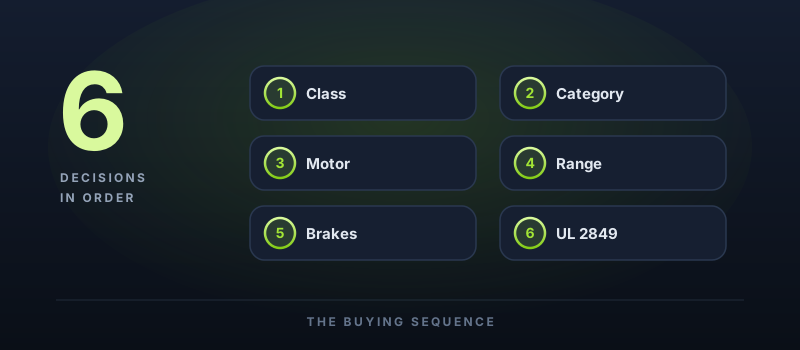
TL;DR — the 6-step framework
Buying your first e-bike is six decisions made in the right order. Get the order right and the rest is easy:
- Class — Class 1, 2, or 3. Decides where you can legally ride (paths vs roads) and helmet/age rules.
- Category — folding, commuter, cargo, family, or mountain. Decides the frame and what the bike is good at.
- Motor — power (250–750 W) and placement (hub vs mid-drive). Decides hill-climbing and feel.
- Battery — watt-hours (Wh). Decides real-world range.
- Fit & components — frame size, brakes, pedal-assist sensor, tires.
- Safety — insist on UL 2849 certification (battery UL 2271).
Do those six in order and your budget reveals itself. The good news for 2026: quality has pushed downmarket — genuinely good commuter e-bikes now start around $500–$1,000, and you no longer need to spend $2,000+ for a safe, certified bike.
The full guide, section by section. Tap any section to read it.
Step 1 — Pick your class
Step 1 — Pick your class
The three-class system decides where you can legally ride and the helmet/age rules that apply:
| Class | Top assisted speed | Throttle? | Best for |
|---|---|---|---|
| Class 1 | 20 mph | No (pedal-assist) | Bike paths, trails, the widest legal access |
| Class 2 | 20 mph | Yes (throttle) | Riders who want to cruise without pedaling |
| Class 3 | 28 mph | No (pedal-assist) | Faster commuting on roads + bike lanes |
Class 1 has the broadest access (most paths allow it). Class 3 is faster but is often barred from bike paths and usually carries a helmet and a minimum-age rule. Before you buy, confirm what your state and city allow — read Class 1, 2 & 3 e-bikes explained, check your state on the law pages, and run your ZIP through the legality checker.
Step 2 — Pick your category
Step 2 — Pick your category
Match the frame to what you will actually do with it:
- Commuter — the default for most buyers. Comfortable geometry, lights, racks, 40–60 mi range. Start here if you are unsure.
- Folding — small apartments, mixed transit, RV/boat storage. Compact, lighter, smaller wheels.
- Cargo — hauling groceries, gear, or a passenger. Long wheelbase, big battery, high payload.
- Family — carrying kids. Cargo frames rated for passengers, low standover, extra stability.
- Mountain — off-road trails. Suspension, knobby tires, torque-focused motors.
If you are buying one bike to do everything, a commuter or a compact cargo bike is the most flexible starting point.
Step 3 — Understand the motor (power + placement)
Step 3 — Understand the motor (power + placement)
Two things matter: how much power, and where the motor sits.
Power. The US federal e-bike cap is 750 W (Oregon allows up to 1,000 W). For most riders:
- 250–350 W — flat cities, lighter riders, maximum efficiency (and EU-spec bikes).
- 500 W — the comfortable all-rounder for moderate hills.
- 750 W — hills, heavier riders, or cargo loads. The most common US spec.
Placement decides feel and hill performance:
- Hub motor (in the wheel) — simpler and cheaper; great on flats; common on budget and commuter bikes.
- Mid-drive motor (at the cranks) — uses the bike's gears, so it climbs better and balances the bike; common on cargo and premium models.
Most first e-bikes are hub-drive, and that is fine for flat-to-moderate terrain. If you live somewhere steep or haul loads, prioritise a mid-drive. Full breakdown: mid-drive vs hub motor.
Step 4 — Battery and range (the number that matters most)
Step 4 — Battery and range (the number that matters most)
Range is set by the battery's watt-hours (Wh), not by motor power. The formula:
Range (miles) = battery Wh ÷ Wh used per mile
Real e-bikes use roughly 10 Wh/mi (efficient, flat, pedaling hard) to 30 Wh/mi (throttle-heavy, hills, heavy load). A practical planning number is 20 Wh/mi. So a 500 Wh battery realistically does ~25 miles hard or ~50 miles easy.
Battery sizing across our catalog (verified specs):
| Battery size | Catalog example | Realistic range |
|---|---|---|
| ~230 Wh | Gotrax Nano | ~12–22 mi (compact commuter) |
| ~468 Wh | Heybike Cityscape 2 | ~25–45 mi |
| ~960 Wh | AddMotor M-81 | ~40–70 mi |
| ~1,680 Wh | Lectric XPedition 2 | ~60–100+ mi (dual-battery cargo) |
Always cut the advertised range by 20–30% — manufacturer figures assume the lowest assist, a light rider, and flat ground. Model your own number with the range calculator, and see how far an e-bike can go on one charge for the full method.
Step 5 — Fit and components
Step 5 — Fit and components
The spec details that separate a bike you love from one you tolerate:
- Frame size + standover. You should stand flat-footed over the top tube. Most brands publish a height range per frame — match it.
- Brakes. Hydraulic disc brakes stop better than mechanical, especially on a heavy e-bike or in the wet. Worth prioritising on faster (Class 3) and cargo bikes.
- Pedal-assist sensor. A torque sensor feels natural (power scales to how hard you pedal); a cadence sensor is cheaper but surges on/off. Torque is the upgrade most riders notice.
- Tires. Wider tires (2.4"+) add comfort and grip; fat tires (4") suit sand/snow; narrower tires roll faster on pavement.
- Weight. E-bikes run 45–80+ lb. If you will carry it up stairs or onto a rack, weight (and a folding frame) matters more than range.
Step 6 — Safety: insist on UL 2849
Step 6 — Safety: insist on UL 2849
Non-negotiable in 2026: buy a bike whose complete electrical system is certified to UL 2849 (battery to UL 2271). This is the single biggest safety decision, and many apartments, HOAs, and insurers now require it to store or charge a bike on the premises. New York City has mandated it since 2023.
Plenty of certified bikes are affordable — the Jasion EB5 (~$199) and Gotrax Nano ($313.48) are both UL 2849-certified. Full explanation: are e-bike batteries a fire risk? and our UL-certified apartment picks.
What to spend — budget tiers
What to spend — budget tiers
| Budget | What you get | Catalog examples |
|---|---|---|
| $300–$700 | Entry commuter/folding, smaller battery, cadence sensor — buy UL-certified | Jasion EB5, Gotrax Nano |
| $800–$1,300 | The value sweet spot — bigger battery, hydraulic brakes, UL 2849 | Heybike Cityscape 2, Heybike Ranger |
| $1,500–$2,000 | Cargo/family capability, large or dual batteries | Cyrusher Kommoda 3, Lectric XPedition 2 |
The $800–$1,300 band is where most buyers should look in 2026 — it is where UL certification, hydraulic brakes, and a 500 Wh+ battery all become standard. Model the long-run cost (electricity vs gas, plus a battery replacement) with the savings calculator.
5 common first-e-bike mistakes
5 common first-e-bike mistakes
- Chasing top speed over range and brakes. A 28 mph bike you can't stop well in the rain is worse than a 20 mph bike that fits your commute.
- Ignoring the class rules. Buying a Class 3 then discovering it is banned from your favourite path. Check first.
- Skipping UL certification to save $100. The riskiest saving you can make — and it may be unrentable/uninsurable.
- Believing the advertised range. Cut it by 20–30% and plan around that.
- Wrong frame size. No motor compensates for a bike that doesn't fit. Match the height range.
Bottom line
Bottom line
Work the six steps in order — class, category, motor, battery, fit, safety — and the right bike (and budget) becomes obvious. For most first-time buyers in 2026 that means a UL 2849-certified commuter in the $800–$1,300 range with a 500 Wh+ battery and hydraulic brakes. Don't overspend on speed you can't legally use, and never skip certification.
Keep going: confirm the rules where you ride with the legality checker, size your range with the range guide, and browse our buyer guides for ranked picks by use case.
As an Amazon Associate I earn from qualifying purchases. Ebike Oracle may also earn a commission on links to other retailers. Full disclosure.
If you just want the answer
 Amazon
Funhang
Funhang City Cruiser 26
Worked through the checklist and still undecided? This is the highest-rated bike we've reviewed (8.6/10) — the one we'd point a first-time buyer at.
As an Amazon Associate I earn from qualifying purchases. Ebike Oracle may also earn a commission on links to other retailers. Full disclosure.
Frequently asked questions
How do I choose the right e-bike as a beginner?
Decide six things in order: (1) class (1/2/3 — where you can legally ride), (2) category (commuter, folding, cargo, family, mountain), (3) motor power and placement (250–750 W; hub vs mid-drive), (4) battery watt-hours (which sets range), (5) fit and components (frame size, hydraulic brakes, torque sensor), and (6) safety (insist on UL 2849). Budget falls out of those choices — most beginners are best served in the $800–$1,300 band.
How much should I spend on a good e-bike?
In 2026, $800–$1,300 is the value sweet spot — that is where UL 2849 certification, hydraulic disc brakes, and a 500 Wh+ battery become standard. You can get a safe, UL-certified entry bike for $400–$700 (e.g. the Jasion EB5 at ~$399), and cargo/family bikes run $1,500–$2,000. Spending more mainly buys range, payload, and premium motors, not basic safety.
What class of e-bike should I get?
Class 1 (20 mph pedal-assist) has the widest legal access — most bike paths and trails allow it — and is the safest default. Class 2 adds a throttle (also capped at 20 mph). Class 3 (28 mph pedal-assist) is faster for road commuting but is often banned from bike paths and usually carries helmet and minimum-age rules. Check your state on the law pages before buying.
How many watts do I need in an e-bike motor?
250–350 W is plenty for flat cities and lighter riders; 500 W is a comfortable all-rounder for moderate hills; 750 W (the US federal cap) suits hills, heavier riders, and cargo. Placement matters too: hub motors are cheaper and fine on flats, while mid-drive motors use the bike's gears to climb better. See mid-drive vs hub motor.
How much range do I really need?
Estimate it: range ≈ battery watt-hours ÷ ~20 Wh per mile for typical riding. A 500 Wh battery realistically does ~25 miles hard or ~50 miles easy. Buy enough that your round-trip commute uses less than ~60% of a charge, and always cut the advertised figure by 20–30%. Model it with the range guide.
Should I get a hub motor or a mid-drive?
For flat-to-moderate terrain and a tighter budget, a hub motor is perfectly good and most first e-bikes use one. If you live somewhere steep or carry cargo, a mid-drive climbs better and balances the bike because it drives through the gears — at a higher price and with more drivetrain wear. Full comparison: mid-drive vs hub motor.
Is UL certification important when buying an e-bike?
Yes — it is the most important safety spec. Buy a bike whose full electrical system is certified to UL 2849 (battery UL 2271). Nearly every documented e-bike fire involves uncertified hardware, and many apartments, HOAs, and insurers now require UL 2849 to store or charge a bike on-site. Certified bikes start under $450. See are e-bike batteries a fire risk?.
What are the most common mistakes when buying a first e-bike?
Chasing top speed over range and braking; ignoring class rules and buying a bike banned from your local paths; skipping UL certification to save a little money; trusting the advertised range (cut it 20–30%); and getting the wrong frame size. Avoiding those five gets most beginners a bike they are happy with.
Keep reading
Guide
Class 1 vs 2 vs 3 E-Bikes Explained (2026)
The US e-bike class system is actually simple: Class 1 is pedal-assist only at 20 mph, Class 2...
ReadGuide
Do You Need a License for an E-Bike? (2026)
In 49 states and Washington, DC you do not need a license, registration, or insurance to ride a...
ReadGuide
Are E-Bikes Worth It in 2026? The Real Cost to Own
For most commuters, yes — an e-bike is one of the cheapest vehicles you can own. A full...
Read
Reviewed by