Review · ESKUTE
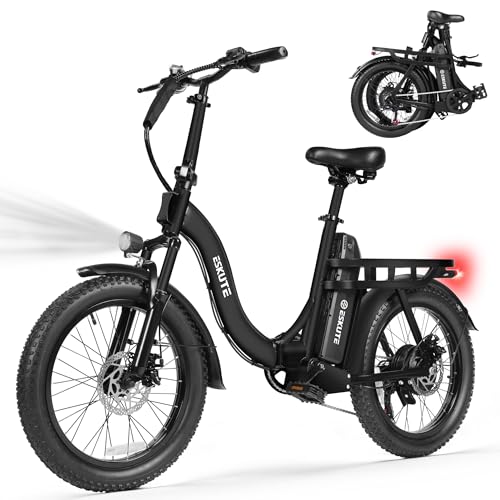
folding6.6/10ESKUTE Folding Cargo 20
Spec-verified against the manufacturer listing
Our verdict
A folding step-through with 20×3 fat tires, a 624Wh removable pack, a front basket and rear rack as standard, and NFC unlock instead of a key: a well-specified commuter package for $319.99 (as of Sep 15, 2:10 AM EDT, subject to change). But the listing never states a rated wattage (only 1200W peak), never commits to a top speed (only "20+ MPH"), and, the one that matters most for a bike designed to be carried indoors, never mentions UL certification at all. Good hardware, an incomplete answer to the questions a folding-bike buyer should be asking.
- Best for
- Flat and apartment commuters with somewhere uncontrolled to charge
As an Amazon Associate I earn from qualifying purchases. Ebike Oracle may also earn a commission on links to other retailers. Full disclosure.
Free 30-day returns via Amazon
Not sold on this one? See every ranked pick in our guide to the best e-bikes under $500 on Amazon.
At a glance
Run this in our range calculator →The numbers
ESKUTE Folding Cargo 20 is a folding, step-through e-bike that scores 6.6/10 on our editorial rubric, last verified on July 29, 2026. Amazon listed it at $320 as of September 15, 2026. Prices change often, so treat that as a snapshot. On Amazon it currently ranks #38 Best Seller in Electric Folding Bikes. It pairs a 624 Wh battery, good for a claimed range of up to 26 miles. It best suits flat and apartment commuters with somewhere uncontrolled to charge.
Pros
- + Genuine tool-free fold plus front basket and rear rack included, not sold separately
- + 624Wh removable pack: lift it out and charge indoors
- + NFC-card unlock, no key to lose
- + Step-through frame stays mountable with the front basket loaded
- + 20×3 fat tires absorb broken pavement better than a slim folding-bike tire
Cons
- - No UL 2849 or UL 2271 claimed anywhere, the wrong omission on a carry-indoors bike
- - Peak wattage only (1200W); the rated figure that statutes use is never stated
- - "20+ MPH" does not commit to a speed, so the class cannot be established before buying
- - 55-mile range claim needs ~11.3 Wh/mile; realistic mixed riding is 22-31 miles
- - Two feature bullets are duplicated verbatim, on a page that was not proofread
Who is this for?
- Flat and apartment commuters with somewhere uncontrolled to charge
- Riders who need one bike that both folds and carries groceries
- Multimodal commuters combining a train leg with a ride at each end
The 30-second verdict
On hardware this is an enormous amount of commuter for $319.99 (as of Sep 15, 2:10 AM EDT, subject to change): a frame that folds without tools, 20×3 fat tires that take the sting out of bad pavement, a 48V 13Ah (624Wh) pack you can lift out and carry upstairs, a 7-speed cluster, a step-through you can mount with a full basket on the front, and NFC-card unlock so there is no key to lose. Fold it, carry the battery up, charge it in the flat: that is the whole pitch of a bike like this, and the hardware executes it. What undercuts the pitch is what is missing from the page. There is no rated motor wattage, only a 1200W peak. There is no top speed, only "20+ MPH", which is a number chosen not to commit. And there is no mention of UL 2849 or UL 2271 anywhere: no certification, no certifying body, nothing. For a bike whose entire design logic is that you bring the battery indoors, that is the wrong specification to leave blank, and it is why this scores below its hardware.
The full review, section by section. Tap any section to read it.
The two numbers the listing will not give you
The two numbers the listing will not give you
Every US state that regulates e-bikes does it with two figures: rated motor power and top speed. This listing states neither. "1200W peak" describes what the motor can briefly draw, not what it is rated to sustain, and the rated number is the one written into 15 U.S.C. §2085 and into nearly every state statute, almost always at a 750W ceiling. A 1200W peak is entirely consistent with a legal 500W or 750W rated motor; it is also consistent with something above the line. Without the rated figure there is no way to tell from the page. "20+ MPH" has the same problem from the other direction: if it arrives capped at 20 it rides as a Class 2 almost everywhere, and if the "+" is doing real work it may not. Neither of these makes the bike illegal, and most bikes in this bracket are fine, but it means you cannot establish that it is legal before buying, and you should check the display settings on day one. Our state-by-state map tells you which number needs to be what where you ride.
Range, with the arithmetic shown
Range, with the arithmetic shown
The listing claims up to 55 miles. Working from its own stated pack, 48V × 13Ah = 624Wh, that requires 624 ÷ 55 ≈ 11.3 Wh per mile. A 20×3 fat tire in mixed riding draws roughly 20-28 Wh per mile, which puts the realistic figure at 22-31 miles; throttle-only will sit at the bottom of that. The 55 is not a lie, it is a best case of lowest assist, flat ground, light rider and real pedalling, but the listing does not label it as one. Compare the Funhang, which prints its throttle-only figure alongside its pedal-assist figure and lets you see the gap. Plan this bike around 25 miles and you will not be disappointed.
The missing certification
The missing certification
UL 2849 certifies the complete electrical system and UL 2271 the battery pack. Neither appears on this listing. That matters more here than on a bike that lives in a garage, because a folding commuter is bought precisely so the battery comes indoors. New York City's Local Law 39 of 2023 prohibits selling or renting a powered mobility device in the city without UL 2849 or equivalent, and landlords and employers well beyond New York now ask for the certificate before permitting indoor charging or storage. If your building asks, this listing gives you nothing to show them. The Funhang Fat 26 names SGS and TÜV as its certifying bodies and costs roughly $80 more, which is what the paperwork this one lacks is currently priced at.
Detail work, good and careless
Detail work, good and careless
The considered touches are real: NFC unlock, a rust-resistant front basket and reinforced rear rack included rather than sold as accessories, and a step-through frame that stays mountable when the basket is loaded. Then there is the careless bit: the third and fourth feature bullets on the listing are byte-for-byte identical, the same paragraph about the folding mechanism printed twice. It changes nothing about the bike, but on a page that omits the rated wattage, the top speed and the certification, a duplicated bullet reads as a page nobody proofread, and it is fair to weigh that when the same page is your only source of specification.
Who should buy it
Who should buy it
Riders who need a genuine fold plus genuine cargo capacity in one bike, and who have somewhere to charge that nobody polices: a house, a garage, a workplace without a certification policy. At around $320 it is now the cheapest folding fat-tire bike we list, and it undercuts every obvious cross-shop by a wide margin. Still cross-shop the Jasion EB6, which states 500W rated and 20 mph and therefore can be reasoned about legally, and the Heybike Ranger for a bigger-name folder. Both cost meaningfully more, and what the extra money buys is numbers you can check. If your building asks for UL paperwork, none of the above matters; buy something that has it.
Ready to buy?
See current pricing at Amazon
We update prices as the listing changes, and the final price is set by the retailer at checkout.
Frequently asked questions
What is the best fat tire foldable electric bike?
Among the folding fat-tire bikes we list, the Heybike Ranger has the strongest brand support and a stated 28 mph, and the Jasion EB6 is the one whose legal numbers are actually printed (500W rated, 20 mph). This ESKUTE beats both on included cargo hardware, basket and rack as standard, and now on price by a large margin, but it is the only one of the three that claims no UL certification. Pick on that axis first.
Is the ESKUTE Folding Cargo 20 street legal?
Probably, but the listing does not let you prove it. It quotes a 1200W peak motor without a rated figure, and "20+ MPH" without a cap, and both rated wattage and top speed are what state statutes actually measure. A 1200W peak is perfectly consistent with a legal 750W rated motor. Check the display settings when it arrives, then confirm against your state.
How far does it really go on a charge?
Plan for about 25 miles, not the 55 on the listing. The stated 48V 13Ah pack is 624Wh; the 55-mile claim needs roughly 11.3 Wh per mile, whereas a 20×3 fat tire in mixed riding draws 20-28. That puts the honest range at 22-31 miles, with throttle-only at the bottom end.
Does it have UL certification?
Not that the listing states. Neither UL 2849 (complete e-bike) nor UL 2271 (battery) appears anywhere on the page. If you need certification, because your building, landlord or employer requires it for indoor charging as NYC Local Law 39 does, this is not the bike. The Funhang Fat 26 documents both standards for roughly $80 more.
What are the disadvantages of fat tire ebikes?
Efficiency and weight. A 20×3 tire draws 20-28 Wh per mile against 12-15 for a slim commuter tire, so the same battery takes you roughly half as far, which is why this bike gets ~25 miles from a 624Wh pack. Fat tires also add rotating mass, making the bike heavier to lift and slower to accelerate. The trade buys grip and comfort on gravel, snow and broken pavement. Worth it if you ride those surfaces; not if you commute on smooth tarmac.
Bottom line
Is the ESKUTE Folding Cargo 20 for you?
Check the live price + availability before deciding.
If this isn't the one

folding
URLIFE Mini 14
One of Amazon's best-selling folding e-bikes is a 14-inch mini that costs , states UL 2849 certification, and...
Read the review
folding
Askmy Mini 14
A 14-inch folding e-bike at carrying 480 Wh, nearly double the battery of most minis at this price,...
Read the review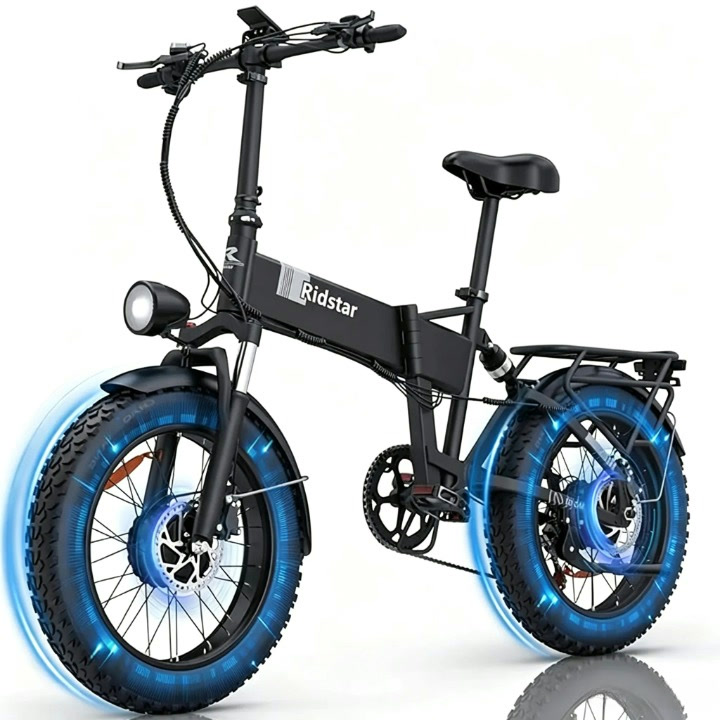
folding
Ridstar H20 Pro 2000W Folding Fat Tire E-Bike
Save $1,201
Two hub motors, a 1,104 Wh battery, hydraulic brakes at both ends, front and rear suspension and a...
Read the review
