Mississippi E-Bike Laws 2026: Natchez Trace
Are e-bikes legal in Mississippi?
Mississippi adopted the federal three-class e-bike framework in 2021 through HB 1195 (2021 Regular Session), effective 1 July 2021. The operative statute is Miss. Code §63-3-1315 (Article 27 — the John Paul Frerer Bicycle Safety Act), with the bicycle definition at §63-3-103 amended by HB 1195 to fold in e-bikes. The §63-3-103 citation alone is incomplete — the operative e-bike rules live at §63-3-1315. Motor cap: less than 750 watts (strict inequality). Class 1 (20 mph pedal-assist), Class 2 (20 mph throttle), and Class 3 (28 mph pedal-assist) are all street-legal — no driver license, no DMV registration, no insurance, no title (HB 1195 conformed §§27-19-3 / 27-51-5 / 63-15-3 / 63-17-55 / 63-17-155 / 63-19-3 / 63-21-5 / 63-31-3). NO statewide helmet rule for any class at any age. Class 3 minimum operator age: 16 (under-16 may ride as a passenger).
Class 3 must carry a speedometer under §63-3-1315 — easy to miss. Mandatory class label (class + top assisted speed + motor wattage, Arial ≥9pt, permanently affixed) on every bike sold since 1 January 2022. Path access: §63-3-1315(7) — Class 1 and Class 2 presumptively allowed on paved bike + multi-use paths; Class 3 may be restricted by the path authority (default-permissive, not statutory ban). Natural-surface singletrack is excluded from the statutory permission — land-manager call. The marquee cycling destination: Natchez Trace Parkway — 444 miles of NPS-managed scenic road from Natchez to Nashville, one of the most famous cycling roads in the United States. NPS Superintendent's Compendium has no e-bike-specific restrictions; default NPS framework (Secretary's Order 3376 + 36 CFR §§1.4, 4.30) applies — e-bikes permitted where bicycles are. Other major paved trails: Tanglefoot Trail (44 mi, Houston ↔ New Albany) — Class 1 + 2 only, Class 3 prohibited, 15 mph speed limit, age 16+. Longleaf Trace (~41 mi, Hattiesburg ↔ Prentiss): rules silent on e-bikes — confirm with district. Gulf Coast Heritage Trail / US-90 Beach Boulevard (~26 mi paved post-Katrina corridor Bay St. Louis → Ocean Springs) — the de-facto premier coastal e-bike route.
Buying one? The NARRAK Folding Trike 350 (Class 2, 16 mph) and the Vivi F26FUL Long-Range Fat-Tire (Class 3, 25 mph) are class-legal in Mississippi and in stock at Amazon. For more choice, see our best e-bikes under $600.
Legal to ride in Mississippi: our top class-legal pick
As an Amazon Associate I earn from qualifying purchases. Ebike Oracle may also earn a commission on links to other retailers. Full disclosure.
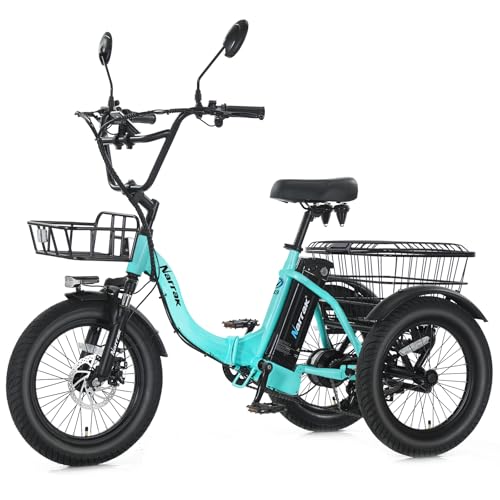
NARRAK
NARRAK Folding Trike 350
Class 2 — pedal-assist + throttle to 20 mph
Class 2 · 16 mph · Score 7.1
Free 30-day returns via Amazon
Other legal picks for Mississippi


Street-legal e-bikes you can buy in Mississippi (2026)
Each fits a class Mississippi treats as a bicycle, so it needs no registration or licence to ride.
| E-bike | Buy | Class | Speed |
|---|---|---|---|
| NARRAK Folding Trike 350 | Check price at Amazon | Class 2 | 16 mph |
| Vivi F26FUL 500W Long-Range Fat-Tire E-Bike | Check price at Amazon | Class 3 | 25 mph |
| Vivi M026SHUL 500W Hardtail Mountain E-Bike | Check price at Amazon | Class 3 | 22 mph |
What are the e-bike rules in Mississippi?
Sourced from the Mississippi statute and verified against the PeopleForBikes State Law Tracker.
Check your setup
Is your e-bike legal in Mississippi?
Your match
NARRAK
NARRAK Folding Trike 350
Permitted on roads, bike lanes, and bike paths in Mississippi.
Our score 7.1/10
Our top class-legal pick for Mississippi, street-legal to ride today.
Free 30-day returns via Amazon
The 30-second answer
E-bikes are legal across Mississippi under the federal Class 1/2/3 framework adopted by HB 1195 (2021), effective 1 July 2021. The operative statute is Miss. Code §63-3-1315, inside Article 27 — the John Paul Frerer Bicycle Safety Act. HB 1195 also amended §63-3-103 (the general traffic-code bicycle definition) plus ten conforming sections (privilege taxes, titling, financial responsibility, sales finance) to fold e-bikes in. Motor cap is less than 750 watts.
Key facts: no driver license, no DMV registration, no insurance, no title — for any compliant e-bike. NO statewide helmet rule for any class at any age. Class 3 minimum operator age is 16 (§63-3-1315) — under-16 may ride as a passenger. Class 3 must carry a speedometer. Mandatory class label (class + speed + wattage, Arial ≥9pt) on every bike sold since 1 January 2022.
Path access is default-permissive for Class 1 and Class 2 on paved bike + multi-use paths; Class 3 may be restricted by the path authority (§63-3-1315(7)). Many out-of-state retailer blog templates incorrectly state a statewide Class 3 path ban — that's wrong for Mississippi. Natural-surface singletrack is excluded from the statutory permission — land-manager call.
The full Mississippi rules, section by section. Tap any section to read it.
Quick reference
Quick reference
| Spec | Mississippi rule |
|---|---|
| Framework | Federal Class 1/2/3 (adopted 2021, HB 1195) |
| Definition statute | Miss. Code §63-3-1315 (NOT §63-3-103 alone — that's the general traffic-code definitions chapter amended by HB 1195) |
| Statute name | John Paul Frerer Bicycle Safety Act (Article 27) |
| Motor power cap | <750 W (§63-3-1315) |
| Class 1 (pedal-assist, ≤20 mph) | ✅ Legal · paths ✅ default |
| Class 2 (throttle, ≤20 mph) | ✅ Legal · paths ✅ default |
| Class 3 (pedal-assist, ≤28 mph) | ✅ Legal · operator 16+ · speedometer required · paths default-allowed but path authority MAY restrict |
| Driver license | Not required (HB 1195 conformed §63-15-3) |
| Registration | Not required (HB 1195 conformed §27-19-3 / §63-21-5) |
| Insurance | Not required (HB 1195 conformed §63-15-3) |
| Title | Not required (HB 1195 conformed §63-21-5) |
| Statewide helmet rule | None — for any class, any age |
| Minimum age (Class 1 + 2) | None |
| Minimum age (Class 3, operator) | 16 (§63-3-1315) — under-16 may ride as passenger |
| Class 3 speedometer | Required (§63-3-1315) |
| Mandatory label | Class + top assisted speed + motor wattage, Arial ≥9pt, permanently affixed (since 1 Jan 2022) |
| Path access — Class 1 + 2 | Presumptively allowed on paved bike + multi-use paths; local authority may restrict |
| Path access — Class 3 | Default-allowed; path authority may restrict (§63-3-1315(7)) |
| Natural-surface singletrack | Excluded from statutory permission — land-manager call |
| Natchez Trace Parkway (NPS) | E-bikes allowed where bicycles are (default NPS framework — Compendium has no e-bike-specific restriction); 50 mph motor-vehicle speed limit (40 mph in Ridgeland MS + Leiper's Fork TN), narrow lanes, no dedicated shoulder |
| Tanglefoot Trail (44 mi, Houston ↔ New Albany) | Class 1 + 2 ✅; Class 3 prohibited; 15 mph cap; age 16+ (rules) |
| Longleaf Trace (~44 mi, Hattiesburg ↔ Prentiss) | Rules silent on e-bikes — battery-powered Class 1/2 implicitly OK; verify with district (rules) |
| Mississippi State Parks (MDWFP) | No e-bike-specific rule; treat as bicycles unless park posts otherwise (MDWFP rules) |
| Mississippi Sandhill Crane NWR | Bikes allowed on Crane Lane entrance corridor only; trails closed to bikes (USFWS) |
| Mississippi Gulf Coast cycling segments | Disconnected paved assets — Beach Boulevard Scenic Byway (~13 mi, Hancock County), Live Oaks Bicycle Route (~15.5 mi round-trip, Ocean Springs), Bay Bridge bikeway (~1.5 mi). The MS Gulf Coast National Heritage Area markets ~101 mi of pathways across Hancock / Harrison / Jackson counties from Bay St. Louis to Pascagoula, but the segments are not a single continuous trail. State law treats Class 1/2 as bicycles on paved segments; Class 3 at host-municipality discretion (§63-3-1315(7)) |
Two practical reads. First, Mississippi is more permissive on path access than retailer SEO templates suggest — Class 3 is NOT banned by statute; it's at local-authority discretion. The Tanglefoot Trail's Class 3 ban is a trail-management rule, not a state-law mandate. Second, the Natchez Trace Parkway is the marquee cycling destination — the 444-mile NPS-managed scenic road from Natchez to Nashville is one of the most-photographed cycling roads in the United States, but its 50 mph motor-vehicle speed limit, narrow 11-ft lanes, and lack of shoulder make it a serious-cyclist destination rather than a casual ride. High-visibility clothing and lights are NPS-recommended but not required.
The three-class system in Mississippi
The three-class system in Mississippi
Mississippi defines an "electric bicycle" at Miss. Code §63-3-1315:
"an electric bicycle [is] a bicycle or tricycle equipped with fully operable pedals, a saddle or seat for the rider, and an electric motor of less than 750 watts."
The three classes follow the federal PFB model:
- Class 1 — pedal-assist only, motor cuts at 20 mph.
- Class 2 — throttle-capable, motor cuts at 20 mph.
- Class 3 — pedal-assist only, motor cuts at 28 mph.
The framework was enacted by HB 1195 during the 2021 Regular Session, effective 1 July 2021.
Why some sources cite the wrong statute
A common citation error in retailer SEO blogs is referencing §63-3-103 alone as Mississippi's e-bike statute. §63-3-103 is the general traffic-code definitions chapter — HB 1195 amended it to fold "bicycle" in to include "electric bicycle," but the operative e-bike rules (class definitions, path access, age, speedometer, label) live at §63-3-1315 inside Article 27 (the John Paul Frerer Bicycle Safety Act). Cite §63-3-1315 as the operating statute and §63-3-103 only as the supporting definition cross-reference.
Where can you ride an e-bike in Mississippi?
Where can you ride an e-bike in Mississippi?
Can you ride on roads and bike lanes?
Same rights and duties as a regular bicycle. All three classes may use roads and bike lanes.
Multi-use paths — Mississippi is permissive by default
§63-3-1315(7) verbatim: "A municipality, local authority or state agency having jurisdiction over a bicycle or multi-use path may prohibit the operation of a class 3 electric bicycle on that path."
The plain reading: Class 1 + Class 2 are presumptively allowed on paved bike + multi-use paths; Class 3 is also presumptively allowed but a path authority may restrict it. The subsection also adds: this permission "shall not apply to a trail that is specifically designated as nonmotorized and that has a natural surface tread that is made by clearing and grading the native soil with no added surfacing materials" — i.e., the statute does NOT auto-permit e-bikes on dirt singletrack; that's land-manager-controlled.
One nuance worth knowing: §63-3-1315(7) does NOT require a safety-finding precondition for a local authority to prohibit Class 3 (the statute only requires a stated safety basis for Class 1 + 2 prohibitions). In practice, Class 3 access is the most legally precarious in Mississippi — a city or trail authority can ban Class 3 with no published rationale, while a Class 1 or Class 2 ban requires a stated safety basis. The Tanglefoot Trail's Class 3 prohibition is an example of a local rule using this discretionary authority.
Can you ride an e-bike on the sidewalk?
No statewide rule — local ordinance controls. Verify Jackson, Biloxi, Gulfport, and Tupelo codes before riding sidewalks in those cities.
Natchez Trace Parkway — the marquee Mississippi cycling destination
Natchez Trace Parkway — the marquee Mississippi cycling destination
The Natchez Trace Parkway is the most famous cycling road in the Southeastern United States. 444 miles of NPS-managed scenic road from Natchez, MS to Nashville, TN — about 313 miles of which are inside Mississippi.
The current rules:
- E-bikes allowed where bicycles are allowed. The Natchez Trace Parkway Superintendent's Compendium contains no e-bike-specific provisions — meaning the default NPS framework controls. Per NPS Secretary's Order 3376 (29 August 2019) and the implementing rule at 36 CFR §§1.4 + 4.30, e-bikes are permitted on park roads and routes where traditional bicycles are allowed.
- Motor-vehicle speed limit: 50 mph in most sections (40 mph in Ridgeland MS and Leiper's Fork TN). Lanes are narrow and the Parkway has no dedicated shoulder — cyclists share the travel lane.
- Chisha Foka Multi-Use Trail (MP 96–105.6, Jackson/Ridgeland) — designated for non-motorized scooters, skates, and similar devices alongside bicycles.
- No section of the Parkway is routinely closed to bicycles. Temporary roadway-rehabilitation closures do occur, with fines up to $5,000 for entering a closed section.
- High-visibility clothing and lights are NPS-recommended but not required. No helmet mandate on the Parkway.
For serious cyclists, the Mississippi portion of the Natchez Trace (~313 mi) is a destination ride — but the absence of shoulders and the 50 mph motor-vehicle limit make it a route for experienced touring cyclists rather than casual riders.
Tanglefoot Trail
Tanglefoot Trail
The Tanglefoot Trail is Mississippi's marquee paved rail-trail — 44 miles from Houston to New Albany. Managed by the Tanglefoot Trail Trust:
- Class 1 and Class 2 e-bikes: ✅ permitted.
- Class 3 e-bikes: ❌ prohibited.
- 15 mph trail-wide speed limit.
- Age 16+ to operate any e-bike on the trail.
- Must be battery-powered only.
- As of 13 March 2026, no Special Use Permit or fee is required (older online text still references the prior permit regime — that requirement was rescinded).
Longleaf Trace
Longleaf Trace
The Longleaf Trace runs ~44 miles from Hattiesburg to Prentiss. The trail rules page makes no specific mention of e-bikes, only prohibiting "petroleum-propelled vehicles." By plain reading, battery-powered Class 1 + Class 2 e-bikes are not excluded — but the rules don't expressly speak to them. Call the district before riding Class 3, and verify the current treatment of any class with trail management.
Gulf Coast cycling — the disconnected reality
Gulf Coast cycling — the disconnected reality
Mississippi's Gulf Coast cycling network is widely marketed as a continuous coastal trail — but on the ground, the paved assets are disconnected segments, not a single long-distance corridor. The Mississippi Gulf Coast National Heritage Area markets a ~101-mile pathway network across Hancock, Harrison, and Jackson counties from Bay St. Louis to Pascagoula, but the segments are not contiguous.
The actual paved segments most-used by cyclists:
- Beach Boulevard Scenic Byway — ~13 miles of paved multi-use path through Hancock County (Bay St. Louis area), the most-used post-Hurricane-Katrina coastal cycling segment.
- Live Oaks Bicycle Route — ~15.5 miles round-trip in the Ocean Springs area, the marquee East-of-Biloxi cycling loop.
- Bay Bridge bikeway — ~1.5 miles, the dedicated bike+ped span across the Bay of Biloxi.
State law treats Class 1 and Class 2 e-bikes as bicycles on these paved segments; Class 3 is at the host municipality's discretion under §63-3-1315(7). No comprehensive Beach Boulevard ordinance has been pulled from primary municipal-code sources — confirm with the host city (Bay St. Louis, Pass Christian, Long Beach, Gulfport, Biloxi, Ocean Springs, Pascagoula) before assuming Class 3 access on the path itself.
Mississippi State Parks + federal lands
Mississippi State Parks + federal lands
- Mississippi State Parks (MDWFP): Per the statewide rules, bicycles are permitted (lights required after dark; no more than two abreast). MDWFP has no e-bike-specific rule — treat e-bikes as bicycles unless a specific park posts otherwise. Tishomingo SP, LeFleur's Bluff SP (Jackson), and Buccaneer SP (Gulf Coast) are the main bike-oriented state parks.
- Mississippi Sandhill Crane NWR (USFWS, Gautier): Per USFWS rules, bicycles may be ridden on the Crane Lane entrance corridor only — bicycles are NOT allowed on refuge trails. E-bikes on the entrance corridor follow the USFWS framework (e-bikes treated as bicycles where bicycles are allowed under 50 CFR §27.31).
- National Forests in Mississippi (USFS — De Soto, Bienville, Holly Springs, Homochitto, Tombigbee): USFS national rule (36 CFR §212.1) treats e-bikes as motor vehicles by default, allowed only on routes designated for motor-vehicle use per the Motor Vehicle Use Map (MVUM). Verify the current MVUM directly with the forest supervisor before riding singletrack.
Do you need a helmet, license, or registration in Mississippi?
Do you need a helmet, license, or registration in Mississippi?
| Topic | Mississippi rule |
|---|---|
| Driver license | Not required (HB 1195 conformed §63-15-3) |
| Registration | Not required (HB 1195 conformed §27-19-3 / §63-21-5) |
| Insurance | Not required (HB 1195 conformed §63-15-3) |
| Title | Not required (HB 1195 conformed §63-21-5) |
| Statewide helmet | None — §63-3-1315 contains no helmet mandate; Mississippi has no general statewide bicycle helmet law |
| Minimum age (Class 1 + 2) | None |
| Minimum age (Class 3, operator) | 16 (§63-3-1315) — under-16 may ride as a passenger on a Class 3 designed for it |
| Class 3 speedometer | Required (§63-3-1315) |
| Mandatory label | Class + top assisted speed + motor wattage, Arial ≥9pt font, permanently affixed in a prominent location (effective 1 January 2022) |
Mississippi's baseline — no statewide helmet, no Class 1/2 age, no license/registration/insurance/title, default-permissive path access — makes it one of the more rider-friendly e-bike jurisdictions in the Southeast. The trade-offs are real but limited: Class 3 needs a speedometer; Tanglefoot Trail caps Class 3 at the trail-rule level; and the marquee Natchez Trace Parkway is a serious-cyclist destination rather than a casual ride.
Is Mississippi changing its e-bike laws?
Is Mississippi changing its e-bike laws?
No targeted e-bike amendments to §63-3-1315 located in the 2024, 2025, or 2026 Regular Sessions. The 2021 enactment stands as the operative law. Track the Mississippi Legislature bill tracker for any new e-bike legislation.
Current law remains: §63-3-1315 + amended §63-3-103 + HB 1195 conforming amendments to titling/registration/insurance/finance chapters.
Check your setup against Mississippi law
Check your setup against Mississippi law
The rules above are the statewide baseline. Two things decide whether a specific bike is legal for a specific rider: which class it actually is, and how old the rider is.
- E-bike legality checker — enter motor wattage, top assisted speed, throttle and rider age, and get the Mississippi verdict with the statute reference.
- Class 1, 2, 3 e-bikes explained — what the three classes mean and why the label on the frame is the thing states regulate. Most compliance problems are a bike that was never in-class to begin with.
- All 50 states + DC compared — one sortable table: classification tier, Class 3 legality, path access, helmet rule, minimum age, licence and registration.
Sources
Sources
- Miss. Code §63-3-1315 — Electric Bicycle (Justia)
- Miss. Code §63-3-103 — General traffic-code definitions (FindLaw)
- HB 1195 (2021 Regular Session) — enacting bill text (LegiScan mirror)
- NPS Natchez Trace Parkway — bicycling
- NPS Natchez Trace Parkway — Superintendent's Compendium
- NPS national e-bike policy
- DOI Secretary's Order 3376 — federal lands e-bike policy
- Tanglefoot Trail — rules + regulations
- Longleaf Trace — rules + etiquette
- Mississippi State Park rules + regulations (MDWFP)
- Mississippi Sandhill Crane NWR rules + policies (USFWS)
E-bikes that fit Mississippi's rules
Filtered from our review catalog by class eligibility under Mississippi statute. Spec-matched, not popularity-ranked.
- Class 2
 Amazon
NARRAK
NARRAK Folding Trike 350
Class 2 — pedal-assist + throttle to 20 mph
Permitted on roads, bike lanes, and bike paths in Mississippi.350 W · 16 mph · Score 7.1
Read the review - Class 3AmazonSave $348
Vivi
Vivi F26FUL 500W Long-Range Fat-Tire E-Bike
Class 3 — pedal-assist to 25 mph
Mississippi is one of the few states that allow Class 3 on bike paths. Riders must be 16+ per Mississippi law.500 W · 25 mph · Score 7.0
Read the review - Class 3AmazonSave $72
Vivi
Vivi M026SHUL 500W Hardtail Mountain E-Bike
Class 3 — pedal-assist to 22 mph
Mississippi is one of the few states that allow Class 3 on bike paths. Riders must be 16+ per Mississippi law.500 W · 22 mph · Score 6.8
Read the review
Eligibility is class-based: picks shown here are legal to own and operate on roads in Mississippi. Local jurisdictions (state parks, beach paths, individual cities) may add further restrictions; see the body above for the specifics.
Recent Mississippi e-bike law coverage
News-form posts that reference Mississippi's statutes or covered a change affecting Mississippi riders.
Frequently asked questions
Are e-bikes legal in Mississippi?
Yes. Mississippi adopted the federal Class 1/2/3 framework via HB 1195 (2021 Regular Session), effective 1 July 2021. The operative statute is Miss. Code §63-3-1315 inside Article 27 (the John Paul Frerer Bicycle Safety Act). Motor cap: less than 750 watts. All three classes are street-legal — no driver license, no DMV registration, no insurance, no title required (HB 1195 conformed §§27-19-3 / 27-51-5 / 63-15-3 / 63-17-55 / 63-17-155 / 63-19-3 / 63-21-5 / 63-31-3).
Can I ride an e-bike on the Natchez Trace Parkway?
Yes. The Natchez Trace Parkway Superintendent's Compendium has no e-bike-specific provisions; the default NPS framework (Secretary's Order 3376 + 36 CFR §§1.4, 4.30) controls — e-bikes are permitted where traditional bicycles are allowed. The 444-mile Parkway runs from Natchez MS to Nashville TN (~313 mi inside Mississippi). The motor-vehicle speed limit is 50 mph in most sections, lanes are 11 ft (substandard), and there is no shoulder — high-visibility clothing and lights are NPS-recommended but not required. No helmet mandate. The route is a destination ride for experienced touring cyclists rather than casual riders.
Does Mississippi require a helmet on an e-bike?
No statewide helmet rule — for any class, any age. §63-3-1315 contains no helmet mandate, and Mississippi has no general statewide bicycle helmet law. §63-7-64 covers motorcycles and scooters only. Some local ordinances may impose a rule — verify with the city.
Is there a minimum age to ride an e-bike in Mississippi?
Only for operating Class 3. §63-3-1315 verbatim: "No person under the age of sixteen (16) may operate a class 3 electric bicycle. However, a person under the age of sixteen (16) may ride as a passenger on a class 3 electric bicycle that is designed to accommodate passengers." No minimum age for Class 1 or Class 2.
Are Class 3 e-bikes allowed on Mississippi bike paths?
Yes by default. §63-3-1315(7) is permissive: a municipality, local authority, or state agency with jurisdiction over a bike or multi-use path may prohibit Class 3 — but the default is permitted. Many retailer blog templates incorrectly state a statewide Class 3 path ban — that's wrong for Mississippi. The Tanglefoot Trail bans Class 3, but that's a trail-management rule, not a state-law mandate. Natural-surface singletrack (dirt) is excluded from the statutory permission entirely — land-manager call.
Can I ride an e-bike on the Tanglefoot Trail?
Class 1 and Class 2 only. Per the official Tanglefoot Trail rules, Class 1 + Class 2 e-bikes are permitted; Class 3 is prohibited. 15 mph trail-wide speed limit, age 16+ to operate, battery-powered only. As of 13 March 2026, no Special Use Permit or fee is required (older online text still references the prior permit regime — that requirement was rescinded). The trail runs 44 miles from Houston to New Albany.
Do Class 3 e-bikes need a speedometer in Mississippi?
Yes. §63-3-1315 requires a Class 3 e-bike to be equipped with a speedometer. This is easy to overlook in retailer marketing copy. Mississippi also requires a mandatory class label on every e-bike sold since 1 January 2022: class number + top assisted speed + motor wattage, Arial font ≥9pt, permanently affixed in a prominent location.
What is the motor power limit for e-bikes in Mississippi?
Less than 750 watts under §63-3-1315 — strict inequality. A motor rated exactly 750 W technically fails Mississippi's definition. Bikes above 750 W or whose throttle alone exceeds the class speed cap fall outside §63-3-1315 and are regulated as mopeds or motor vehicles, with full license/registration/insurance/title obligations.
How do other states compare?
Compare Mississippi's rules with states that share a similar framework.
Common e-bike law questions
The national answer to the questions Mississippi riders ask most, covering every US state, side by side.
Cite or link this page
Found this useful? Link to it.
This guide is free to reference. If it helped you, a link helps more riders find accurate, up-to-date law info, and we keep it current (last reviewed May 31, 2026). Licensed CC BY 4.0. Reuse the data with attribution.
<a href="https://ebikeoracle.com/laws/mississippi">Mississippi E-Bike Laws 2026: Natchez Trace — Ebike Oracle</a>
Ebike Oracle. "Mississippi E-Bike Laws 2026: Natchez Trace." Ebike Oracle, 2026, https://ebikeoracle.com/laws/mississippi.