Review · Heybike
folding8.0/10Heybike Mars 3.0
Spec-verified against the manufacturer listing
Our verdict
The Heybike Mars 3.0 is the direct 2026 successor to the Mars 2.0: same 20×4 folding fat-tire format, but now with full suspension (Horst-link rear), a torque sensor instead of a cadence sensor, 95 Nm of torque, an NFC quick-unlock, and UL2849 + UL2271 certification, at a $1,199 sale price ($100 below the Mars 2.0 launch). Electric Bike Report measured 35 miles at PAS 5 and 54 miles at PAS 1 in real-world testing, and the bike sailed up an 8% hill at 16+ mph in Turbo. The compromises are weight (75 lb assembled, 65 lb without battery) and a single battery slot, with no dual-battery option for long-haul rides.
- Best for
- Apartment dwellers who need to bring the bike inside for charging: the frame folds and the battery comes out, so you have two ways to manage the storage problem.
As an Amazon Associate I earn from qualifying purchases. Ebike Oracle may also earn a commission on links to other retailers. Full disclosure.
Free 30-day returns via Amazon
Not sold on this one? See every ranked pick in our guide to the best e-bikes under $1,500 on Amazon.
Ranked #5 in Best Electric Bikes for Heavy Riders (2026).

At a glance
Run this in our range calculator →The numbers
Heybike Mars 3.0 is a Class 3 folding e-bike that scores 8.0/10 on our editorial rubric, last verified on May 10, 2026. Amazon listed it at $1,199 as of September 29, 2026. Prices change often, so treat that as a snapshot. On Amazon it currently ranks #233 Best Seller in Electric Folding Bikes. It pairs a 750 W hub motor with 95 Nm of torque and a 624 Wh battery, good for a claimed range of up to 65 miles and assisted speeds up to 28 mph. As a Class 3 e-bike it assists to 28 mph, and several states restrict where Class 3 can ride or set a minimum rider age, so it is worth checking your state law before buying. The bike weighs 75 lb and is rated to carry 440 lb of rider and cargo. It best suits apartment dwellers who need to bring the bike inside for charging: the frame folds and the battery comes out, so you have two ways to manage the storage problem.
Pros
- + **Torque sensor + 95 Nm** at this price is genuinely rare; most $1,200 folders run cadence sensors. Ride feel is closer to a traditional bike under power than a moped.
- + **Full suspension** (50 mm front fork + Horst-link rear) is the headline spec upgrade vs the Mars 2.0, meaningful for the rough urban surfaces this bike is designed for.
- + **Class 1/2/3 switchable** via app or display: the same hardware covers all three US e-bike classes, so the bike is legal across state-line trips without spec changes.
- + **440 lb total payload** with a 100 lb rear rack rating handles a passenger-rated child seat + groceries.
- + **UL2849 + UL2271 certified**: full system + battery. This matters: New York City bans the sale of e-bikes without UL 2849 under Local Law 39, and a growing number of multi-unit residential buildings ask for it before indoor charging.
- + **NFC unlock + Heybike app** for power monitoring, ride tracking, and Class-mode switching.
Cons
- - **Mechanical disc brakes** rather than hydraulic, fine for flat city riding, less confident on long fast descents.
- - **Single 624 Wh battery slot** with no dual-battery option, so long-range riders need a spare pack or a charge stop.
- - **75 lb assembled** is heavy for a "folding" bike, and lifting into a car trunk is a two-arm job, especially with the battery in.
- - **Integrated lights inconsistent** across 2026 inventory, so confirm with the seller before buying or budget $40 for an aftermarket set.
- - **Tourney-tier 7-speed drivetrain** shifts fine on flat ground but feels notchy under load on hills.
Who is this for?
- Apartment dwellers who need to bring the bike inside for charging: the frame folds and the battery comes out, so you have two ways to manage the storage problem.
- Drivers who want to throw a bike in the back of a hatchback for weekend trail-side parking; folded dimensions fit most cars, weight is manageable for two-arm lift.
- Multi-state US riders who need one bike legal across Class 1, 2, and 3 jurisdictions without spec swaps. The in-display class switch is a real feature, not a marketing claim.
What surprises us about this bike
Folding fat-tire e-bikes typically pick one of: full suspension, torque sensor, or a 60+ mile measured range. The Mars 3.0 hits all three at $1,199, and adds NFC unlock, full UL2849 + UL2271 certification, and a 95 Nm hub motor that climbs an 8% grade in Turbo mode at 16+ mph. The closest comparable spec sheet at this price is the Lectric XP 4.0 ($1,199 as of Sep 28, 11:10 PM EDT, subject to change) which has cadence sensor, no rear shock, and a 588 Wh battery; or the Aventon Sinch.2 ($1,599) which has torque sensor + cadence sensor + a 26-mile measured range. The Mars 3.0 offers more spec for less money, and the trade-offs are honest ones: 75 lb assembled (you will need both arms to fold it into a car boot) and a single 624 Wh battery slot rather than the dual-battery design Heybike offers on the Hauler.
The full review, section by section. Tap any section to read it.
Power, torque sensor, and ride feel
Power, torque sensor, and ride feel
The motor is the standout upgrade over the Mars 2.0. The Mars 2.0 ran a cadence-sensor system: motor power was tied to whether your pedals were turning, not how hard. The Mars 3.0 swaps that for a torque sensor that reads pedal-effort in real time and modulates the 1,400 W peak output proportionally. In practice this means the bike feels less like a moped that needs you to spin the cranks and more like a regular bike that gets stronger as you push harder.
Electric Bike Report's reviewer ran the bike up an 8% test grade in Turbo (PAS 5) and recorded a sustained 16+ mph at the crest, almost identical to Heybike's claim. On throttle alone the same hill produced "almost as well, proving the motor has plenty of torque for serious climbs." That matches what we'd expect from 95 Nm, a comfortable margin above the 60–70 Nm typical of value-tier hub-motor folders.
The bike ships configured as Class 2 (20 mph throttle + 20 mph PAS) by default. Switching to Class 3, which raises pedal-assist to 28 mph and unlocks 32 mph in the display's "off-road" mode, is a setting in the Heybike app or the LCD. Class 1 (PAS only, 20 mph) is also a one-tap toggle. For US riders this means one bike covers the spec ranges of three different US states' rules. UK and EU riders should leave it in Class 1 / 25 km/h limited; the Mars 3.0 isn't EAPC-legal at the higher classes.
Range and battery
Range and battery
Heybike publishes "65 miles" as the headline range. Electric Bike Report's real-world test on flat ground with a single rider produced 35 miles at PAS 5 (Turbo) and 54 miles at PAS 1 (Eco). Throttle-only on flat ground delivers in the 22–28 mile range based on multiple user reports. Those are honest numbers for a 624 Wh battery: ~45-55 Wh per mile at high assist is right in the expected envelope for a 75 lb fat-tire folder.
The pack is a 48 V / 13 Ah / 624 Wh removable lithium-ion with UL2271 certification. Charge time on the included 4 A charger is approximately 5–6 hours from empty. The pack drops out of the frame for off-bike charging, useful if you live in an apartment where you can't bring the whole bike upstairs.
The single-battery slot is the main range constraint. Heybike's Hauler cargo bike offers a dual-battery option (864 + 600 Wh = 1,464 Wh combined); the Mars 3.0 doesn't. For 80+ mile rides you'll need to plan a charge stop or carry a spare in a backpack.
Build, fold, and fit
Build, fold, and fit
Folded dimensions: 40 × 20 × 31 inches. Unfolded: 70 × 24 × 50 inches. The fold is a single-pivot mid-frame mechanism, the same pattern as the Mars 2.0, and it takes about 15 seconds with practice. The 20×4 Kenda fat tires (puncture-resistant, marked) hold their shape well at the 20 PSI Heybike recommends; lower pressure for soft surfaces, higher for paved commutes.
Suspension is where the Mars 3.0 most distinguishes itself from the 2.0. The previous model had only a front coil fork; the 3.0 adds a Horst-link rear suspension with about 50mm of travel. Reviewers note that this isn't dirt-bike-level suspension: small bumps still register through the frame, and it's tuned more for road comfort than aggressive trail use. But for the rough urban surfaces this bike is designed for (potholes, broken sidewalks, occasional gravel), it's a meaningful comfort upgrade.
Rider fit: 4'11" to 6'3" per Heybike's sizing chart. The seatpost telescopes 12 inches and the handlebar is height-adjustable. Total payload is 440 lb (rider + cargo). The integrated rear rack carries 100 lb, enough for a 30 lb child seat plus groceries, or for a Yepp Maxi mounted directly. There's no included child seat; you'd add a Thule Yepp Maxi or similar.
Trade-offs at $1,199
Trade-offs at $1,199
Three notable concessions Heybike made to hit the price:
- Mechanical disc brakes, not hydraulic. The 180 mm rotors stop the bike fine on flat ground but don't modulate as well as a hydraulic system on long downhills. Brake-pad refresh is part of the maintenance cycle every ~600 miles.
- Cable-actuated front shifter with a 7-speed Shimano cassette. Not Shimano Altus or Acera quality, closer to Tourney. Shift feel is fine but not crisp under load.
- No included lights in the box for some configurations. The integrated front and rear LED lights are present on most US 2026 inventory but not all, so confirm before buying. The lights, when present, are powered off the main battery.
None of these are dealbreakers at $1,199; they're what gets cut at this tier. If you want full hydraulic disc + Acera + permanent integrated lighting, the next step up is the Aventon Sinch.2 at $1,599, with the trade-off that you lose the rear suspension and the bike weighs about the same.
Verdict
Verdict
The Mars 3.0 is the easiest folder to recommend in the $1,000–$1,300 range as of mid-2026. It hits a spec combination (full suspension + torque sensor + 95 Nm + UL2849 + 440 lb payload) that no other bike in the tier matches. The compromises are honest (mechanical brakes, single battery slot, 75 lb assembled), and the $1,199 sale price is meaningfully under the original $1,499 MSRP, which means you're getting Mars 2.0 successor performance at slightly less than the 2.0 cost at launch.
If you currently ride a Mars 2.0, the upgrade case is real but not urgent: the rear suspension and torque sensor are noticeably better, but the frame, fold, and battery capacity are similar. Wait until your 2.0's battery starts losing range (typical at 600+ charge cycles) and switch then.
If you're cross-shopping against the Lectric XP 4.0 or Aventon Sinch.2, the Mars 3.0 wins on suspension and torque sensor at the lowest price. The Sinch wins on brake quality, drivetrain, and dealer support if you live near an Aventon shop. The XP 4.0 wins on Lectric's US-only support reputation.
Ready to buy?
See current pricing at Amazon
We update prices as the listing changes, and the final price is set by the retailer at checkout.
Frequently asked questions
Mars 3.0 vs Mars 2.0: is it worth upgrading?
The 3.0 has three meaningful upgrades over the 2.0: (1) full Horst-link rear suspension where the 2.0 had only the front fork, (2) a torque sensor where the 2.0 had a cadence sensor, meaning power tracks how hard you pedal, not just whether the cranks are turning, (3) the 95 Nm motor torque rating is a step up from the 2.0's 80 Nm. If you already own a healthy 2.0, those upgrades aren't urgent; wait until your battery starts losing range. If you're buying new, the 3.0 is the better bike and currently $100 cheaper than the 2.0 was at launch.
Class 1, Class 2, or Class 3: which one is it?
All three. The Mars 3.0 ships configured as Class 2 (20 mph pedal-assist + 20 mph throttle) by default. From the Heybike app or the bike's LCD display you can switch to Class 1 (20 mph PAS only, no throttle) or Class 3 (28 mph PAS + 20 mph throttle). The hardware is the same; only the firmware-enforced caps change. There's also an "off-road" mode that unlocks 32 mph, and that's not road-legal in any US state, so use it on private property only. UK/EU riders should leave it in Class 1 with the 25 km/h cap; the throttle modes aren't EAPC-compliant.
How real is the 65-mile range claim?
Honest within the bracket. Electric Bike Report's flat-ground test measured 54 miles at the lowest assist (PAS 1) and 35 miles at the highest (PAS 5/Turbo). Throttle-only on flat is around 22–28 miles depending on rider weight and headwind. The 65-mile claim Heybike publishes assumes PAS 1 at low rider weight under good conditions, possible to hit but not typical. Plan around 30 miles for daily riding at PAS 3-4, which is the assist level most owners settle into.
Will it carry a child seat?
Yes, the rear rack is rated to 100 lb, which handles a Thule Yepp Maxi (5 lb seat + up to 49 lb child) plus a small grocery load. The frame mounting points fit standard pannier+childseat hardware. For two-kid hauling you'll want a dedicated cargo bike, not the Mars 3.0; the 100 lb rack rating and the folding-hinge frame aren't designed for the sustained side loads of two children. The Heybike Hauler is the in-brand option for that use case.
Bottom line
Is the Heybike Mars 3.0 for you?
Check the live price + availability before deciding.
If this isn't the one

folding
URLIFE Mini 14
Save $14
The URLIFE Mini 14, #3 in Amazon's Electric Folding Bikes (September 2026), is a 14-inch mini that costs...
Read the review
folding
Askmy Mini 14
A 14-inch folding e-bike at carrying a stated 480 Wh, in line with the better-equipped 14-inch minis we...
Read the review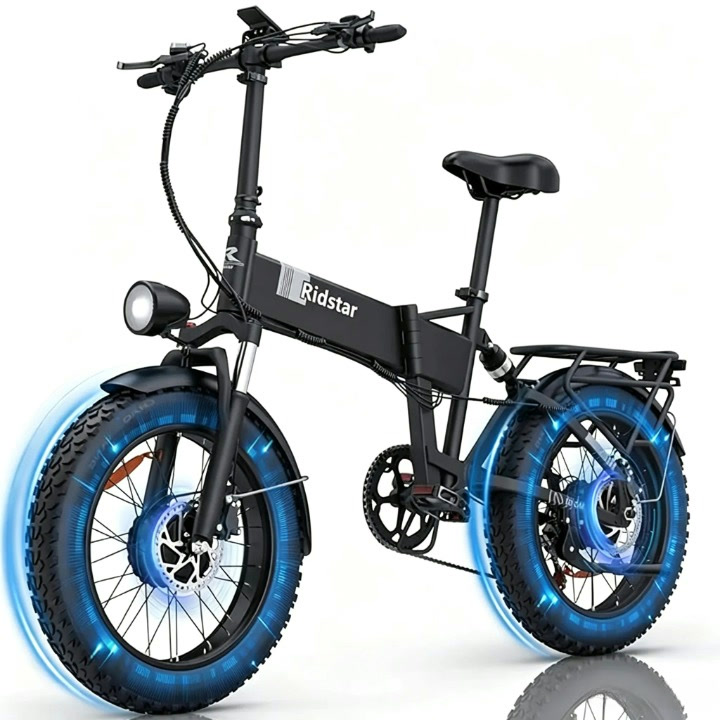
folding
Ridstar H20 Pro 2000W Folding Fat Tire E-Bike
Save $1,201
Two hub motors, a 1,104 Wh battery, hydraulic brakes at both ends, front and rear suspension and a...
Read the review
