Virginia E-Bike Laws 2026: Class 3 on Paths
Are e-bikes legal in Virginia?
E-bikes are legal in Virginia under VA Code §46.2-100, which defines an "electric power-assisted bicycle" with a motor of no more than 750 watts — the federal CPSC standard. The three-class framework (operation rules at §46.2-904.1) matches the federal model: Class 1 (20 mph pedal-assist), Class 2 (20 mph throttle), Class 3 (28 mph pedal-assist). Per the PeopleForBikes Virginia handout: by statewide default, e-bikes may be ridden on bicycle lanes and multi-use paths wherever bicycles are permitted — but §46.2-904.1 explicitly authorizes any locality or state agency with jurisdiction over a path to prohibit Class 3 e-bikes outright, and to prohibit Class 1 or Class 2 after notice and a public hearing — so always check posted rules. Class 3 operators must be 14 or older, all operators and passengers of Class 3 e-bikes must wear a helmet regardless of age, and every Class 3 e-bike must be equipped with a speedometer that displays speed in mph (§46.2-904.1). No driver license, no registration, no insurance required — e-bikes are regulated like bicycles. The biggest local context is the DC-commuter corridor in Northern Virginia (W&OD Trail, Mount Vernon Trail) and the Virginia Capital Trail between Richmond and Williamsburg.
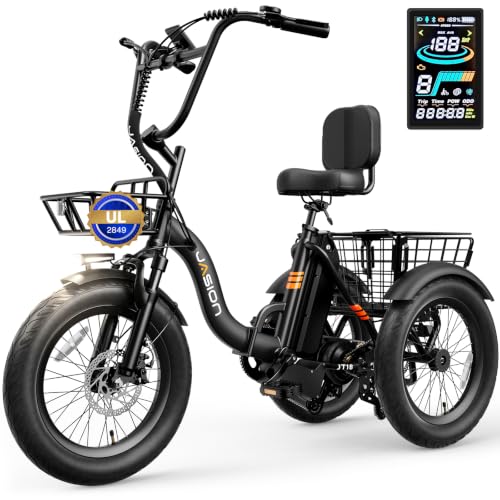
Buying one? The Funhang Fat 26 (Class 2, 20 mph) and the Jasion Electric Trike (Class 2, 16 mph) are class-legal in Virginia and in stock at Amazon. For more choice, see our best e-bikes under $500.
Legal to ride in Virginia: our top class-legal pick
As an Amazon Associate I earn from qualifying purchases. Ebike Oracle may also earn a commission on links to other retailers. Full disclosure.

Class 2 — pedal-assist + throttle to 20 mph
Class 2 · 20 mph · Score 7.4
Free 30-day returns via Amazon
Other legal picks for Virginia

Street-legal e-bikes you can buy in Virginia (2026)
Each fits a class Virginia treats as a bicycle, so it needs no registration or licence to ride.
| E-bike | Buy | Class | Speed |
|---|---|---|---|
| Funhang Fat 26 | Check price at Amazon | Class 2 | 20 mph |
| Jasion Electric Trike | Check price at Amazon | Class 2 | 16 mph |
| Qlife Cityone Plus Step-Through Commuter | Check price at Amazon | Class 3 | 28 mph |
What are the e-bike rules in Virginia?
Sourced from the Virginia statute and verified against the PeopleForBikes State Law Tracker.
Check your setup
Is your e-bike legal in Virginia?
Your match
Funhang
Funhang Fat 26
Permitted on roads, bike lanes, and bike paths in Virginia.
Our score 7.4/10
Our top class-legal pick for Virginia, street-legal to ride today.
Free 30-day returns via Amazon
The 30-second answer
E-bikes are legal in Virginia under VA Code §46.2-100, which defines an "electric power-assisted bicycle" and adopts the federal Class 1/2/3 framework (operation rules in §46.2-904.1). Virginia caps motor input at 750 W — the federal CPSC standard.
The practical rules: no driver license, no registration, no insurance for any compliant e-bike. Class 3 operators must be 14+, all Class 3 operators AND passengers must wear a helmet regardless of age, and every Class 3 e-bike must have a speedometer displaying speed in mph (§46.2-904.1). Statewide default path access: all three classes may use bike lanes and multi-use paths wherever bicycles are permitted — but the same statute lets any locality or state agency with jurisdiction over a path prohibit Class 3 (and prohibit Class 1 or Class 2 after notice and a public hearing), so check posted trail rules.
The full Virginia rules, section by section. Tap any section to read it.
Quick reference
Quick reference
| Spec | Virginia rule |
|---|---|
| Framework | Federal Class 1/2/3 |
| Definition statute | VA Code §46.2-100 |
| Operation statute | VA Code §46.2-904.1 |
| Motor power cap | ≤750 W input (federal CPSC standard) |
| Class 1 (pedal-assist, ≤20 mph) | ✅ Legal |
| Class 2 (throttle, ≤20 mph) | ✅ Legal |
| Class 3 (pedal-assist, ≤28 mph) | ✅ Legal — operator 14+ |
| Driver license | Not required for compliant e-bikes |
| Registration | Not required |
| Insurance | Not required |
| Minimum age (Class 1 + 2) | None statewide |
| Minimum age (Class 3) | 14 |
| Class 3 helmet | Required for any operator OR passenger, regardless of age |
| Bike lanes + multi-use paths | All three classes allowed wherever bicycles are permitted (subject to local restriction) |
| Local override | A city, town, or state agency with jurisdiction may restrict where e-bikes ride |
Virginia's statewide default opens bike lanes and multi-use paths to all three classes, but §46.2-904.1 gives any locality or state agency with jurisdiction over a path the power to prohibit Class 3 outright (and to prohibit Class 1 or Class 2 after notice and a public hearing). Combined with the strict all-rider Class 3 helmet rule and the statutory Class 3 speedometer requirement, Virginia is best described as middle-of-the-pack, not unusually permissive.
The three-class system in Virginia
The three-class system in Virginia
Virginia's e-bike definition lives at VA Code §46.2-100, which defines an "electric power-assisted bicycle" as a vehicle with operable pedals and an electric motor of no more than 750 watts input (the federal CPSC standard). The operating rules and three-class structure are at §46.2-904.1.
Per the PeopleForBikes Virginia handout, Virginia designates three classes of electric bicycles, matching the federal Class 1/2/3 model:
Class 1 — pedal-assist only, 20 mph cutoff
Per the PFB handout: "Bicycle equipped with a motor that provides assistance only when the rider is pedaling, and that ceases to provide assistance when the electric bicycles reaches 20 mph." No throttle. Class 1 is the most universally permitted class in Virginia — every road, bike lane, and multi-use path that allows bicycles also allows Class 1.
Class 2 — pedal-assist plus throttle, 20 mph cutoff
Per the PFB handout: "Bicycle equipped with a throttle-actuated motor, that ceases to provide assistance when the electric bicycle reaches 20 mph." Adds a throttle so the bike can move without pedaling. Same 20 mph motor cap. Allowed on roads, bike lanes, and multi-use paths where bicycles are permitted.
Class 3 — pedal-assist only, 28 mph cutoff
Per the PFB handout: "Bicycle equipped with a motor that provides assistance only when the rider is pedaling, and that ceases to provide assistance when the electric bicycle reaches 28 mph." Pedal-assist up to 28 mph. Virginia's Class 3 rules:
- Minimum age 14 to operate
- Helmet required for any operator OR passenger, regardless of age
- Speedometer required — must display the speed the bicycle is traveling in mph (§46.2-904.1)
- Statewide default: allowed on bike lanes and multi-use paths where bicycles are permitted — BUT §46.2-904.1 explicitly authorizes any locality or state agency with jurisdiction over a path to prohibit Class 3 outright (and to prohibit Class 1 or Class 2 after notice and a public hearing). Always check posted rules.
The all-rider Class 3 helmet rule is one of the stricter helmet provisions in the US, and the speedometer requirement is also unusual. Virginia opens paths to Class 3 by statewide default, but the locality-prohibition power means access is not guaranteed on any given trail.
Where can each class ride in Virginia?
Where can each class ride in Virginia?
Can you ride on the road?
All three classes are allowed on every public road in Virginia. There is no class restriction on roadways.
Bike lanes and multi-use paths
Per the PFB Virginia handout: "Electric bicycles may be ridden on bicycle lanes and multi-use paths where bicycles are permitted." That is the statewide default for all three classes — Virginia does not write a blanket Class 3 path ban into §46.2-904.1.
But §46.2-904.1 immediately delegates that decision to path managers: any locality or state agency with jurisdiction over a bicycle or shared-use path may prohibit Class 3 e-bikes on that path, and may prohibit Class 1 or Class 2 after notice and a public hearing. So always check posted trail rules — the W&OD Trail, Mount Vernon Trail, and Virginia Capital Trail each have their own posted policies, and a locality may ban Class 3 outright.
Can you ride an e-bike on the sidewalk?
No statewide e-bike sidewalk rule. Localities regulate sidewalk cycling — most Northern Virginia jurisdictions (Arlington, Alexandria, Fairfax) restrict or prohibit sidewalk riding in dense commercial corridors. Check the local ordinance.
Mountain bike trails
Per the PFB Virginia handout, USFS-managed land (the majority of Virginia's public recreation land) treats eMTBs as motorized vehicles: "eMTBs are considered motorized vehicles and have access to motorized trails." On the George Washington & Jefferson National Forests, e-bikes are restricted to designated motorized routes only. Contact the USFS Southern Regional Office for the specific trail.
Iron Mountain (Damascus) and Potts Mountain (New Castle) are popular eMTB areas — verify the motorized-route designation before riding.
Northern Virginia — the DC commuter corridor
Northern Virginia — the DC commuter corridor
Northern Virginia has the highest e-bike commuting density in the state, anchored by two major trails:
Washington & Old Dominion (W&OD) Trail — a 45-mile paved rail-trail from Arlington to Purcellville, managed by NOVA Parks. Heavy bidirectional commuter traffic. Under Virginia state law all three e-bike classes may use the trail (it's a multi-use path where bicycles are permitted), but NOVA Parks posts speed and yielding rules — verify the current trail policy before riding.
Mount Vernon Trail — an 18-mile NPS-managed paved trail along the Potomac from Arlington to Mount Vernon. Because it's National Park Service land (George Washington Memorial Parkway), NPS Order 3376 + 36 CFR §4.30(i) govern e-bike access — e-bikes are allowed where regular bikes are allowed, but verify the current superintendent's compendium.
Both trails feed DC commuters; Virginia's permissive path-access rules make the NoVA corridor one of the easiest places in the mid-Atlantic to commute by e-bike.
Virginia Capital Trail + Richmond
Virginia Capital Trail + Richmond
The Virginia Capital Trail is a 52-mile paved multi-use path connecting Richmond to Williamsburg/Jamestown. Under Virginia state law all three classes are permitted (multi-use path where bikes are allowed). The trail foundation posts cycling-speed and yielding guidance — check before riding.
Richmond also has a growing protected-bike-lane network; e-bikes follow the same rules as bicycles on city infrastructure.
Virginia State Parks
Virginia State Parks
Per the PFB Virginia handout: "The Virginia Department of Conservation and Recreation allows Class 1 and 2 electric bicycles wherever traditional bikes are allowed." This is the Virginia DCR policy — Class 1 and Class 2 are permitted on state-park trails open to bicycles; Class 3 is not specifically listed, so verify Class 3 access with the specific park before riding.
Contact the Virginia DCR for the most up-to-date park-by-park policy.
National Park Service land in Virginia
National Park Service land in Virginia
Virginia has significant NPS acreage. NPS Order 3376 + 36 CFR §4.30(i) allow e-bikes only where regular bicycles are allowed AND only on routes the park superintendent has specifically opened to e-bike use.
- Shenandoah National Park — bicycles (and e-bikes where permitted) are allowed on public paved roads (Skyline Drive) only; all trails are closed to bikes. Verify the current compendium.
- George Washington Memorial Parkway / Mount Vernon Trail — e-bikes allowed on the paved multi-use trail; verify the current superintendent's compendium.
- Colonial National Historical Park — paved roads + the Capital Trail connection; verify current rules.
- Blue Ridge Parkway — bikes allowed on the roadway; no off-road bike trails.
Always check the park superintendent's most recent compendium before riding.
Do you need a helmet, license, or registration in Virginia?
Do you need a helmet, license, or registration in Virginia?
Do you need a helmet?
The Class 3 helmet rule is set in VA Code §46.2-904.1, which reads:
"Each operator and passenger of a class three electric power-assisted bicycle shall wear a properly fitted and fastened bicycle helmet that meets the current standards provided by either the U.S. Consumer Product Safety Commission or the American Society for Testing and Materials International."
- Class 3: Any operator or passenger must wear a helmet, regardless of age (VA Code §46.2-904.1). This is one of the stricter Class 3 helmet rules in the US. Note: under the same statute, failure to wear a helmet cannot be treated as negligence or used to reduce damages in a civil action.
- Class 1 + Class 2: Virginia's general bicycle helmet rules are set by locality — many Northern Virginia jurisdictions require helmets for cyclists under 14/15. Check the local ordinance.
How old do you have to be?
- Class 1 and Class 2: no statewide minimum age.
- Class 3: 14+ minimum to operate (per PFB Virginia handout).
Do you need a license, insurance, or registration?
None of these are required to ride a compliant e-bike in Virginia. Per the PFB handout: "Electric bicycles are regulated like bicycles. The same rules of the road apply to both electric bicycles and human-powered bicycles. Electric bicycles are not subject to the registration, licensing, or insurance requirements that apply to motor vehicles."
A bike that exceeds the §46.2-100 envelope (over 750 W input or capable of more than 28 mph under motor power in a way that takes it outside the e-bike definition) is reclassified as a moped or motorcycle under Virginia's motor-vehicle code — which DOES require registration, a license, and (for motorcycles) insurance.
Do local rules differ within Virginia?
Do local rules differ within Virginia?
Arlington + Alexandria
Dense DC-suburb jurisdictions with heavy e-bike commuting. Both follow Virginia state law for path access (all classes on the W&OD and local trails) but post sidewalk-riding restrictions in commercial corridors (Crystal City, Old Town Alexandria). Check the local ordinance.
Fairfax County
Large multi-use-trail network (Fairfax County Parkway Trail, Cross County Trail). State-default path access applies; verify any park-authority restrictions.
Virginia Beach + the coast
The Virginia Beach Boardwalk has its own bicycle/e-bike rules and seasonal restrictions — verify with the city before riding the boardwalk in summer. Beach-area multi-use paths follow state-default rules.
Richmond
Growing protected-bike-lane network; e-bikes follow bicycle rules. Virginia Capital Trail access for all classes under state law.
Is Virginia changing its e-bike laws?
Is Virginia changing its e-bike laws?
Virginia's three-class framework is codified at VA Code §46.2-100 and §46.2-904.1. For current bill status and amendment history, check the Virginia Legislative Information System and the Virginia Code.
The PeopleForBikes Virginia handout is the canonical secondary source. The referenced Virginia statutes are §46.2-100, §46.2-904.1, §46.2-908.1, and §46.2-906.1.
What are the penalties for breaking e-bike laws in Virginia?
What are the penalties for breaking e-bike laws in Virginia?
Most e-bike violations in Virginia are infractions, handled at the local level:
- Class 3 helmet violation: subject to local fines.
- Under-14 operating a Class 3 e-bike: infraction — enforcement is locality-discretion.
- Sidewalk riding in restricted areas (Arlington, Alexandria, Virginia Beach Boardwalk): subject to municipal fines.
- Operating an out-of-compliance bike (outside the §46.2-100 e-bike definition) without moped/motorcycle registration and a license: treated as unlicensed motor-vehicle operation — much steeper penalties.
Enforcement is shared by municipal police (cities/towns), county sheriffs, Virginia State Police (highways), DCR rangers (state parks), and federal LEOs (NPS / USFS land).
What special e-bike rules apply in Virginia?
What special e-bike rules apply in Virginia?
Sur-Ron, Talaria, and other "e-moto" bikes
These are NOT e-bikes under Virginia law. Sur-Ron, Talaria, and similar off-road electric motorcycles exceed the 750 W input cap and the 28 mph pedal-assist Class 3 ceiling, so they fall out of VA Code §46.2-100 entirely. They are classified as mopeds or motorcycles depending on power and require registration, a license, and (for motorcycles) insurance to operate on public roads.
Is it legal to modify a Class 2 to go faster?
If you de-restrict a Class 2 e-bike so it exceeds the §46.2-100 limits, it stops being an "electric power-assisted bicycle" and is reclassified as a moped or motorcycle — requiring DMV registration, a license, and motor-vehicle equipment. Modification also typically voids the manufacturer warranty.
Can a 13-year-old ride a Class 2 e-bike in Virginia?
Statewide: yes. Virginia has no statewide minimum age for Class 1 or Class 2.
On Class 3: no — operators must be 14 or older. Class 3 also requires a helmet for every rider and passenger regardless of age.
What about other states?
What about other states?
Virginia's three-class framework is shared by most US states, but Virginia stands out for its full Class 3 path access (most states ban Class 3 from paths by default) and its strict all-rider Class 3 helmet rule (every rider, regardless of age). The PeopleForBikes State Law Tracker is the authoritative source for the current per-state count.
For a quick state-by-state check, use the e-bike legality checker — it includes all 50 US states plus the UK and EU equivalents.
For the federal-framework explanation, read the foundational guide: Class 1, 2, 3 e-bikes explained.
Bottom line
Bottom line
Virginia's statewide default opens bike lanes and multi-use paths to all three classes, including the heavily-used W&OD and Virginia Capital trails. But §46.2-904.1 lets any locality or state agency with jurisdiction over a path prohibit Class 3 outright (no notice or hearing required), and prohibit Class 1 or Class 2 after notice and a public hearing — so default access is not the same as guaranteed access. The two strict statutory rules are the all-rider Class 3 helmet requirement and the Class 3 speedometer requirement (must display speed in mph).
Stay compliant: 14+ to operate Class 3, helmet on Class 3 always (operator AND passenger), Class 3 must have a working mph speedometer, keep your bike inside the 750 W / 28 mph envelope, and check posted trail rules on the W&OD, Mount Vernon, and Virginia Capital trails — local agencies can prohibit Class 3 on their paths.
Virginia rules sourced from the PeopleForBikes Virginia handout. Statutes (§46.2-100, §46.2-904.1, §46.2-908.1, §46.2-906.1) at law.lis.virginia.gov. State park policy from the Virginia DCR. Trail rules from NOVA Parks + the Virginia Capital Trail Foundation.
E-bikes that fit Virginia's rules
Filtered from our review catalog by class eligibility under Virginia statute. Spec-matched, not popularity-ranked.
- Class 2
 Amazon
Funhang
Funhang Fat 26
Class 2 — pedal-assist + throttle to 20 mph
Permitted on roads, bike lanes, and bike paths in Virginia.500 W · 20 mph · Score 7.4
Read the review - Class 2Amazon
Jasion
Jasion Electric Trike
Class 2 — pedal-assist + throttle to 20 mph
Permitted on roads, bike lanes, and bike paths in Virginia.500 W · 16 mph · Score 7.6
Read the review - Class 3Amazon
Qlife
Qlife Cityone Plus Step-Through Commuter
Class 3 — pedal-assist to 28 mph
Virginia is one of the few states that allow Class 3 on bike paths. Riders must be 14+ per Virginia law.500 W · 28 mph · Score 7.4
Read the review
Eligibility is class-based: picks shown here are legal to own and operate on roads in Virginia. Local jurisdictions (state parks, beach paths, individual cities) may add further restrictions; see the body above for the specifics.
Recent Virginia e-bike law coverage
News-form posts that reference Virginia's statutes or covered a change affecting Virginia riders.
Frequently asked questions
Are e-bikes legal in Virginia?
Yes. E-bikes are legal in Virginia under VA Code §46.2-100, which defines an "electric power-assisted bicycle" and adopts the Class 1/2/3 framework (operation rules in §46.2-904.1). All three classes are street-legal statewide. Virginia uses the federal 750 W motor-input cap.
Do I need a license or registration to ride an e-bike in Virginia?
No. Virginia treats compliant e-bikes as bicycles, not motor vehicles. You do not need a driver license, DMV registration, license plate, or insurance — as long as the bike meets the VA Code §46.2-100 definition (motor input ≤750 W, within the three-class speed limits).
Do I have to wear a helmet on a Class 3 e-bike in Virginia?
Yes — for any operator OR passenger, regardless of age. Per the PeopleForBikes Virginia handout: "All operators and passengers of Class 3 electric bicycles must wear a helmet." This is one of the stricter Class 3 helmet rules in the US. Class 1 and Class 2 helmet rules are set by locality.
What's the minimum age for a Class 3 e-bike in Virginia?
14 years old to operate. Per the PeopleForBikes Virginia handout: "You must be 14 years or older to operate a Class 3 electric bicycle." Class 1 and Class 2 have no statewide minimum age.
Are Class 3 e-bikes allowed on bike paths in Virginia?
By statewide default, yes — per the PeopleForBikes Virginia handout: "Electric bicycles may be ridden on bicycle lanes and multi-use paths where bicycles are permitted." But VA Code §46.2-904.1 explicitly authorizes any locality or state agency with jurisdiction over a path to prohibit Class 3 e-bikes outright on that path (no notice or hearing required), and to prohibit Class 1 or Class 2 after notice and a public hearing. So always check posted rules on the W&OD, Mount Vernon, Virginia Capital, and your local park trails before riding Class 3.
Can I ride my e-bike on the W&OD Trail?
Yes. The 45-mile Washington & Old Dominion (W&OD) Trail is a multi-use path where bicycles are permitted, so all three e-bike classes may use it under Virginia state law. It's managed by NOVA Parks, which posts speed and yielding rules — verify the current trail policy before riding, since local agencies can restrict e-bike use.
Can I ride my e-bike on the Virginia Capital Trail?
Yes. The 52-mile Virginia Capital Trail (Richmond to Williamsburg/Jamestown) is a multi-use path where bicycles are permitted, so all three classes are allowed under Virginia state law. The trail foundation posts cycling-speed and yielding guidance — check before riding.
Are e-bikes allowed in Virginia state parks?
Per the PeopleForBikes Virginia handout: "The Virginia Department of Conservation and Recreation allows Class 1 and 2 electric bicycles wherever traditional bikes are allowed." Class 3 is not specifically listed for state parks, so verify Class 3 access with the specific park before riding. Contact the Virginia DCR for the current park-by-park policy.
Does Virginia allow 1,000 W e-bikes?
No — this is a common misconception. Some older guides list Virginia as a 1,000 W state (that was the pre-2020 definition), but the current VA Code §46.2-100 caps an "electric power-assisted bicycle" at 750 watts input — the federal CPSC standard. Oregon is the only US state that allows up to 1,000 W. A bike rated above 750 W is not a legal e-bike in Virginia and is treated as a moped or motorcycle.
Can I ride my e-bike in Shenandoah National Park?
Shenandoah National Park allows bicycles (and e-bikes where permitted) on public paved roads such as Skyline Drive only — all park trails are closed to bicycles. Federal NPS rules (NPS Order 3376 + 36 CFR §4.30(i)) govern e-bike access. Verify the park's current superintendent compendium before riding.
Are Sur-Ron and Talaria e-motos legal on Virginia roads?
No. Sur-Ron, Talaria, and similar high-powered off-road electric motorcycles exceed Virginia's 750 W input cap and the 28 mph Class 3 pedal-assist ceiling, so they are NOT e-bikes under VA Code §46.2-100. They are classified as mopeds or motorcycles depending on power and require registration, a license, and (for motorcycles) insurance to operate on public roads.
Is my 28 mph throttle e-bike legal in Virginia?
No. The federal Class 3 definition (and Virginia's adoption of it) is pedal-assist only to 28 mph — no throttle above 20 mph. A 28 mph throttle-equipped bike falls outside the VA Code §46.2-100 e-bike definition and is reclassified as a moped or motorcycle, requiring DMV registration and a license.
How do other states compare?
Compare Virginia's rules with states that share a similar framework.
Common e-bike law questions
The national answer to the questions Virginia riders ask most, covering every US state, side by side.
Cite or link this page
Found this useful? Link to it.
This guide is free to reference. If it helped you, a link helps more riders find accurate, up-to-date law info, and we keep it current (last reviewed July 16, 2026). Licensed CC BY 4.0. Reuse the data with attribution.
<a href="https://ebikeoracle.com/laws/virginia">Virginia E-Bike Laws 2026: Class 3 on Paths — Ebike Oracle</a>
Ebike Oracle. "Virginia E-Bike Laws 2026: Class 3 on Paths." Ebike Oracle, 2026, https://ebikeoracle.com/laws/virginia.