Review · RPINT
folding7.5/10RPINT Mini 14
Spec-verified against the manufacturer listing
Our verdict
The best-selling folding e-bike on Amazon costs $199 and is, unexpectedly, the most honestly documented bike of the three current best-sellers. RPINT claims UL 2271 for the battery and UL 2849 for the complete bike, both validated by SGS — a named certifying laboratory, which almost nothing at this price provides — states a 20 mph top speed that makes it a clean Class 2, and publishes an actual weight (55 lb) and payload (260 lb). What you give up is power: it quotes peak wattage only, its own two peak figures disagree, and 480Wh is a modest tank. As a certified, compliant, genuinely cheap first e-bike it is hard to argue with.
- Best for
- Apartment riders who need certification they can show a building manager, on a $200 budget
As an Amazon Associate I earn from qualifying purchases. Ebike Oracle may also earn a commission on links to other retailers. Full disclosure.
Free 30-day returns via Amazon

At a glance
Run this in our range calculator →The numbers
RPINT Mini 14 is a Class 2 folding e-bike that scores 7.5/10 on our editorial rubric, last verified on July 30, 2026. Amazon listed it at $199 as of July 31, 2026 — prices change often, so treat that as a snapshot. On Amazon it currently ranks #1 Best Seller in Electric Folding Bikes. It pairs a 480 Wh battery, good for a claimed range of up to 24 miles and assisted speeds up to 20 mph. As a Class 2 e-bike it adds a throttle while keeping assistance capped at 20 mph, which keeps it street-legal in nearly every US state without a licence or registration. The bike weighs 55 lb and is rated to carry 260 lb of rider and cargo. It best suits apartment riders who need certification they can show a building manager, on a $200 budget.
Pros
- + Claims UL 2271 and UL 2849 with SGS named as validator — checkable certification at $199
- + Clean Class 2 configuration: 20 mph with throttle and pedal assist, legal in every state
- + Publishes a real weight (55 lb) and payload (260 lb) where rivals publish neither
- + 413 Amazon ratings at 4.1 out of 5 — the deepest feedback pool of the current best-sellers
- + Pure-electric range claim of 20-25 miles stands up to its own battery arithmetic
- + Battery, charger, tool kit and manual all included; three riding modes and 3-speed gearing
Cons
- - Peak-only wattage, and the two published peak figures disagree (740W title vs 700W bullets)
- - No rated wattage published anywhere — the only number statutes actually regulate
- - 480Wh is the modest end of the field; the DTTZH A12 offers 720Wh for $120 more
- - Front suspension only, on 14-inch wheels — firm over broken pavement
- - 55 lb is heavy for a bike sold on portability, and folded dimensions are unpublished
- - 260 lb payload is the lowest of the three current best-sellers
Who is this for?
- Apartment riders who need certification they can show a building manager, on a $200 budget
- Last-mile commuters pairing a folded bike with a train or a car boot
- First-time e-bike buyers who want the lowest-risk possible entry point
The 30-second verdict
This is Amazon's #1 best-seller in Electric Folding Bikes (rank #9,345 site-wide in Sports & Outdoors, checked 2026-07-30) with 413 buyer ratings averaging 4.1 out of 5 — the deepest feedback pool of the three best-sellers we added this week. At $199 the expectation is a corner-cutting exercise, and the surprise is that RPINT cuts the corners you can live with while documenting the things that actually carry legal and safety weight. It claims UL 2271 for the battery pack and UL 2849 for the complete bike, and it names SGS as the validating laboratory — a specificity the $319 DTTZH A12 does not offer and the $270 ASKGO Mountain 26 does not attempt. It states a 20 mph top speed with a throttle, which makes it a textbook Class 2 e-bike, legal on most roads and many shared paths in every state. It publishes a 55 lb weight and a 260 lb payload rating, where most rivals publish neither. The costs are real but narrow: peak-only wattage claims that contradict each other, front suspension only, and a 480Wh battery that is the modest end of the current field.
The certification is the reason to buy it
Two standards matter for e-bikes and this listing names both. UL 2271 is the safety standard for the lithium battery pack; UL 2849 covers the electrical system of the complete bicycle — charger, controller, wiring, pack, together. Claiming one is common. Claiming both, and naming the body that validated them, is not.
RPINT states that compliance with both standards has been validated by SGS, one of the large international testing houses. That single detail is what separates a checkable claim from a marketing sticker: the DTTZH A12 claims UL 2849 but names no laboratory, and the TST City Commuter — Amazon's overall #1 seller — mentions no standard at all. This is not an abstract distinction any more. NYC Local Law 39 requires certified equipment to charge an e-bike battery indoors, and California SB 1271 restricts the sale of uncertified e-bikes from January 2026. If you live in an apartment building that asks the question, this $199 bike answers it better than most bikes at four times the price. Our UL-certified shortlist puts it in context, and the battery fire safety guide explains what the two standards actually test for.
Motor: peak-only, and what that hides
Here is the weak half of the disclosure. The product title advertises a 740W peak motor. The feature bullet immediately below it describes a 700W peak motor. Those are the seller's own two numbers, and they disagree. Neither is a rated figure, and no rated figure appears anywhere on the listing.
That gap matters because rated wattage is the only number statutes measure. The federal definition in 15 U.S.C. § 2085 and the state three-class laws built on it regulate continuous rated output — every US state caps e-bikes at 750W rated except Oregon, which allows 1,000W. Peak is a momentary controller ceiling during a hill start and appears in no statute. A motor with a 740W peak almost certainly carries a rated figure in the 350-500W range, which is comfortably legal everywhere but also genuinely modest: expect assistance rather than acceleration, and expect to work on hills. We leave the rated wattage field on this page blank rather than guess, because publishing a peak number in a rated field is how misinformation about e-bike legality spreads. Our class explainer covers the distinction. The good news is the speed claim: 20 mph with both throttle and pedal assist is a clean Class 2 configuration, which is more than can be said for the 25 mph ASKGO.
Range: the one claim that nearly survives its own arithmetic
The battery is 48V × 10Ah = 480Wh, removable. RPINT claims 20-25 miles in pure electric mode and 30-35 miles on pedal assist for this configuration.
Run the division and this is the rare budget listing that lands near reality. Real-world consumption is 15 to 30 Wh per mile. The 35-mile PAS claim implies 13.7 Wh per mile — a little under the floor, so optimistic, but by a margin measured in a few percent rather than the factor of two-and-a-half the ASKGO needs for its 65-mile claim. The pure-electric figure is properly honest: 480 ÷ 25 = 19.2 Wh per mile, right in the middle of the band. At a realistic 20 Wh per mile you get 24 miles, so plan on 20 to 28 miles of mixed riding and you will not be caught out. Note the title also advertises "30-60 Miles PAS Range" and a "10/20AH" battery choice: the 60-mile end belongs to a 20Ah variant, not the 10Ah build this page reviews. If your commute needs the range, buy that configuration deliberately. Our range guide has more on the arithmetic.
55 lb, 14-inch wheels, and the portability reality
RPINT publishes a 55 lb weight, which deserves credit — neither of the other two current best-sellers publishes one at all — and also deserves a reality check. 55 lb is heavy for something sold on portability. It will go in a car boot and onto a train comfortably; carrying it up two flights of stairs daily is a different proposition, and the folded dimensions are not published. The payload rating is 260 lb, the lowest of the three (the ASKGO rates 365 lb), so larger riders or anyone carrying a heavy pack should check that figure against their own numbers before ordering.
The chassis is high-carbon steel with front suspension only — no rear unit and no suspension seatpost — on 14-inch wheels. That combination is firm over broken pavement: small wheels drop into potholes larger ones roll across, and there is nothing behind the saddle to absorb the hit. Dual disc brakes are specified, correct for the weight and speed. Three riding modes are offered (full electric with three assist levels, pedal assist, and unpowered pedalling) and Amazon's spec table lists 3 speeds, so unlike the single-speed DTTZH A12 you have at least some gearing to get home on a dead battery. Battery, charger, tool kit and manual are all in the box.
Who should buy it — and who should not
Buy the RPINT Mini 14 if you want the cheapest genuinely certified e-bike on Amazon, your rides are short urban hops or last-mile-from-the-station trips, and compliance matters — this is the only one of Amazon's three current e-bike best-sellers that arrives as a clean Class 2 with both UL standards named and a laboratory attached. At $199, with 413 ratings behind it and a published weight and payload, it is the lowest-risk entry point into e-bikes we have looked at this year.
Skip it if you need power for hills (peak-only claims of 700-740W mean a modest rated motor), if your route is rough enough that front-only suspension on 14-inch wheels will punish you, or if 55 lb is more than you can carry up your stairs. For more battery at a small premium the DTTZH A12 doubles down at 720Wh for $319; for full-size wheels and real gearing the Heybike Cityscape 2.0 remains our benchmark commuter. Compare the whole bracket in our best folding e-bikes and under-$500 shortlists, and confirm what a Class 2 bike may do where you live on the street-legal-by-state guide.
Ready to buy?
See current pricing at Amazon
We update prices as the listing changes — final price is set by the retailer at checkout.
Frequently asked questions
Is the RPINT Mini 14 street legal?
Yes, as a Class 2 e-bike. The listing states a 20 mph top speed with both a throttle and pedal assist, which is the textbook Class 2 definition — legal on roads and many shared-use paths in every US state. It is the only one of Amazon's three current e-bike best-sellers that fits a class cleanly; the ASKGO Mountain 26 advertises 25 mph, which fits none. One gap: RPINT publishes no rated wattage, only a 700-740W peak, and rated watts are what statutes measure. A 740W peak motor is almost certainly rated well under the 750W cap every state except Oregon applies. Confirm path access for Class 2 in your state on our street-legal-by-state guide.
Is the RPINT Mini 14 UL certified for indoor charging?
This is its strongest feature. The listing claims compliance with UL 2271 (lithium battery packs) and UL 2849 (complete e-bike electrical systems), and names SGS as the laboratory that validated both. Naming the certifying body is what makes the claim checkable, and almost nothing at this price does it. That should satisfy indoor-charging requirements under NYC Local Law 39 and the sales restrictions California SB 1271 brings in from January 2026. Ask the seller for the certificate documents if your building requires paperwork — see our UL-certified shortlist for alternatives.
How far will the RPINT Mini 14 really go on one charge?
Plan on 20 to 28 miles of mixed pedal-assist riding from the 480Wh (48V × 10Ah) pack. Unusually for this price bracket the claims are close to credible: the 35-mile PAS figure implies 13.7 watt-hours per mile, just under the real-world 15-30 Wh/mile band, and the 20-25 mile pure-electric figure works out to 19.2 Wh per mile, which is squarely realistic. Be careful with the title, though: the "30-60 miles" and "10/20AH" span two configurations. The 60-mile end belongs to the 20Ah variant, not the 10Ah build this review covers.
How much does the RPINT Mini 14 weigh, and can I carry it upstairs?
Amazon lists 55 pounds, and RPINT publishing a figure at all puts it ahead of both other current best-sellers, neither of which discloses one. But 55 lb is heavy for a bike sold on portability: fine for lifting into a car boot or wheeling onto a train, genuinely awkward for two flights of stairs every day. The folded dimensions are not published, so if it has to fit a specific cupboard or footwell, measure the space and ask the seller first. Payload capacity is 260 lb.
What is the real motor wattage on the RPINT Mini 14?
Unknown — and that is the honest answer. The title says 740W peak, the feature bullet says 700W peak, and no rated figure appears anywhere. Rated wattage is the continuous output that 15 U.S.C. § 2085 and every state three-class statute regulate; peak is a momentary controller ceiling that appears in no law. A 740W-peak hub motor typically carries a rated figure around 350-500W, which is legal everywhere but modest — expect steady assistance rather than punch, and expect to pedal on hills. We leave the rated field blank on this page rather than pass a peak number off as rated. Our class explainer covers why the difference matters.
Bottom line
Is the RPINT Mini 14 for you?
Check the live price + availability before deciding.
If this isn't the one

folding
Heybike Mars 2.0
If you want a folding fat-tire e-bike for around $1,500 and you're shopping Amazon, the Heybike Mars 2.0...
Read the review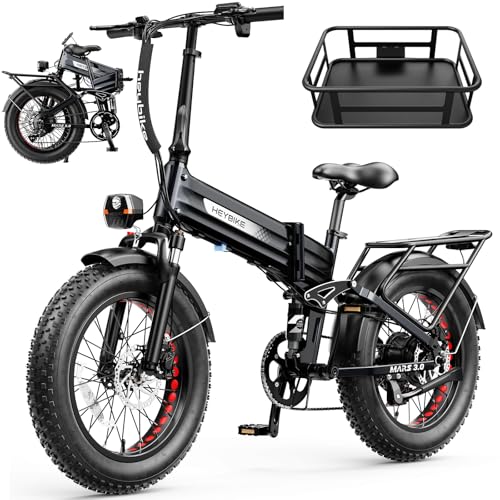
folding
Heybike Mars 3.0
The Heybike Mars 3.0 is the direct 2026 successor to the Mars 2.0: same 20×4 folding fat-tire format,...
Read the review
folding
Heybike Ranger
Save $100
The Heybike Ranger is the budget de-spec of the Heybike Ranger S — same step-through folding fat-tire frame,...
Read the review