Kansas E-Bike Laws 2026: 20 mph State Park Cap
Are e-bikes legal in Kansas?
Kansas adopted the federal three-class e-bike framework in 2022 through House Substitute for SB 101, approved by Governor Laura Kelly on 11 April 2022 and effective 1 July 2022. The definition lives at K.S.A. §8-1489 (electric-assisted bicycle = two or three wheels, saddle, fully operative pedals, electric motor of less than 750 watts, meeting one of the three classes). The operating rules are at K.S.A. §8-1592b: e-bikes are not motor vehicles; no driver license, no vehicle registration, no certificate of title, no license plate, and no vehicle liability insurance required. The motorcycle definition at K.S.A. §8-1438 was amended to explicitly exclude electric-assisted bicycles — that is the statutory hook keeping e-bikes out of the DMV regime. Kansas has NO statewide helmet rule for any class at any age. Class 3 operator minimum age is 16 (passengers under 16 are allowed on a Class 3 designed for passengers).
The headline practical wrinkle is not in the statute — it is in Kansas Department of Wildlife and Parks (KDWP) policy: only e-bikes that cease providing assistance at 20 mph may be used in state parks, which effectively allows Classes 1 and 2 and excludes Class 3 from Kansas's marquee rail-trails (Flint Hills Trail State Park, Prairie Spirit Trail State Park, Landon Nature Trail). Johnson County Park and Recreation District (Kansas City metro) runs a different overlay: Classes 1 and 3 ✅, Class 2 ❌ — one of the few jurisdictions in the country where throttle is the disqualifier and Class 3 pedal-assist is allowed.
Legal to ride in Kansas: our top class-legal pick
As an Amazon Associate I earn from qualifying purchases. Ebike Oracle may also earn a commission on links to other retailers. Full disclosure.

Class 2 — pedal-assist + throttle to 20 mph
Class 2 · 20 mph · Score 8.6
Free 30-day returns via Amazon
Other legal picks for Kansas

Street-legal e-bikes you can buy in Kansas (2026)
Each fits a class Kansas treats as a bicycle, so it needs no registration or licence to ride.
| E-bike | Buy | Class | Speed |
|---|---|---|---|
| Funhang City Cruiser 26 | Check price at Amazon | Class 2 | 20 mph |
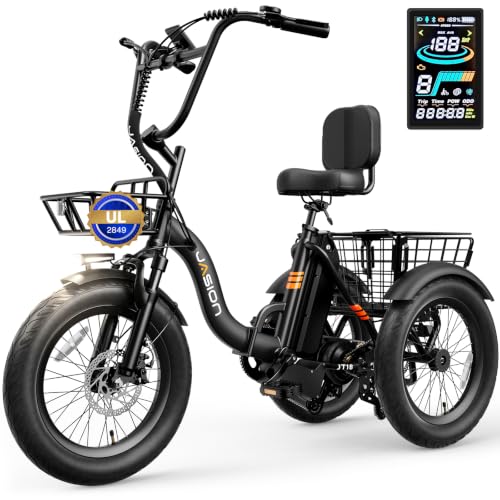
| Jasion Electric Trike | Check price at Amazon | Class 2 | 16 mph |
| Gotrax Dolphin 26" Step-Through Commuter | Check price at Amazon | Class 2 | 20 mph |
What are the e-bike rules in Kansas?
Sourced from the Kansas statute and verified against the PeopleForBikes State Law Tracker.
Check your setup
Is your e-bike legal in Kansas?
Your match
Funhang
Funhang City Cruiser 26
Permitted on roads, bike lanes, and bike paths in Kansas.
Our score 8.6/10
Our top class-legal pick for Kansas, street-legal to ride today.
Free 30-day returns via Amazon
The 30-second answer
E-bikes are legal across Kansas under the federal Class 1/2/3 framework adopted by 2022 House Substitute for SB 101, signed by Governor Laura Kelly on 11 April 2022 and effective 1 July 2022. The definition is at K.S.A. §8-1489 (motor less than 750 watts); the operating rules are at K.S.A. §8-1592b.
Three things to know about Kansas:
- No DMV anything. K.S.A. §8-1592b expressly says e-bikes do not require a driver license, vehicle registration, certificate of title, license plate, or liability insurance. K.S.A. §8-1438 (the motorcycle definition) was amended to explicitly exclude electric-assisted bicycles — that is the statutory hook keeping e-bikes out of the Kansas DMV regime.
- No statewide helmet rule. For any class, any age, anywhere in Kansas. Helmet rules, where they exist, are municipal-only (Topeka requires helmets under 18 for e-scooters, but not bicycles).
- The KDWP 20 mph state-park cap is the real bite. The statute lets all three classes on paths by default — but Kansas Department of Wildlife and Parks allows only e-bikes that cease providing assistance at 20 mph, which effectively allows Class 1 and Class 2 and excludes Class 3 from the marquee rail-trails (Flint Hills Trail State Park, Prairie Spirit Trail State Park, Landon Nature Trail).
The full Kansas rules, section by section. Tap any section to read it.
Quick reference
Quick reference
| Spec | Kansas rule |
|---|---|
| Framework | Federal Class 1/2/3 (adopted 2022, House Sub. for SB 101) |
| Definition statute | K.S.A. §8-1489 |
| Operating rules | K.S.A. §8-1592b |
| Motorcycle exclusion (DMV exemption hook) | K.S.A. §8-1438 — "Motorcycle... excluding an electric-assisted bicycle" |
| Enacting bill | 2022 House Sub. for SB 101 — signed 11 Apr 2022, effective 1 Jul 2022 |
| Governor | Laura Kelly |
| Motor power cap | <750 W (§8-1489, strict inequality) |
| Class 1 (pedal-assist, ≤20 mph) | ✅ Legal · paths ✅ default · state parks ✅ |
| Class 2 (throttle, ≤20 mph) | ✅ Legal · paths ✅ default · state parks ✅ · Johnson County Parks ❌ |
| Class 3 (pedal-assist, ≤28 mph) | ✅ Legal · operator 16+ · roads ✅ · state parks ❌ (KDWP 20 mph cap) |
| Driver license | Not required (§8-1592b) |
| Registration | Not required |
| Certificate of title | Not required |
| License plate | Not required |
| Vehicle liability insurance | Not required |
| Statewide helmet rule | None — for any class, any age |
| Minimum age (Class 1 + 2) | None |
| Minimum age (Class 3 operator) | 16 (§8-1592b) |
| Class 3 passenger under 16 | Allowed if the Class 3 is designed for passengers (§8-1592b) |
| Manufacturing / labeling | Permanently affixed class label required (§8-1592b) |
| Path access (statewide default) | All three classes permitted where bicycles are; cities and agencies may restrict (§8-1592b) |
| Kansas State Parks (KDWP) | Class 1 + 2 ✅; Class 3 ❌ — 20 mph assistance cap, trails approved for bicycle use only |
| Flint Hills Trail State Park (~117 mi rail-trail) | Class 1 + 2 ✅; Class 3 ❌ (KDWP) |
| Prairie Spirit Trail State Park (~51 mi Ottawa→Iola) | Class 1 + 2 ✅; Class 3 ❌ (KDWP) |
| Landon Nature Trail (~38 mi Topeka→Lomax Jct) | Class 1 + 2 ✅; Class 3 ❌ (KDWP / Kanza Trails) |
| Johnson County Park and Rec District | Class 1 + Class 3 ✅; Class 2 ❌ (throttle is the disqualifier) |
| Overland Park | E-bike speed cap 20 mph; operation limited to streets posted ≤35 mph |
| Wichita | Sidewalk bicycling allowed everywhere except the Central Business District |
| Topeka | Downtown / NOTO sidewalk bicycling ban; e-scooter (not e-bike) ordinance requires age 16+ and helmets under 18 |
| Tallgrass Prairie National Preserve (only NPS unit in KS) | Bicycles prohibited on backcountry hiking trails (NPS) |
Two practical reads. First, Kansas's statewide statute is among the cleaner three-class regimes in the country — no license, no registration, no title, no plate, no insurance, no statewide helmet rule, no minimum age for Class 1 or Class 2, and a permissive path-access default. Second, the bite is administrative: the KDWP 20 mph state-park rule closes Class 3 out of the Flint Hills Trail and Prairie Spirit Trail (the two biggest rail-trails in the state), and Johnson County Parks runs a rare throttle-disqualifier overlay. Check the trailhead sign before riding.
The three-class system in Kansas
The three-class system in Kansas
Kansas defines an "electric-assisted bicycle" at K.S.A. §8-1489:
"Electric-assisted bicycle" means a bicycle with two or three wheels, a saddle, fully operative pedals for human propulsion, and an electric motor of less than 750 watts, and that meets the requirements of one of the following three classes:
- Class 1 — "a motor that provides assistance only when the rider is pedaling and ceases to provide assistance when the bicycle reaches the speed of 20 miles per hour."
- Class 2 — "a motor that may be used exclusively to propel the bicycle and is not capable of providing assistance when the bicycle reaches the speed of 20 miles per hour."
- Class 3 — "a motor that provides assistance only when the rider is pedaling and ceases to provide assistance when the bicycle reaches the speed of 28 miles per hour."
The framework was enacted by 2022 House Substitute for SB 101, signed by Governor Laura Kelly on 11 April 2022, effective 1 July 2022.
Why some sources cite the wrong statute
You will see retailer blogs cite "K.S.A. §8-1438" as the Kansas e-bike law. That is not the e-bike statute. §8-1438 is the motorcycle definition — which was amended by SB 101 to exclude electric-assisted bicycles. That exclusion is the statutory hook that keeps e-bikes out of the Kansas DMV regime, but the definitional statute is §8-1489 and the operating rules live at §8-1592b. When verifying a Kansas e-bike question, those are the two sections to read.
Where can you ride an e-bike in Kansas?
Where can you ride an e-bike in Kansas?
Can you ride on roads and bike lanes?
Same rights and duties as a regular bicycle. K.S.A. §8-1592b expressly says an electric-assisted bicycle may be operated on streets, highways, roadways, and bicycle lanes. All three classes.
Multi-use paths — permissive by default, KDWP overlay closes Class 3 out of state parks
The statewide default under K.S.A. §8-1592b is permissive for all three classes: e-bikes may be ridden where bicycles are permitted, including multi-use paths — unless restricted by a city or the agency with jurisdiction.
The big administrative overlay is Kansas Department of Wildlife and Parks: only e-bikes that cease providing assistance at 20 mph may be used in Kansas state parks, and only on trails already approved for bicycle use. That effectively allows Class 1 and Class 2 (both cap at 20 mph) and excludes Class 3 (which assists to 28 mph). The policy was announced 26 September 2019.
The practical consequence: Class 3 is shut out of the two biggest rail-trails in the state.
Flint Hills Trail State Park (~117 mi)
The Flint Hills Trail State Park runs ~117 miles along the rail-banked former Missouri Pacific corridor from Osawatomie to Herington — making it the longest rail-trail in Kansas and one of the longest in the United States. Established as a state park by the Kansas Legislature in 2018.
- Class 1 and Class 2: ✅ permitted (KDWP 20 mph rule).
- Class 3: ❌ prohibited (KDWP 20 mph rule, not statute).
- Non-motorized travel only — hiking, biking, horseback.
Prairie Spirit Trail State Park (~51 mi)
The Prairie Spirit Trail State Park runs ~51 miles between Ottawa and Iola along the former Atchison, Topeka & Santa Fe corridor.
- Class 1 and Class 2: ✅ permitted (KDWP 20 mph rule).
- Class 3: ❌ prohibited (KDWP 20 mph rule).
- Trail-use permit required for anyone 16+ outside the city limits of Ottawa, Garnett, and Iola — see bikeprairiespirit.com/rules.
Landon Nature Trail (~38 mi)
The Landon Nature Trail runs ~38 miles from Topeka south to Lomax Junction (managed by Kanza Trails). Same KDWP-tier 20 mph regime applies on the state-park-managed segments — Class 1 + 2 ✅, Class 3 ❌.
Johnson County Park and Recreation District — the throttle-disqualifier overlay
In the Kansas City metro, the Johnson County Park and Recreation District runs an unusual overlay on its shared-use paved trail network: Classes 1 and 3 are permitted, but Class 2 is NOT. This is one of the rare jurisdictions in the country where throttle operation is the disqualifier and Class 3 pedal-assist is allowed (most jurisdictions invert this — Class 1 + 2 ✅, Class 3 ❌).
The rationale: Class 2 throttle operation is treated as "motorized" by JCPRD policy, while Class 3 pedal-assist is treated as a higher-speed bicycle. If you ride a Class 2 in Johnson County, you are on the road or off-trail.
Can you ride an e-bike on the sidewalk?
No statewide sidewalk rule for bicycles or e-bikes. Cities control:
- Wichita: Sidewalk bicycling is allowed everywhere except the Central Business District (unless the CBD sidewalk is signed for bicycle use). Riders must yield to pedestrians and give an audible signal before passing — see the City of Wichita FAQ.
- Topeka: Downtown / NOTO sidewalk bicycling is banned by ordinance. Topeka's separate e-scooter ordinance requires riders to be 16+ and to wear a helmet under 18 — that rule does not apply to e-bikes.
- Lawrence: Bicycles prohibited on Downtown sidewalks (city code).
- Overland Park: E-bike speed cap of 20 mph and operation limited to streets posted at 35 mph or lower.
- Kansas City, KS / Kansas City, MO: Different jurisdictions; check the relevant Unified Government / city code before riding.
Can you ride an e-bike on federal land in Kansas?
Can you ride an e-bike on federal land in Kansas?
- Tallgrass Prairie National Preserve (the only NPS unit in Kansas, in the Flint Hills near Strong City): per NPS guidance, the three signed nature trails are dog-friendly but the backcountry hiking trails are for hikers only — no bicycles, no e-bikes. Bicycle parking is available at the visitor center.
- USFS lands in Kansas: Kansas has no national forest, so there is no statewide USFS e-bike posture to verify (unlike Idaho, Colorado, Montana). The federal context is governed by DOI Secretary's Order 3376 on the few federal recreation lands in the state.
- Konza Prairie Biological Station (The Nature Conservancy / Kansas State University, in the Flint Hills): nature trails are open dawn-to-dusk to the public, but the area is primarily a research station and bicycle access is not the default. Confirm at the trailhead.
Do you need a helmet, license, or registration in Kansas?
Do you need a helmet, license, or registration in Kansas?
| Topic | Kansas rule |
|---|---|
| Driver license | Not required (§8-1592b) |
| Registration | Not required |
| Certificate of title | Not required |
| License plate | Not required |
| Vehicle liability insurance | Not required (common-law liability still applies) |
| Statewide helmet | None — Kansas has no statewide bicycle or e-bike helmet law for any class at any age. Municipal-only. |
| Minimum age (Class 1 + 2) | None |
| Minimum age (Class 3 operator) | 16 (§8-1592b) |
| Class 3 passenger under 16 | Allowed if the Class 3 is designed to accommodate passengers (§8-1592b) |
| Class 3 labeling | Required — permanently affixed class label on the bike (§8-1592b) |
Kansas's permissive baseline — no helmet, no Class 1/2 age, Class 3 just 16, no license/registration/title/plate/insurance — makes it one of the simpler statewide e-bike regimes in the United States. The administrative trade-off is the KDWP 20 mph state-park cap, which closes Class 3 out of the marquee rail-trails.
Is Kansas changing its e-bike laws?
Is Kansas changing its e-bike laws?
- 2025–2026 session — no e-bike-specific bills enacted that change the §8-1489 / §8-1592b regime. Verify against the Kansas Legislature bill tracker before relying on this for any active dispute.
- 2024 session — no e-bike-specific bills enacted.
- 2023 session — no e-bike-specific bills enacted; the 2022 framework (House Sub. for SB 101) remains the operative law.
Current law remains: K.S.A. §8-1489 (definition + classes) + K.S.A. §8-1592b (operating rules, license/registration/insurance exemption, Class 3 age 16, manufacturing requirements, location of operation) + K.S.A. §8-1438 (motorcycle exclusion hook).
What are the penalties for breaking e-bike laws in Kansas?
What are the penalties for breaking e-bike laws in Kansas?
Kansas does not impose a specific statutory penalty for operating an out-of-class e-bike (e.g., a 1,000 W direct-drive at 32 mph). Two enforcement pathways apply:
- Reclassification as a motor vehicle. A two-wheeler that exceeds the §8-1489 motor cap (≥750 W) or speed caps falls outside the electric-assisted bicycle definition. It then defaults into the motorcycle / moped regime under K.S.A. §8-1438 et seq. — full driver license, registration, title, plate, and liability insurance required, with the usual misdemeanor penalties for driving without each.
- Local ordinance penalties. Riding a Class 3 on a KDWP state-park trail or on a Johnson County Parks paved trail with a Class 2 violates the agency's posted rule, typically resulting in a written warning escalating to a citation under the agency's general code-of-conduct authority.
What special e-bike rules apply in Kansas?
What special e-bike rules apply in Kansas?
What if you are riding in from out of state?
A bicycle that meets the §8-1489 definition is street-legal in Kansas regardless of where it was bought. The bike does not need a Kansas-issued label as long as it carries the manufacturer's permanent class label. The Class 3 operator age of 16 applies to the rider, not the bike.
DIY / converted e-bikes
A homebuilt or conversion-kit e-bike still qualifies under §8-1489 if it has two or three wheels, a saddle, fully operative pedals, a motor under 750 W, and behaves within one of the three class speed caps. The §8-1592b labeling requirement is on the manufacturer — for a DIY build the practical workaround is a sticker or plate noting "Class 1/2/3" so that an enforcement officer can read the configuration without disassembly.
Cargo e-bikes and family hauling
Kansas has no specific cargo-e-bike or passenger-carrying rule. The §8-1592b provision allowing under-16 passengers on a Class 3 "designed to accommodate passengers" is the relevant clause — practical for parents using a longtail or front-loader Class 3 to carry kids on roads where Class 3 is allowed. State parks remain a Class 1 + 2 zone regardless of cargo configuration.
E-bike share / rental fleets
Operators (e.g., Spin, Lime, university bike-share programs) deploy fleets configured to the local overlay: typically Class 1 or Class 2 capped at 20 mph to satisfy both the KDWP state-park rule and most municipal speed caps. Johnson County Parks' Class-2-prohibition is the geographic exception to watch.
Bottom line
Bottom line
Kansas runs one of the cleanest three-class statewide regimes in the country: no license, no registration, no title, no plate, no insurance, no statewide helmet rule, no minimum age for Class 1 or Class 2, Class 3 age 16, and a permissive path-access default. The two practical wrinkles to remember are (1) the KDWP 20 mph state-park cap closes Class 3 out of the Flint Hills Trail and Prairie Spirit Trail — the two biggest rail-trails in the state — and (2) Johnson County Parks runs a rare throttle-disqualifier overlay (Classes 1 + 3 ✅, Class 2 ❌). Read the trailhead sign, ride within your class, and the Kansas statute leaves you alone.
Check your setup against Kansas law
Check your setup against Kansas law
The rules above are the statewide baseline. Two things decide whether a specific bike is legal for a specific rider: which class it actually is, and how old the rider is.
- E-bike legality checker — enter motor wattage, top assisted speed, throttle and rider age, and get the Kansas verdict with the statute reference.
- Class 1, 2, 3 e-bikes explained — what the three classes mean and why the label on the frame is the thing states regulate. Most compliance problems are a bike that was never in-class to begin with.
- All 50 states + DC compared — one sortable table: classification tier, Class 3 legality, path access, helmet rule, minimum age, licence and registration.
Sources
Sources
- K.S.A. §8-1489 — Electric-assisted bicycle definition + three classes
- K.S.A. §8-1438 — Motorcycle definition (excludes electric-assisted bicycles)
- 2022 House Substitute for SB 101 — enacting bill, full record
- 2022 SB 101 — Legislative summary (Defining and Regulating Electric-Assisted Bicycles)
- Kansas Legislative Research Department — Kansas Laws on Bicycle, E-Bike, and Scooter Operation
- KDWP — E-bicycles Now Legal at Kansas State Parks (26 Sept 2019, 20 mph cap policy)
- Flint Hills Trail State Park — KDWP
- Prairie Spirit Trail State Park — Travel Kansas
- Bike Prairie Spirit Trail — Rules + permit info
- Kanza Trails — Flint Hills Trail / Landon Nature Trail
- Tallgrass Prairie National Preserve — NPS
- City of Wichita — bicycle on sidewalk FAQ
- DOI Secretary's Order 3376 — federal lands e-bike policy
- PeopleForBikes — Kansas e-bike law handout (2020 baseline)
- PeopleForBikes State E-Bike Law Tracker
E-bikes that fit Kansas's rules
Filtered from our review catalog by class eligibility under Kansas statute. Spec-matched, not popularity-ranked.
- Class 2
 Amazon
Funhang
Funhang City Cruiser 26
Class 2 — pedal-assist + throttle to 20 mph
Permitted on roads, bike lanes, and bike paths in Kansas.500 W · 20 mph · Score 8.6
Read the review - Class 2AmazonSave $25
Jasion
Jasion Electric Trike
Class 2 — pedal-assist + throttle to 20 mph
Permitted on roads, bike lanes, and bike paths in Kansas.500 W · 16 mph · Score 7.6
Read the review - Class 2AmazonSave $55
Gotrax
Gotrax Dolphin 26" Step-Through Commuter
Class 2 — pedal-assist + throttle to 20 mph
Permitted on roads, bike lanes, and bike paths in Kansas.350 W · 20 mph · Score 7.1
Read the review
Eligibility is class-based: picks shown here are legal to own and operate on roads in Kansas. Local jurisdictions (state parks, beach paths, individual cities) may add further restrictions; see the body above for the specifics.
Recent Kansas e-bike law coverage
News-form posts that reference Kansas's statutes or covered a change affecting Kansas riders.
Frequently asked questions
Are e-bikes legal in Kansas?
Yes. Kansas adopted the federal Class 1/2/3 framework via 2022 House Substitute for SB 101, signed by Governor Laura Kelly on 11 April 2022 and effective 1 July 2022. The definition is at K.S.A. §8-1489 (motor less than 750 watts, two or three wheels, saddle, fully operative pedals, meeting one of the three classes). The operating rules are at K.S.A. §8-1592b. All three classes are street-legal and treated as bicycles, not motor vehicles — and K.S.A. §8-1438 (the motorcycle definition) was amended to explicitly exclude electric-assisted bicycles.
Do you need a license, registration, or insurance for an e-bike in Kansas?
No to all of them. K.S.A. §8-1592b expressly says an electric-assisted bicycle meeting the §8-1489 definition does not require a driver's license, vehicle registration, certificate of title, license plate, or vehicle liability insurance. Common-law liability for negligent operation still applies, but you carry no DMV paperwork.
Does Kansas require a helmet on an e-bike?
No statewide helmet rule — for any class, any age, any rider. Kansas has no statewide bicycle or e-bike helmet law. Some municipalities may impose helmet ordinances for specific vehicle types — Topeka, for example, requires under-18 helmets for e-scooter riders — but those rules do not apply to e-bikes statewide. Always verify the local ordinance for the city you are riding in.
What is the minimum age to ride an e-bike in Kansas?
Only for operating a Class 3. K.S.A. §8-1592b sets the Class 3 operator minimum age at 16. A person under 16 may still ride as a passenger on a Class 3 that is designed to accommodate passengers (which is the practical hook for longtail and front-loader cargo Class 3 builds that carry kids). No minimum age for Class 1 or Class 2 operators.
Are Class 3 e-bikes allowed in Kansas state parks?
No. Per Kansas Department of Wildlife and Parks (KDWP), only e-bikes that cease providing assistance at 20 mph may be used in Kansas state parks. That effectively allows Class 1 and Class 2 and excludes Class 3 (which assists to 28 mph) from the Flint Hills Trail State Park, Prairie Spirit Trail State Park, Landon Nature Trail, and all other KDWP units. This is administrative policy, not statute — the statewide §8-1592b default permits all three classes; KDWP narrowed it for its own units.
What is the rule for Johnson County Park and Recreation District?
Classes 1 and 3 are permitted; Class 2 is NOT. Johnson County Park and Recreation District (the agency for the southwest Kansas City metro) runs one of the rare overlays in the country where throttle is the disqualifier: Class 2 (throttle-to-20-mph) is banned on its shared-use paved trail network, while Class 1 (pedal-assist to 20 mph) and Class 3 (pedal-assist to 28 mph) are both allowed. The rationale: Class 2 throttle operation is treated as "motorized" by JCPRD policy. If you ride a Class 2 in Johnson County, you are on the road or off-trail.
Can I ride an e-bike on the sidewalk in Kansas?
No statewide rule — cities control. Wichita allows sidewalk bicycling everywhere except the Central Business District (unless the CBD sidewalk is signed for bicycle use); riders must yield to pedestrians and give an audible signal before passing — see the City of Wichita FAQ. Topeka bans bicycling on downtown / NOTO sidewalks. Lawrence prohibits bicycling on Downtown sidewalks. Overland Park caps e-bike speed at 20 mph and limits operation to streets posted at 35 mph or lower. Check the city code for wherever you are riding.
What is the motor power limit for e-bikes in Kansas?
Less than 750 watts under K.S.A. §8-1489 (strict inequality — less than, not up to). Kansas is not a 1,000-watt state. A bike whose motor is rated at 750 W or more, or whose throttle alone propels it past the class speed cap, falls outside §8-1489 and defaults into the motorcycle / moped regime — full driver license, registration, title, plate, and liability insurance required under K.S.A. §8-1438 et seq.
Are e-bikes allowed on the Flint Hills Trail and Prairie Spirit Trail?
Class 1 and Class 2 only. The Flint Hills Trail State Park (~117 mi, one of the longest rail-trails in the United States) and the Prairie Spirit Trail State Park (~51 mi Ottawa to Iola) are both managed by KDWP, so the 20 mph state-park assistance cap applies — Class 1 ✅, Class 2 ✅, Class 3 ❌. The Prairie Spirit Trail also requires a trail-use permit for anyone 16 or older outside the city limits of Ottawa, Garnett, and Iola — see bikeprairiespirit.com/rules.
Are bicycles or e-bikes allowed at Tallgrass Prairie National Preserve?
Bicycles are allowed at the visitor center (there is a bike rack) but are prohibited on the backcountry hiking trails per NPS rules. The three nature trails (1.6 to 6 miles) are dog-friendly but the longer backcountry trails (3.8 to 13 miles) are for hikers only. The preserve, in the Flint Hills near Strong City, is the only NPS unit in Kansas and the only NPS unit in the country dedicated to tallgrass prairie. The general DOI e-bike policy under Secretary's Order 3376 treats e-bikes as bicycles for trail-access purposes — so wherever a regular bicycle is banned, an e-bike is also banned.
How do other states compare?
Compare Kansas's rules with states that share a similar framework.
Common e-bike law questions
The national answer to the questions Kansas riders ask most, covering every US state, side by side.
Cite or link this page
Found this useful? Link to it.
This guide is free to reference. If it helped you, a link helps more riders find accurate, up-to-date law info, and we keep it current (last reviewed May 31, 2026). Licensed CC BY 4.0. Reuse the data with attribution.
<a href="https://ebikeoracle.com/laws/kansas">Kansas E-Bike Laws 2026: 20 mph State Park Cap — Ebike Oracle</a>
Ebike Oracle. "Kansas E-Bike Laws 2026: 20 mph State Park Cap." Ebike Oracle, 2026, https://ebikeoracle.com/laws/kansas.