Throttle vs Pedal-Assist: Which E-Bike Is Right?
Pedal-assist gives the motor power only while you pedal; a throttle delivers power on demand without pedaling. They are not either/or — a Class 2 e-bike has both, while Class 1 and Class 3 are pedal-assist only. Choose a throttle if you want effortless starts, help on hills from a standstill, or stop-and-go city riding. Choose pedal-assist (ideally with a...
The short version
- Pedal-assist gives power only while you pedal. A throttle gives power on demand, pedalling or not.
- They are not either/or — a Class 2 e-bike has both. Class 1 and Class 3 are pedal-assist only.
- Pick a throttle for effortless starts, hill starts from a standstill, and stop-and-go city riding.
- Pick pedal-assist (ideally with a torque sensor) for natural feel, more range, more exercise, and the widest trail access.
- Most US riders are happiest on a Class 2, which offers both and is treated like Class 1 almost everywhere.

Our pick for most readers
Funhang City Cruiser 26
$320
As an Amazon Associate I earn from qualifying purchases. Ebike Oracle may also earn a commission on links to other retailers. Full disclosure.
TL;DR — throttle or pedal-assist?
They solve different problems, and many bikes give you both:
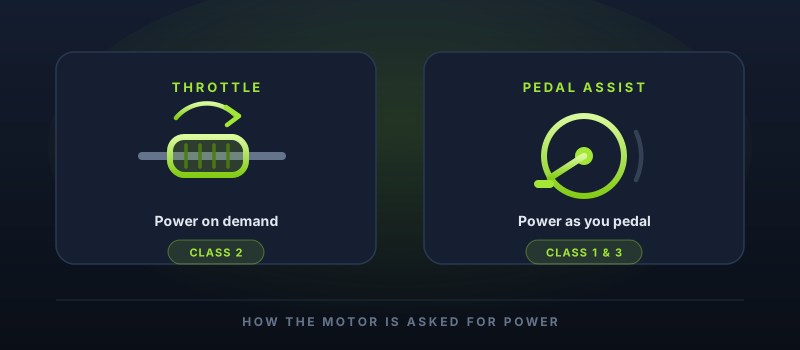
- Pedal-assist (PAS) — the motor adds power only while you pedal. It feels like a strong tailwind and is what defines Class 1 and Class 3 e-bikes.
- Throttle — a thumb lever or twist grip that delivers power on demand without pedaling, like a scooter. A throttle is what defines a Class 2 e-bike.
It is not a strict either/or: a Class 2 bike has a throttle and pedal-assist, so you get both. Pick based on how you ride — throttle for effortless, stop-and-go, hills-from-a-stop; pedal-assist for natural feel, more range, more exercise, and the widest legal access. Most US buyers are best served by a Class 2 (both) or a Class 1 (pedal-assist only) for maximum path access.
The full guide, section by section. Tap any section to read it.
The three setups, side by side
The three setups, side by side
| Setup | How power is delivered | Typical class | Best for |
|---|---|---|---|
| Pedal-assist only | Motor helps only while you pedal | Class 1 (20 mph), Class 3 (28 mph) | Natural feel, range, exercise, trail/path access |
| Throttle | Power on demand, no pedaling needed | Class 2 (20 mph) | Effortless starts, hills from a stop, stop-and-go |
| Both (throttle + PAS) | Switch between as you like | Class 2 | Maximum flexibility — the most common US setup |
See the full legal breakdown in Class 1, 2 & 3 e-bikes explained.
Pedal-assist quality: torque sensor vs cadence sensor
Pedal-assist quality: torque sensor vs cadence sensor
If you go pedal-assist, the sensor matters more than almost any other spec for ride feel:
- Torque sensor — measures how hard you pedal and scales motor power proportionally. The ride feels natural and responsive, like your legs are simply stronger. Found on better bikes; the upgrade most riders notice immediately.
- Cadence sensor — only detects whether you are pedaling and delivers a preset power level. Cheaper, but it tends to surge on and lag off, which can feel abrupt.
A throttle bypasses the sensor entirely — you just press for power. If natural ride feel is your priority, prioritise a torque sensor; if on-demand power is your priority, prioritise a throttle. The best commuters offer a torque-sensed pedal-assist and a throttle.
When to choose a throttle
When to choose a throttle
A throttle earns its keep if you:
- Ride stop-and-go city streets — getting moving from every light without pedaling hard is genuinely nice.
- Need help starting on hills — a throttle gets a heavy or loaded bike rolling from a dead stop.
- Have knee, hip, or recovery limits — power without pedaling load lowers the barrier to riding.
- Haul cargo or kids — launching a heavy cargo bike is easier on the throttle.
- Want a "moped moment" — to rest your legs on the last stretch home.
The trade-offs: throttle riding uses more battery (see range below) and pushes the bike into Class 2, which some bike paths restrict.
When to choose pedal-assist
When to choose pedal-assist
Pedal-assist (especially torque-sensed) is the better default if you:
- Want the most range — pedaling shares the load, so the battery lasts longer.
- Want exercise — you are still riding a bike, just with help.
- Want the widest legal access — Class 1 (pedal-assist, 20 mph) is allowed on the most bike paths and trails.
- Want a natural ride feel — a torque sensor makes the assist disappear into your pedaling.
- Ride longer distances — efficient assist plus your own effort goes farther.
The legal angle — it changes where you can ride
The legal angle — it changes where you can ride
This is the part buyers miss: the throttle decides your class, and your class decides where you can ride.
- A throttle makes a bike Class 2, which many shared-use paths and trails restrict relative to Class 1.
- Class 1 (pedal-assist, 20 mph) has the broadest access — most paths allow it.
- A throttle that works above 20 mph, or a bike over the power cap, falls out of the three-class system and is regulated as a moped.
Rules vary by state and city, so confirm before you buy: read your state's e-bike law page and run your ZIP through the legality checker.
The range angle — throttle costs miles
The range angle — throttle costs miles
Throttle-only riding draws far more energy than pedal-assist — roughly 25–30+ watt-hours per mile versus 10–20 Wh/mi when you pedal along. In practice, leaning on the throttle can cut your range by a third or more. If you want both maximum range and the convenience of a throttle, pedal with light assist most of the time and save the throttle for hills and tired legs. Full detail in how far can an e-bike go.
Catalog examples
Catalog examples
How the setups show up across our reviews (verified specs):
| Setup | Class | Catalog example |
|---|---|---|
| Pedal-assist only | Class 1 (20 mph) | Eleglide T1, Gotrax Nano |
| Throttle + pedal-assist | Class 2 (20 mph) | Jasion EB5, Gotrax R1 |
| Pedal-assist only | Class 3 (28 mph) | Heybike Mars 3 |
If you are still deciding on the whole bike, work through how to choose an e-bike, and for the motor that drives either system, see mid-drive vs hub motor.
Bottom line
Bottom line
Throttle and pedal-assist are not rivals — a Class 2 bike gives you both, and that flexibility is why it's the most popular US setup. Choose a throttle for effortless, stop-and-go, hill-start riding; choose pedal-assist (ideally torque-sensed) for natural feel, more range, more exercise, and the widest path access. Just remember the throttle pushes you into Class 2 and costs range — so if maximum trail access or distance is the goal, a torque-sensed Class 1 may serve you better.
Next: Class 1, 2 & 3 explained, the e-bike glossary for every term, and how to choose an e-bike.
Best throttle bike we rate
 Amazon
Funhang
Funhang City Cruiser 26
If you decided you want a throttle: a throttle is exactly what makes a bike Class 2, and this is the best-rated Class 2 we've reviewed. 500W, 20 mph capped.
As an Amazon Associate I earn from qualifying purchases. Ebike Oracle may also earn a commission on links to other retailers. Full disclosure.
Frequently asked questions
What is the difference between throttle and pedal-assist?
Pedal-assist (PAS) gives the motor power only while you are pedaling — it feels like a strong tailwind and defines Class 1 and Class 3 e-bikes. A throttle delivers power on demand without pedaling, like a scooter, and defines a Class 2 e-bike. A Class 2 bike has both, so you can switch between them.
Is a throttle or pedal-assist better?
Neither is universally better — it depends on how you ride. A throttle is better for effortless starts, hills from a standstill, and stop-and-go city riding. Pedal-assist is better for natural ride feel, more range, more exercise, and the widest legal trail access. Most US riders pick a Class 2 (both) or a Class 1 (pedal-assist only) for maximum path access.
Do I need a throttle on an e-bike?
Not necessarily. A throttle is genuinely useful for stop-and-go riding, hill starts, hauling cargo, or knee/recovery limits. But it uses more battery and makes the bike Class 2, which some bike paths restrict. If you want maximum range and trail access, a torque-sensed Class 1 pedal-assist bike may suit you better.
What is the difference between a torque sensor and a cadence sensor?
A torque sensor measures how hard you pedal and scales motor power proportionally, giving a natural, responsive feel — it is the upgrade most riders notice. A cadence sensor only detects whether you are pedaling and delivers a preset power level, which is cheaper but can surge on and lag off. For pedal-assist ride quality, prioritise a torque sensor.
Does using the throttle reduce e-bike range?
Yes, significantly. Throttle-only riding uses roughly 25–30+ watt-hours per mile versus 10–20 Wh/mi when you pedal with assist, so leaning on the throttle can cut range by a third or more. To get both range and convenience, pedal with light assist most of the time and save the throttle for hills and tired legs.
Can a pedal-assist e-bike also have a throttle?
Yes — that is exactly what a Class 2 e-bike is: it has both a throttle and pedal-assist, capped at 20 mph. Class 1 and Class 3 e-bikes are pedal-assist only (no throttle). So if you want both options, look for a Class 2 bike.
Are throttle e-bikes legal?
Throttle e-bikes are legal in most US states as Class 2 (throttle capped at 20 mph), but some bike paths and trails restrict Class 2 relative to Class 1, and a throttle that works above 20 mph falls outside the three-class system (regulated as a moped). Rules vary by state and city — check your state law page and the legality checker.
Which is better for hills, throttle or pedal-assist?
A throttle is best for starting on a hill from a dead stop (especially on a heavy or loaded bike), while pedal-assist — particularly with a torque sensor and a mid-drive motor that uses the gears — is more efficient for sustained climbing. Many riders use the throttle to launch and pedal-assist to keep climbing. See mid-drive vs hub motor.
Keep reading
Guide
Class 1 vs 2 vs 3 E-Bikes Explained (2026)
The US e-bike class system is actually simple: Class 1 is pedal-assist only at 20 mph, Class 2...
ReadGuide
Do You Need a License for an E-Bike? (2026)
In 49 states and Washington, DC you do not need a license, registration, or insurance to ride a...
ReadGuide
Are E-Bikes Worth It in 2026? The Real Cost to Own
For most commuters, yes — an e-bike is one of the cheapest vehicles you can own. A full...
Read
Reviewed by