Mid-Drive vs Hub Motor: Hills & Range Compared
For most US riders in the $1,000–$2,500 price band, a hub motor is the right choice — simpler, cheaper, lower maintenance, and good enough for flat-to-rolling commutes up to ~30 miles a day. Switch to mid-drive if your commute has steep hills (>8% grade), you're hauling kids or 200+ lb cargo, you ride 50+ miles per day, or your budget...
The short version
- In the $1,000–$2,500 band, a hub motor is the right call for most US riders.
- Hub wins on price, simplicity and maintenance — the motor is a sealed unit with nothing to wear out against your drivetrain.
- Go mid-drive for steep hills (>8% grade), 200+ lb cargo, kids on board, 50+ mile days, or a $3,000+ budget.
- Mid-drives drive through the gears, so they hold torque and efficiency on climbs where a hub motor bogs down.
- A mid-drive also chews chains and cassettes faster. That is the trade you are making.

Our pick for most readers
Funhang City Cruiser 26
$320
As an Amazon Associate I earn from qualifying purchases. Ebike Oracle may also earn a commission on links to other retailers. Full disclosure.
TL;DR — answer four questions
1. How steep is your commute?
- Mostly flat to rolling (<5% grades) → hub motor
- Frequent climbs of 8% or more → mid-drive
2. What are you carrying?
- Yourself + a backpack → hub motor
- Kids + groceries (>150 lb of cargo) → mid-drive
3. How far do you ride per day?
- Under 30 miles → hub motor
- 50+ miles → mid-drive (efficiency matters)
4. What's your budget?
- $1,000–$2,500 → hub motor (the only credible choice at this price)
- $3,000+ → mid-drive becomes available
If you said "hub motor" to 2 or more, buy a hub-motor bike. That's most riders. The full reasoning is below.
The full guide, section by section. Tap any section to read it.
What's the actual difference (mechanically)
What's the actual difference (mechanically)
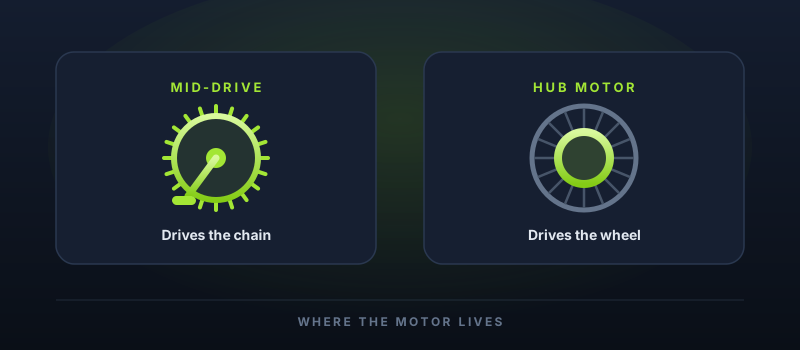
Mid-drive = motor mounted at the bottom bracket (where pedals attach). The motor drives the bike's chain, leveraging the bike's gears.
Hub motor = motor inside the wheel hub (rear or front). The motor drives the wheel directly, no gear leverage.
Why this matters: gears multiply torque. Mid-drives get to use them; hub motors don't. On a steep hill, a mid-drive in low gear has 3–5× the effective torque of the same-rated hub motor. That's the whole reason cargo and mountain bikes prefer mid-drive.
Side-by-side comparison
Side-by-side comparison
| Dimension | Mid-Drive | Hub Motor |
|---|---|---|
| Hill climbing | ★★★★★ | ★★★ |
| Range efficiency | ★★★★★ | ★★★ |
| Acceleration (flat) | ★★★★ | ★★★★ |
| Cost (motor only) | $400–$1,200 | $100–$400 |
| Maintenance | More (chain wears 2× faster) | Less (sealed unit) |
| DIY repairability | Harder (specialised tools) | Easier (commodity parts) |
| Throttle support | Less common | Almost universal |
| Weight distribution | Centred (better handling) | Rear-heavy (slight handling penalty) |
| Best for | Hills, cargo, long-range | Flat-to-rolling commutes, value buyers |
When mid-drive wins
When mid-drive wins
On hills. Mid-drive wins definitively above 8% grade. The motor leverages the bike's gears to multiply torque. A typical 250 W rated mid-drive (Bosch Performance Line, Shimano EP801) climbs a 12% grade at full payload with the rider barely working; a 500 W rated hub motor at the same grade overheats within a minute.
For cargo. Cargo bikes need torque at low speeds (starting from a stop with 100+ lb of cargo) and on hills (where range tanks fastest with weight). Mid-drives nail both. The Bosch Cargo Line, Bafang Ultra M620, and Shimano EP6 are the cargo-bike standard for a reason.
For long-range commuters (50+ mi/day). Mid-drives are more efficient because they work with the rider's gear choice. On flat pavement, a hub motor can match a mid-drive's efficiency, but add hills or start-stop traffic and range drops faster on the hub.
At the premium tier ($3,000+). Above the $3K mark, mid-drive is the default. Bosch, Shimano, Brose, Yamaha — all premium drive systems are mid-drive. If you're shopping in that tier, you're shopping mid-drive.
When hub motor wins
When hub motor wins
On price. Below $2,500, almost every credible bike is hub-motor. The motor itself costs 2–4× less; the bike doesn't need a frame designed around bottom-bracket motor mounting; the BMS is simpler. Hub motors at this price are a real spec match for the use case, not a compromise.
On simplicity. A hub motor is a sealed unit. No gearing through it, no chain stretch under motor torque, no specialised drivetrain. For a daily commuter who isn't a wrench, this matters.
On 5-year maintenance cost. Mid-drives wear chains and cassettes 2–3× faster because both rider torque AND motor torque pass through them. Replace the chain every 1,500–2,000 miles instead of 4,000 for a non-electric bike. Hub motors are sealed — minimal maintenance, occasional grease repack, but they generally outlast the rest of the bike.
For repairability. If a hub motor fails, it's a wheel rebuild — any bike shop can do it, and replacement motors are commodity parts ($150–$300). If a mid-drive fails out of warranty, you're looking at $600+ and a specialised shop.
Common myths debunked
Common myths debunked
- "Mid-drives don't have throttles." False. Many do (Bafang BBSHD with throttle, Bafang Ultra). Throttle is more common on hub motors but not exclusive to them.
- "Hub motors aren't repairable." False. They're more repairable than mid-drives because they're commodity parts. Hub motor conversion kits ($500–$1,200) are a major aftermarket category.
- "Mid-drive is always better." False. For flat commutes under 30 miles, the price + maintenance penalty vs hub isn't worth it for most riders.
- "Hub motors stress the wheel." Partially true. Rear-hub motors load the wheel more, but quality builds with reinforced spokes (most modern e-bikes) handle it fine for 5+ years.
What you'll find in our catalog (and why)
What you'll find in our catalog (and why)
Every e-bike currently reviewed on Ebike Oracle uses a hub motor. That's a deliberate editorial choice, not an oversight: we anchor on the $700–$2,500 buyer market where hub motors are the right call for ~70% of riders. Here's how the catalog maps to the four-question decision tree above:
- Flat-to-rolling commutes (Q1: hub): Heybike Cityscape 2 — 1200 W peak hub, 50 mi range, 28 mph Class 3. UL 2849 certified. The default US-spec commuter at $1,299.
- Light cargo / family hauling (Q2: hub or mid): Heybike Mars 3.0 — 1400 W peak hub, 440 lb payload, full suspension. Hub-motor cargo works for flat-to-rolling family routes; if your route has 8%+ climbs with 100+ lb of cargo, you'd want mid-drive (not yet in our catalog). AddMotor M-81 is the dedicated cargo longtail in our catalog — also hub.
- Day commuter under 30 mi (Q3: hub): Eleglide T1 — 250 W rated hub, 62 mi range, 15.5 mph (Class 1 EU spec). The efficient pedal-assist commuter.
- Budget tier (Q4: hub): every bike we cover is under $2,500. Heybike Ranger at $799.99 is the floor.
We'll add mid-drive coverage when our catalog moves into the $3,000+ tier. Until then, our reviews honestly answer "which hub-motor bike is right for you" — they don't pretend to compare across motor types we haven't tested.
Bottom line
Bottom line
For most readers of this page: buy a hub motor. The $1,000–$2,500 price band where most US e-bike sales happen is hub-motor territory, and that's the right call for flat-to-rolling commutes under 30 miles a day. Switch to mid-drive only if you genuinely need it: 8%+ hills, 200+ lb cargo, 50+ mi/day, or a $3,000+ budget.
Cross-link to Class 1, 2, 3 e-bikes explained for the regulatory class your motor is allowed to operate in, and our range calculator for terrain-specific range estimates.
Top-rated pick
 Amazon
Funhang
Funhang City Cruiser 26
Whichever way you land on the motor debate, this is the highest-rated bike we've reviewed (8.6/10) with a live US listing.
As an Amazon Associate I earn from qualifying purchases. Ebike Oracle may also earn a commission on links to other retailers. Full disclosure.
Frequently asked questions
Is a mid-drive or hub motor better for hills?
Mid-drive wins definitively on hills above 8% grade. The motor leverages the bike's gears to multiply torque, so it can climb steep grades without overheating. A typical hub motor (especially rear-hub, geared) handles up to 6–8% comfortably; above that, expect overheating, slow climbs, and battery drain. If your commute has multiple climbs >8%, get a mid-drive.
Are mid-drive e-bikes more expensive?
Yes — typically $700–$1,500 more for a comparable bike. The motor itself costs 2–4× more, and the bike has to be built tighter to handle the torque. Below $2,500 you're almost always looking at a hub motor; above $3,000 mid-drives become common; above $5,000 mid-drives dominate.
Which motor needs more maintenance?
Mid-drive. The chain and cassette wear 2–3× faster because they carry both rider torque AND motor torque. Plan to replace the chain every 1,500–2,000 miles instead of 4,000 for a non-electric bike. Hub motors are sealed units — minimal maintenance, occasional grease repack, but they generally outlast the rest of the bike.
Can I retrofit a hub motor to a regular bike?
Yes — hub motor conversion kits run $500–$1,200 and are DIY-installable in 2–4 hours. Mid-drive retrofit kits (Bafang BBS02/BBSHD) require frame compatibility and are typically more involved. If you're converting an existing bike, hub motor is the easier path.
Does Bosch make hub motors?
No — Bosch e-bike systems are mid-drive only. Their direct competitors at the premium tier (Shimano STEPS, Brose, Yamaha PW) are also mid-drive. Hub motors at the premium tier come from Mahle (X35, X20), Fazua (lightweight assist), and various Asian manufacturers.
Are mid-drive e-bikes faster?
Top speed is the same — capped by the motor's rpm and the bike's class (see Class 1, 2, 3 e-bikes explained). What's different is acceleration on hills and from a stop. Mid-drives feel snappier in dynamic conditions; hub motors feel smoother on flat ground at cruise speed.
Which is better for cargo bikes carrying kids?
Mid-drive, almost without exception, when the route has hills. Cargo bikes need torque at low speeds (starting from a stop with 100+ lb of cargo) and on climbs (where range tanks fastest with weight). For flat-to-rolling family routes, hub-motor cargo bikes like the Heybike Mars 3 (440 lb payload) and AddMotor M-81 (350 lb payload, dedicated longtail) work well — both are in our Best Family E-Bikes guide. For hilly cargo terrain, you'd want a mid-drive (not yet in our catalog).
Why does my hub-motor e-bike feel weak on hills?
Two reasons: (1) hub motors don't use the bike's gears, so they can't multiply torque the way a mid-drive can; (2) most hub motors have a peak-torque-at-mid-rpm curve, so when you slow down on a steep climb you're below peak power. Workaround: pedal harder to keep cadence up, or pre-shift to lower gears so YOU stay at high cadence even if the motor isn't gaining from it.
Keep reading
Guide
Class 1 vs 2 vs 3 E-Bikes Explained (2026)
The US e-bike class system is actually simple: Class 1 is pedal-assist only at 20 mph, Class 2...
ReadGuide
Do You Need a License for an E-Bike? (2026)
In 49 states and Washington, DC you do not need a license, registration, or insurance to ride a...
ReadGuide
Are E-Bikes Worth It in 2026? The Real Cost to Own
For most commuters, yes — an e-bike is one of the cheapest vehicles you can own. A full...
Read
Reviewed by