E-Bike Maintenance Checklist: What It Requires
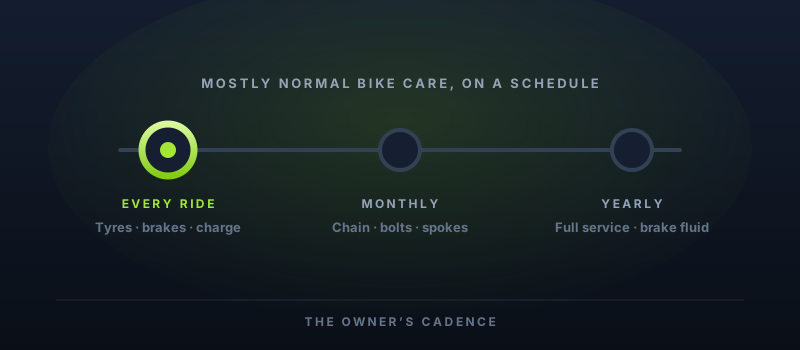
E-bike maintenance is mostly normal bike care plus a few electrical habits. Before every ride: check tire pressure, brakes, and battery charge. Every ~100–150 miles: clean and lube the chain. Monthly: check brake pads (replace near 1.5 mm, the thickness of a penny) and bolt torque. Twice a year: a tune-up (~$100). The electrical parts are low-maintenance — keep them...
The short version
- Before every ride: tyre pressure, brakes, battery charge. That is the whole pre-ride check.
- Every ~100–150 miles: clean and lube the chain. It is the single highest-value job you can do yourself.
- Monthly: brake pads (replace near 1.5 mm — a penny's thickness) and bolt torque.
- Twice a year: a shop tune-up, around $100.
- The electrical parts want to be left alone: keep them dry, never pressure-wash the motor or battery, charge to 80% for daily use.

Our pick for most readers
Funhang City Cruiser 26
$320
As an Amazon Associate I earn from qualifying purchases. Ebike Oracle may also earn a commission on links to other retailers. Full disclosure.
TL;DR — what e-bike maintenance actually involves
An e-bike is a bicycle with a sealed electrical system bolted on. The bicycle parts need normal bike care; the electrical parts need mostly to be kept dry and charged correctly. The essentials: check tire pressure, brakes, and battery before every ride; clean and lube the chain every ~100–150 miles; inspect brake pads and bolt torque monthly; and get a tune-up twice a year (about $100). Never pressure-wash the motor or battery, and follow good charging habits to make the battery (your most expensive part) last. All-in, expect $85–$530 a year.
The full guide, section by section. Tap any section to read it.
The maintenance schedule at a glance
The maintenance schedule at a glance
| When | What to do |
|---|---|
| Before every ride | Tire pressure, brake feel, battery charge, quick bolt/quick-release glance |
| Weekly | Wipe the frame, check tire wear, confirm lights work, check brake-lever firmness |
| Every ~100–150 mi | Clean and lube the chain; wipe the drivetrain |
| Monthly | Inspect brake pads, check bolt torque, test shifting, inspect tires for cuts |
| Every 6 months | Professional tune-up (~$100): brakes, gears, bearings, full safety check |
| Yearly | Deep service: drivetrain wear check, firmware update, brake bleed if hydraulic, battery health check |
Daily commuters lean to the more-frequent end; casual weekend riders can stretch tune-ups to once a year or every 18–24 months.
The 7 things to keep on top of
The 7 things to keep on top of
- Tire pressure. The single highest-impact check — it affects range, grip, and flat resistance. Inflate to the range printed on the tire sidewall (commuter tires are often 50–70 PSI; fat tires far lower, ~20–30 PSI; road-style higher). Check before every ride; tires lose pressure sitting still.
- Brakes. Test lever feel before each ride. Inspect pads monthly and replace them at about 1.5 mm of pad left (roughly a penny's thickness) or when braking gets weak or noisy. Hydraulic brakes need an occasional bleed (a shop job).
- Chain + drivetrain. Clean and lube every 100–150 miles or whenever it looks dry or grimy. A neglected chain wears the cassette and chainring (far pricier to replace) and makes the motor work harder.
- Bolts + torque. E-bikes are heavier and faster, so vibration loosens fasteners. Monthly, check the stem, handlebar, seatpost, rack, and especially the motor and wheel-axle bolts to the torque in your manual.
- Tires + wheels. Inspect for cuts, embedded debris, and sidewall wear; spin each wheel to check it runs true. Replace tires showing casing or flat-spotting.
- Battery + contacts. Keep the battery contacts clean and dry; wipe road grime off the mount. Watch for any swelling or heat (stop using immediately if you see it — fire safety).
- Firmware + electronics. If your bike has an app or display firmware, install updates — they often fix range, shifting, and safety behaviour. Keep all connectors seated and dry.
Battery care — your most expensive part
Battery care — your most expensive part
The battery is the costliest component to replace ($300–$800), so its care is the highest-value maintenance you do. The rules (full detail in how long e-bike batteries last):
- Charge to 80% for daily use; only go to 100% when you need the full range. This roughly doubles cycle life.
- Store at 40–60% if you won't ride for 2+ weeks; never store empty or full long-term.
- Use the original charger (also a fire-safety rule), and unplug at full.
- Keep it cool — don't charge or store in a hot car or freezing garage; let a hot/cold pack reach room temperature before charging.
- Charge above 0°C — charging a frozen battery causes permanent damage.
E-bike-specific do's and don'ts
E-bike-specific do's and don'ts
These are the differences from a regular bike that catch new owners out:
- Don't pressure-wash the motor, battery, display, or connectors. High-pressure water forces past seals into electronics. Use a damp cloth and a gentle hose at most.
- Power off before cleaning or transport, and remove the battery for transport on a car rack or for indoor storage.
- Don't submerge or ride deep water. Most e-bikes are rain-rated (IPX4-ish), not submersible.
- Dry it after wet rides — wipe the contacts and let connectors dry before charging.
- Use the right tools/torque on motor and axle bolts; over- or under-torquing both cause problems on a heavier, faster bike.
DIY vs the shop — what it costs
DIY vs the shop — what it costs
Most upkeep is DIY with basic tools. What to hand to a shop and roughly what it costs:
| Job | DIY or shop | Typical cost |
|---|---|---|
| Tire pressure, chain lube, bolt checks | DIY | A few dollars in supplies |
| Brake-pad replacement | DIY-able | $15–$30 / set |
| Tire replacement | DIY-able | $30–$70 each |
| Hydraulic brake bleed, wheel truing | Shop | part of a tune-up |
| 6-month tune-up | Shop | ~$100 |
| Battery replacement (eventual) | Shop / OEM | $300–$800 |
Budget roughly $85–$530 a year total — casual riders under $200, daily commuters $400+. Compared with a car (AAA: ~$11,577/year), maintenance is a rounding error, which is a big part of why e-bikes are worth it.
Bottom line
Bottom line
Keep tires inflated, the chain clean, the brakes fresh, the bolts tight, and the battery charged smart — and an e-bike is cheap and reliable to own. Do the before-every-ride checks yourself, lube the chain every 100–150 miles, and book a $100 tune-up twice a year. The one rule that's different from a regular bike: treat the electronics gently — keep them dry and never pressure-wash them.
Related: how long e-bike batteries last, e-bike battery fire safety, and are e-bikes worth it.
As an Amazon Associate I earn from qualifying purchases. Ebike Oracle may also earn a commission on links to other retailers. Full disclosure.
Top-rated pick
 Amazon
Funhang
Funhang City Cruiser 26
If the upkeep on your current bike is what brought you here: this is the highest-rated bike we've reviewed (8.6/10) with a live US listing.
As an Amazon Associate I earn from qualifying purchases. Ebike Oracle may also earn a commission on links to other retailers. Full disclosure.
Frequently asked questions
How often should I service my e-bike?
Do quick checks (tire pressure, brakes, battery) before every ride, clean and lube the chain every 100–150 miles, inspect brake pads and bolt torque monthly, and get a professional tune-up twice a year (about $100). Casual riders can stretch tune-ups to once a year or every 18–24 months; daily commuters should stick to the 6-month cadence.
How much does e-bike maintenance cost per year?
Roughly $85–$530 a year all-in: tune-ups (~$100 each, 1–2× a year), wear parts (tires $30–$70 each, brake pads $15–$30 a set), an amortized battery, and a few dollars of electricity. Casual riders spend under $200; daily commuters $400+. It is a rounding error next to a car.
Can I wash my e-bike with a hose or pressure washer?
A gentle hose or damp cloth is fine; a pressure washer is not. High-pressure water forces past seals into the motor, battery, display, and connectors and causes electrical faults. Power off, avoid spraying electronics directly, and dry the contacts before charging after a wet ride.
How often should I lube my e-bike chain?
Every 100–150 miles, or sooner if it looks dry, grimy, or squeaks. Clean it first, apply a bike-specific lube, then wipe off the excess. A clean chain shifts better, lasts longer, and reduces wear on the cassette and chainring — and makes the motor work less.
When should I replace my e-bike brake pads?
Inspect monthly and replace pads at about 1.5 mm of pad material left (roughly the thickness of a US penny), or sooner if braking weakens or you hear persistent squealing or grinding. Pads cost $15–$30 a set and are a manageable DIY job; hydraulic systems may also need an occasional bleed at a shop.
What tire pressure should an e-bike run?
Use the range printed on the tire sidewall — it varies a lot by tire. Commuter tires are often 50–70 PSI, fat tires far lower (around 20–30 PSI), and road-style tires higher. Check before every ride; correct pressure improves range, grip, and flat resistance.
How do I take care of my e-bike battery?
Charge to 80% for daily use (100% only when you need full range), store at 40–60% if idle for 2+ weeks, use the original charger, keep it cool, and never charge it frozen. These habits roughly double cycle life and delay a $300–$800 replacement. Full detail in how long e-bike batteries last.
Can I maintain an e-bike myself?
Most of it, yes — tire pressure, chain cleaning and lube, bolt-torque checks, brake-pad swaps, and tire changes are all DIY with basic tools. Leave hydraulic brake bleeds, wheel truing, and battery replacement to a shop. Budgeting one or two ~$100 tune-ups a year covers the jobs that need a professional.
Keep reading
Guide
Class 1 vs 2 vs 3 E-Bikes Explained (2026)
The US e-bike class system is actually simple: Class 1 is pedal-assist only at 20 mph, Class 2...
ReadGuide
Do You Need a License for an E-Bike? (2026)
In 49 states and Washington, DC you do not need a license, registration, or insurance to ride a...
ReadGuide
Are E-Bikes Worth It in 2026? The Real Cost to Own
For most commuters, yes — an e-bike is one of the cheapest vehicles you can own. A full...
Read
Reviewed by