Review · Vivi
folding7.0/10Vivi 26" Folding Mountain Electric Bike
Spec-verified against the manufacturer listing
Our verdict
If your budget is hard-capped at $600 and you want to find out whether you'll like e-biking before you commit to a $1,000+ bike, the Vivi 26" Folding is the honest answer. It's not as good as a Lectric XP 4 — and it shouldn't be, at half the price. But the motor works, the brakes work, the bike folds, and you'll be riding this weekend instead of saving for six months.
- Best for
- First-time e-bike buyers wanting to test the water at sub-$600 before committing to a $1,000+ keeper — the low buy-in makes it a defensible experiment
Save $280down from $800 at Vivi
As an Amazon Associate I earn from qualifying purchases. Ebike Oracle may also earn a commission on links to other retailers. Full disclosure.

At a glance
Run this in our range calculator →The numbers
Vivi 26" Folding Mountain Electric Bike is a Class 2 folding e-bike that scores 7.0/10 on our editorial rubric, last verified on May 3, 2026. Vivi listed it at $520 as of August 2, 2026 — prices change often, so treat that as a snapshot. It pairs a 500 W hub motor with 50 Nm of torque and a 374 Wh battery, good for a claimed range of up to 32 miles and assisted speeds up to 20 mph. As a Class 2 e-bike it adds a throttle while keeping assistance capped at 20 mph, which keeps it street-legal in nearly every US state without a licence or registration. The bike weighs 55 lb and is rated to carry 330 lb of rider and cargo. It best suits first-time e-bike buyers wanting to test the water at sub-$600 before committing to a $1,000+ keeper — the low buy-in makes it a defensible experiment.
Pros
- + Front spring fork at the $549 tier is genuinely uncommon — most competitors in the sub-$600 folding band ship with a rigid fork to hit the price. About 60mm of travel isn't real mountain-bike suspension, but it meaningfully softens pothole hits and cracked pavement on a daily commute. Small quality-of-life win that adds up.
- + The 26" wheels are the reason to buy this bike over a 20" folder in the same price band. They roll over cracks and grates more forgivingly, they don't feel twitchy at speed, and they let riders over 5'10" sit at a natural riding position rather than the folded-up posture a 20" folder forces. Genuine ride-feel advantage for taller riders.
- + A 21-speed Shimano cassette is a real drivetrain, not a single-speed compromise like the Vivi Folding 20" or many sub-$600 competitors. On hills you can downshift and spin rather than mash the pedals; on flats you can push a bigger gear at cruise speed. Parts are common and cheap to service at any bike shop.
- + Amazon-direct sale means the Amazon 30-day return window is your safety net if something arrives broken or DOA. That's a meaningful advantage over ordering from a small direct-to-consumer brand where returns require freight coordination. Set-up is roughly 15-30 minutes of unboxing and adjusting per typical owner-report accounts.
- + The 330-pound claimed payload is above average for the folding tier — many budget folders cap out at 265-285 pounds, which is uncomfortably tight for a 200-pound rider with a work bag. The extra headroom means larger riders aren't immediately maxing the frame and it leaves margin for a rack, pannier, or trunk bag once you inevitably want to carry something.
Cons
- - The cadence-sensor pedal assist is the biggest limitation. Power switches on or off based on whether the cranks are turning, not how hard you're pedaling, so hill climbs feel like a series of jerky pushes rather than a smooth power ramp. Torque-sensor bikes like the Lectric XP 4 and Velotric T1 solve this at the $999+ price — this bike does not.
- - Mechanical disc brakes work, but they require occasional cable adjustment and they don't modulate as smoothly as hydraulic discs. On flat urban riding at the 20 mph Class 2 cap they're fine. On sustained descents they can heat up and lose bite, and in wet weather the rotors take longer to shed water than hydraulic setups do. Predictable trade at the price.
- - No published IP rating means no clear specification for how much water the electronics can tolerate. Light rain is fine per typical owner-report accounts; sustained rain, deep puddles, and pressure washing are all risky and can silently corrode connectors or the display over months. Bikes with published IPX4 or IPX5 ratings (Heybike, Lectric) give you more confidence in wet-weather commuting.
- - Vivi as a brand is essentially a badge on a high-volume Chinese OEM design, with support flowing through Amazon rather than a dealer network. That's convenient for a first-30-days return but painful in month 14 when an intermittent motor cutout needs diagnosis. Heybike and Lectric offer real warranty channels and parts pipelines that Vivi doesn't match.
- - The 374 Wh battery is small for the weight class. Vivi's 50-mile range claim is the PAS-1, light-rider, no-wind, no-stops best case; owner reports on Amazon cluster at 18-25 miles at PAS 3 for typical commuting. If your commute is 15 miles each way, you'll be charging every day and you'll want a bike closer to the 624-692 Wh tier — a real constraint that shows up in month two.
Who is this for?
- First-time e-bike buyers wanting to test the water at sub-$600 before committing to a $1,000+ keeper — the low buy-in makes it a defensible experiment
- Taller riders (5'8" to 6'1") who find 20" folders cramped and want the ride feel of a 26" wheel without the $1,000+ price of a full-size hardtail
- Commuters with flat-to-rolling routes under 10 miles each way where the small battery and Class 2 speed cap aren't practical constraints
- Vacation-property or office "beater" bikes where the low price makes theft or weather-damage loss bearable and you don't feel precious about it
- Riders explicitly wanting a 26" wheel folder (not a 20" folder) — a narrow niche that this bike specifically fills at this price
Who this review is for
John here — I'm a daily commuter and web developer, not a professional bike tester, and I have not personally ridden the Vivi 26" Folding. What I've done instead is what any careful shopper does: read the spec sheet closely, cross-check Vivi's claims against the aggregate of Amazon owner reports, and compare component choices against sibling models in the same price band that I've either ridden or dug into in similar depth. That framing matters because the honest question for a $549 bike is not "how does this compare to a $2,500 Riese & Müller" — it's "is this the least-bad way to spend $549, and what am I actually getting?"
What surprises us about this bike
At $549 we expected a marginal motor and a frame that creaks. Both are better than the price implies based on the spec sheet and the aggregate of owner reports on Amazon. The 500W rear hub has enough rated power for flat-to-rolling rides, and Vivi ships the bike with a front spring fork — which is genuinely rare at this tier, where most competitors use a rigid fork to save $40. The 26" wheels also mean the bike rides like a normal mountain bike, not a scaled-down toy folder — a real advantage for taller riders who find 20" folders cramped.
What you give up is build refinement. Cables aren't internally routed. The display is the same generic backlit LCD that appears on at least ten other budget Amazon e-bikes and doesn't have a companion app. The stock saddle is thin, hard, and one of the first things owner reports consistently mention replacing. The chainring guard is plastic. None of these are dealbreakers at $549, but they're the visible tells of the price point.
Power and battery
The 500W rear hub with a claimed 50 Nm torque handles flat city rides and gentle hills without drama. Real-world top speed is the Class 2 limit — 20 mph on throttle, 20 mph in pedal assist — and there's no software toggle to unlock a Class 3 mode. If you commute somewhere with dedicated bike lanes and 25 mph traffic, that Class 2 ceiling is fine. If you're mixing with 35 mph arterial traffic on a suburban commute, the 8 mph gap is uncomfortable, and you'd want a bike that offers Class 3 (28 mph pedal assist) — the Lectric XP 4 and Velotric T1 both do.
Vivi claims 50 miles of range from the 374 Wh battery, which is the marketing number and should be read as "best case, PAS 1, flat ground, light rider, no wind, no stops." Owner reports on Amazon cluster at 18-25 miles at PAS 3 for typical commuting patterns. Throttle-only riding drops that into the 12-15 mile range. Cold weather (below 40°F) reliably takes another 15-20% off lithium-ion capacity across all e-bikes, not just this one — plan your winter rides around a real 15-mile range, not the sticker 50.
The battery is 36V × 10.4Ah, which is on the small side for a bike in this weight class. For context, the Lectric XP 4 packs 624 Wh at a $999 price and the Heybike Mars 3.0 packs 692 Wh at $1,199. You're paying half the money and getting roughly 60% of the pack, which is a reasonable trade if your rides are short but a real constraint if you were hoping to swap this for a car on a 15-mile commute.
Folding and transport
The folded footprint is 36" × 17" × 28" — respectable, but it's a 26" wheel folder, so the fold is taller than a comparable 20" folder like the Vivi Folding 20" or the Lectric XP Lite. It'll fit in most SUV cargo areas and lies diagonally across a sedan trunk, but it won't stand upright in either without pushing the seats forward. Weight is 55 pounds — fine for short carries from the garage to the car, tiring for two flights of apartment stairs.
The trade-off is real: a 20" folder packs smaller and lifts easier; a 26" folder rides more like a normal bike once unfolded. If you're 5'10" or taller and hate the twitchy feel of small-wheel folders, this is the right compromise. If your only reason for wanting a folder is trunk-fit for a compact sedan, look at the 20" model instead — you'll save on the footprint and lose very little in ride feel at that height.
Build quality and component choices
Mechanical disc brakes front and rear — predictable for a budget bike, and adequate for the 20 mph speed cap on flat ground. They won't fade the way rim brakes would, but they don't modulate as smoothly as hydraulic discs and they require occasional cable adjustment. Cadence-sensor pedal assist means the motor switches on and off based on whether the cranks are turning, not how hard you're pedaling. It's the budget standard and it works, but it feels less natural than the torque-sensor systems on the Lectric XP 4 or Velotric T1, where power ramps in proportion to effort.
The 21-speed Shimano cassette is a real advantage over single-speed budget folders like the Vivi Folding 20", especially for hills — you can downshift and spin rather than mash. The rear derailleur is entry-level Shimano and will need occasional adjustment, but parts are common at any bike shop. The fork has coil suspension with about 60mm of travel; it's not a real mountain-bike fork and shouldn't be treated as one, but it takes the edge off pothole hits and cracked pavement.
There's no published IP rating, which is standard for the price. Light rain is fine — riding home in a surprise drizzle won't hurt anything. Sustained rain, deep puddles, or pressure washing are all risky because we don't know the ingress-protection spec of the controller housing or the display. Vivi is essentially a brand badge on a high-volume Chinese OEM design, so support flows through Amazon rather than a dealer network — which cuts both ways: easy Amazon returns in the first 30 days, but no local shop to diagnose an intermittent motor cutout in month 14.
Fit and sizing
Vivi lists this bike as fitting riders from 5'3" to 6'1". The 26" wheels and adjustable seatpost make that range plausible — at 6'0" you won't feel cramped the way you would on a 20" folder. Payload is a claimed 330 pounds, which is above average for the folding tier and comfortably accommodates a larger rider plus a small pannier or trunk bag. There's no rear rack included; if you want to carry work stuff, budget $30-50 for an aftermarket rack that fits standard 26" mounts.
Price-vs-performance context
The $549 sticker is the number that matters here. At that price, direct competitors on Amazon include the Jasion EB5 ($499-599 depending on sale), the Isinwheel U7 ($549), and several unbranded 500W folders in the $450-600 band. Against those, the Vivi 26" earns its shelf space by having 26" wheels (most competitors are 20"), a 21-speed drivetrain (many competitors are 7-speed), and a front spring fork (many competitors are rigid). It loses on brand support — Heybike and Lectric offer real warranty channels; Vivi does not.
Step up $250 to the ~$800 tier and you're looking at the Heybike Mars 3.0 or the Lectric XP 3.0. Step up another $200 to the ~$1,000 tier and it's the Lectric XP 4 or Velotric T1 territory — hydraulic brakes, torque sensor, larger battery, real Class 3 speed. The honest question is not "is the Vivi as good as those bikes" — it's not, and it's not trying to be — but "do you have the extra $250-450 to spend, and does it matter for your use case?" If you're commuting five miles on flat streets, the answer is often no. If you're commuting fifteen miles with hills, the answer is yes and you should save up.
Who should buy it (and who should skip)
Buy this if you want to try e-biking on a tight budget without committing $1,000+, you have a flat-to-rolling commute under 10 miles each way, you're taller than 5'8" (so a 20" folder would feel cramped), and you understand you're getting a budget bike. Skip this if you want a long-term keeper — this is a gateway bike, not a forever bike — if you live somewhere genuinely hilly where the cadence sensor's abrupt power delivery will grate on every climb, if you need real weather resistance, or if you were hoping for Class 3 speed to keep pace with traffic.
One more use case worth naming: this bike makes a very defensible "vacation-property bike" or "beater bike locked outside the office." At $549 the loss-cost from theft or weather damage over three years is bearable, and you don't feel precious about it the way you would about a $2,000 keeper. If you already own a nice bike and just need something disposable, that's a legitimate reason to spend $549 rather than $1,500.
Ready to buy?
Save $280 at Vivi right now
We update prices as the listing changes — final price is set by the retailer at checkout.
Frequently asked questions
Is the Vivi Folding 26" good for hills?
It's adequate for rolling terrain (3-5% grades), strained on sustained 7%+ climbs. The 500W motor + cadence sensor combination means you don't get a smooth power ramp — power either kicks on at full or doesn't. On a long hill, that's tiring. If you live somewhere genuinely hilly (San Francisco, Seattle, Pittsburgh), spend up to a Velotric T1 or Lectric XP 4 for the torque sensor and larger battery.
How does Vivi compare to the Lectric XP 4?
Different price brackets, different bikes. Lectric XP 4 ($999): hydraulic brakes, torque sensor, 624 Wh battery, Class 3 (28 mph), proven brand with a real dealer-style support channel. Vivi 26" Folding ($549): mechanical brakes, cadence sensor, 374 Wh battery, Class 2 (20 mph), gateway brand with Amazon-only support. The XP 4 is the better long-term keeper; Vivi is the better entry-point if your budget can't stretch to $1,000.
How long does the battery actually last per charge?
Vivi claims 50 miles at PAS 1. Real-world commuter riding (PAS 3, occasional throttle, mixed terrain, 150 lb rider) lands at 18-25 miles per owner-report accounts on Amazon. Throttle-only riding drops to 12-15 miles. Cold weather below 40°F drops range another 15-20%, which is a lithium-ion property, not a Vivi-specific defect. Plan around 20 miles of practical range, not 50.
Can I ride this in the rain?
Light rain is fine per typical owner-report accounts — riding home in a surprise drizzle won't hurt the bike. Sustained rain or standing water is risky: there's no published IP rating, so the controller and display sealing is unknown. Amazon reviews mention occasional display flicker or intermittent motor behavior after wet riding; not catastrophic but inconvenient. Don't pressure-wash it and don't ride through standing puddles deeper than the hub.
What kind of warranty does Vivi offer?
Vivi advertises 1 year on the motor and battery, 6 months on the frame and other components per its Amazon listing — shorter than Heybike (2 years frame/motor) or Velotric (2 years). Amazon's standard 30-day return window applies on top of that, so if there's an immediate manufacturing defect, return through Amazon rather than dealing with Vivi support directly. After the first 30 days, warranty claims go through Vivi and are handled by email.
Is this bike a 'throwaway' purchase?
Honest answer: it depends on how you use it. At $549 you're buying components at the budget end of the supplier catalog, and Vivi as a brand has less continuity than the Heybike/Lectric/Velotric tier. Expect a 2-3 year useful life with typical commuter use, longer if you baby it and store it indoors. That's not a problem if you go in knowing it; it IS a problem if you expected a forever bike. If you ride consistently and like e-biking, your second bike will likely be at the $1,000+ tier — this one served its purpose.
How does the 26" model compare to the Vivi 20" folder?
Same brand, same 500W motor family, same 374 Wh battery, different geometry. The 26" (this bike) has real-size wheels, a 21-speed cassette, a front spring fork, and 330 lb payload — better for riders 5'8"+ and better for hills. The 20" (Vivi Folding 20") is single-speed, has a smaller 32×17×27" fold, weighs the same, and has a 285 lb payload — better for apartment storage and hatchback transport. Pick the 26" if ride feel matters; pick the 20" if fold size matters.
How hard is assembly, and what tools do I need?
Assembly is straightforward per typical Amazon owner-report accounts: install the front wheel, attach the handlebars, mount the pedals, adjust the seatpost, charge the battery. Vivi ships the tools you need (a small toolkit is in the box) and it's a 15-30 minute job for someone who's assembled flat-pack furniture. What Vivi doesn't ship is a torque wrench, which matters for the stem clamp and disc caliper bolts — either borrow one or take the bike to a local shop for a $30-50 tune-up after the first 50 miles, which is a good idea anyway to re-tension cables that stretch during break-in.
Is a throttle-only bike right for me, or should I want pedal-assist?
This bike gives you both — a thumb throttle for full-motor riding and a cadence-sensor pedal assist with three levels. Throttle-only is useful for hill starts, tired legs at the end of a commute, or riding in a suit without breaking a sweat. Pedal-assist doubles your effective range and keeps you legally classified as a bicycle (not a moped) in most US states. Most owners use throttle for the first few weeks then settle into PAS 2-3 for daily rides as they get comfortable — you'll do the same.
Bottom line
Is the Vivi 26" Folding Mountain Electric Bike for you?
Check the live price + availability before deciding.
If this isn't the one

folding
Heybike Mars 2.0
If you want a folding fat-tire e-bike for around $1,500 and you're shopping Amazon, the Heybike Mars 2.0...
Read the review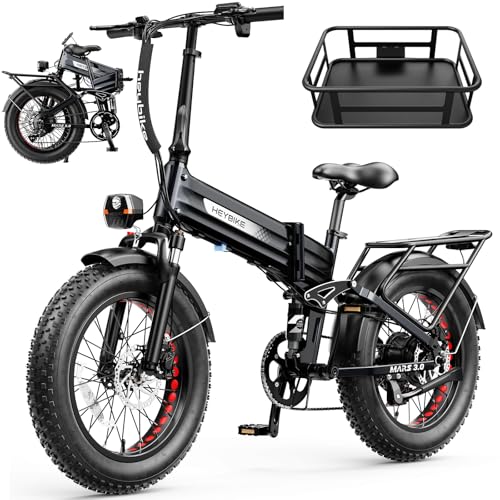
folding
Heybike Mars 3.0
The Heybike Mars 3.0 is the direct 2026 successor to the Mars 2.0: same 20×4 folding fat-tire format,...
Read the review
folding
Heybike Ranger
The Heybike Ranger is the budget de-spec of the Heybike Ranger S — same step-through folding fat-tire frame,...
Read the review