Review · URLIFE
folding7.3/10URLIFE Folding 20
Spec-verified against the manufacturer listing
Our verdict
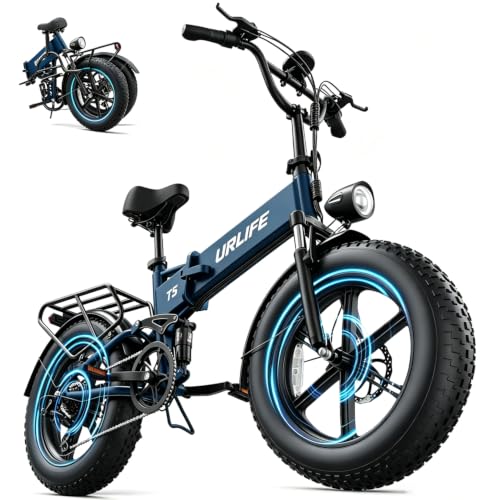
A UL 2849-certified folding fat-tyre e-bike at $559.99 (as of Oct 11, 8:10 PM EDT, subject to change) with a genuine quad-link rear suspension rather than the seatpost spring most bikes at this price call "full suspension" — plus integrated turn signals, which almost nothing in this bracket fits. The certification and the linkage are real reasons to shortlist it. The listing's numbers are not: URLIFE publishes peak wattage only, no top speed, a 60-80 mile range its own battery cannot deliver, and a claim about 30-degree slopes that is physically absurd.
- Best for
- Apartment commuters who must charge indoors and need the certificate
As an Amazon Associate I earn from qualifying purchases. Ebike Oracle may also earn a commission on links to other retailers. Full disclosure.
Free 30-day returns via Amazon
Not sold on this one? See every ranked pick in our guide to the best e-bikes under $600 on Amazon.
At a glance
Run this in our range calculator →The numbers
URLIFE Folding 20 is a folding e-bike that scores 7.3/10 on our editorial rubric, last verified on August 27, 2026. Amazon listed it at $560 as of October 12, 2026. Prices change often, so treat that as a snapshot. On Amazon it currently ranks #13 Best Seller in Electric Folding Bikes. It pairs a 624 Wh battery, good for a claimed range of up to 28 miles. It best suits apartment commuters who must charge indoors and need the certificate.
Pros
- + UL 2849 certification stated in the title — uncommon under $600
- + Genuine quad-link four-bar rear suspension, not a sprung seatpost
- + Integrated left and right turn signals, almost unheard of at this price
- + 80 Nm of torque and an oversized 400 x 190 mm rear rack
- + 20" x 4" puncture-resistant tyres — the roadside fix you will not have to do
- + Removable 624Wh battery, so charging need not happen at the bike
Cons
- - Peak wattage only and no top speed at all — the e-bike class is undeterminable
- - The 60-80 mile claim needs 7.8-10.4 Wh/mi; expect about 28 miles
- - "Conquers 30° slopes" is a 58% gradient — physically impossible, and it tells you something
- - No published weight on a bike sold on portability
- - No payload rating anywhere on the listing
- - Storefront brand with no dealer network behind the warranty
Who is this for?
- Apartment commuters who must charge indoors and need the certificate
- Riders in traffic who will actually use integrated turn signals
- Buyers who want real linkage suspension on a sub-$600 folder
The 30-second verdict
Folding fat-tyre e-bikes under $600 are a crowded, noisy shelf, and most of them differ only in the sticker. URLIFE has two things that genuinely separate it. The first is UL 2849 certification, stated in the listing title — the whole-system electrical standard that fire codes cite, and something a majority of this price bracket simply does not carry. The second is the rear end: a quad-link four-bar linkage, which is a real suspension design with a defined axle path, where nearly every rival at this money fits a sprung seatpost and calls the bike full-suspension in the title. Add 80 Nm of torque, a 48V 13Ah (624Wh) removable battery, 20" x 4" puncture-resistant tyres, 7-speed gearing, an oversized 400 x 190 mm rear rack and — unusually — integrated left and right turn signals, and the hardware is better than the price suggests. The paperwork is where it falls down, and it falls down hard enough to be worth four paragraphs.
The full review, section by section. Tap any section to read it.
What URLIFE will not tell you: rated watts and top speed
What URLIFE will not tell you: rated watts and top speed
The listing quotes 1,500W peak and never states a rated continuous figure. It also never states a top speed anywhere — not in the title, not in the bullets. Those two omissions together mean the e-bike class of this machine cannot be determined from the listing at all, and class is what the law works in. The federal definition at 15 U.S.C. § 2085 and the three-class framework 49 states copied are written in terms of rated wattage, capped at 750W (Oregon alone allows 1,000W), and in terms of the speed at which the motor stops assisting — 20 mph for Class 1 and 2, 28 mph for Class 3. A bike advertising 1,500W peak may well be a perfectly legal 750W rated machine; peak figures of roughly double rated are normal and honest engineering. But it might not be, and you cannot tell. Ask URLIFE for the rated continuous wattage and the assist cut-off speed in writing before buying, and check both against your state's rules — particularly if you live in one of the seven jurisdictions that restrict Class 3.
The range claim, checked
The range claim, checked
URLIFE advertises 60-80 miles per charge. The battery is 48V x 13Ah = 624Wh. Sixty miles from 624Wh requires 624 ÷ 60 = 10.4 Wh per mile; eighty miles requires 7.8 Wh per mile. For scale, an efficient road e-bike with a light rider on minimum assist might reach 12-15 Wh per mile. A 20-inch fat-tyre bike — four-inch tyres, high rolling resistance, an upright rider acting as a sail — draws roughly 18-25 Wh per mile in ordinary pedal-assist use. The honest figure is therefore 624 ÷ 22 ≈ 28 miles, dropping to perhaps 18-20 on throttle alone or into a headwind. Twenty-eight miles is a good number for this money and would have been worth advertising. The 60-80 figure is a lab result at minimum assist on flat ground with a light rider, and quoting it is the single most misleading thing on the page.
The 30-degree slope claim is not possible
The 30-degree slope claim is not possible
The first bullet states the bike "conquers 30° slopes with ease". It is worth being precise about what that would mean, because the number sounds plausible to anyone who has not converted it. A 30-degree incline is a 58% gradient. The steepest public street in the world — Ffordd Pen Llech in Wales, or Baldwin Street in Dunedin depending on whose measurement you accept — tops out around 19 degrees, or roughly 35%. Serious mountain-bike climbing trails are graded at 10-15 degrees. San Francisco's notorious Filbert Street is about 17.5 degrees. A 30-degree slope is not a road; it is a ski run, and no two-wheeled vehicle carrying a rider ascends one under 1,500W of peak power. We flag this not to be pedantic but because it is a useful test: a listing that publishes a physically impossible figure in its first bullet has told you how much weight to put on the rest of its numbers, and the range claim above turns out to fail the same way.
Where the money genuinely went
Where the money genuinely went
Three specifications on this bike are better than its price bracket and deserve credit. UL 2849 is the big one: it certifies the battery, charger and controller as a system, it is the standard New York City's Local Law 39 requires for e-bikes sold in the city, and it is what California SB 1271 ties to legal sale in the state from 2026. For a bike you will fold and store in a flat, that certificate is the difference between a machine your building can object to and one it cannot. The quad-link rear suspension is the second: a four-bar linkage keeps the wheel path controlled under braking and pedalling in a way a sprung seatpost cannot, and finding one at $559.99 (as of Oct 11, 8:10 PM EDT, subject to change) is unusual. The third is the turn signals. They sound like a gimmick and are not — a folding commuter ridden in traffic at dusk benefits more from being seen than from another 100Wh of battery, and almost nothing else in this bracket fits them.
Folding, carrying and the rack
Folding, carrying and the rack
The fold is conventional for the format: a mid-frame hinge and a folding stem, which gets a 20-inch fat bike into a car boot or a cupboard rather than turning it into luggage. URLIFE publishes no weight, which is a meaningful omission on a folding bike — fat-tyre folders typically land between 60 and 75 lbs, and that is the difference between a bike you lift onto a train and one you do not. The 400 x 190 mm rear rack is genuinely oversized for the class and is the practical reason to choose this over a lighter folder: it will take panniers or a crate rather than just a jacket. Tyres are described as puncture-resistant, which on 20 x 4 fat rubber is a real convenience given how unpleasant they are to change at the roadside.
Who should buy it
Who should buy it
Flat-dwellers who need a certified battery to charge indoors, commuters riding in traffic who will use the turn signals, and anyone who wants real linkage suspension at a sprung-seatpost price. Skip it if you need the class settled before purchase and cannot wait for URLIFE to answer, if you were buying on the 60-80 mile figure, or if you need a published weight because you will be lifting it regularly.
Ready to buy?
See current pricing at Amazon
We update prices as the listing changes, and the final price is set by the retailer at checkout.
Frequently asked questions
What class of e-bike is the URLIFE folding bike?
The listing does not say, and the class cannot be worked out from it. URLIFE publishes 1,500W peak with no rated continuous figure, and no top speed at all. Both are what the law works in: the federal definition at 15 U.S.C. § 2085 and the class frameworks in 49 states cap rated wattage at 750W (Oregon allows 1,000W), and the classes are separated by the assist cut-off speed. Ask URLIFE for both numbers in writing, then check your state.
Does it really go 60-80 miles on a charge?
No. The pack is 48V x 13Ah = 624Wh, so 60 miles needs 10.4 Wh per mile and 80 miles needs 7.8. A 20-inch fat-tyre bike draws roughly 18-25 Wh per mile. The realistic figure is 624 ÷ 22 ≈ 28 miles, or under 20 on throttle alone.
Can it really climb a 30-degree slope?
No — and the number is worth converting. 30 degrees is a 58% gradient. The steepest public street on earth is about 19 degrees (35%), and San Francisco's Filbert Street is around 17.5. A 30-degree slope is ski terrain. Treat the claim as a signal about how carefully the rest of the listing's numbers were written.
Is the quad-link suspension actually different from a suspension seatpost?
Yes, substantially. A four-bar linkage is a real rear suspension with a controlled axle path, so the wheel keeps tracking the ground under braking and pedalling. A sprung seatpost only isolates your backside from the frame — the wheel still takes every hit. Most sub-$600 bikes advertising "full suspension" mean the seatpost. This one does not.
What does UL 2849 mean for charging it in a flat?
It means the battery, charger and controller were certified together as a system, which is the standard fire ordinances name. New York City's Local Law 39 bans the sale, lease or rental of uncertified e-bikes and batteries in the city, and California SB 1271 ties certification to legal sale in the state from 2026. On a folding bike you will store and charge inside, it is the most valuable line on the listing.
Bottom line
Is the URLIFE Folding 20 for you?
Check the live price + availability before deciding.
If this isn't the one

folding
URLIFE Mini 14
Save $15
The URLIFE Mini 14, #3 in Amazon's Electric Folding Bikes (September 2026), is a 14-inch mini states UL...
Read the review
folding
Askmy Mini 14
A 14-inch folding e-bike carrying a stated 480 Wh, in line with the better-equipped 14-inch minis we cover,...
Read the review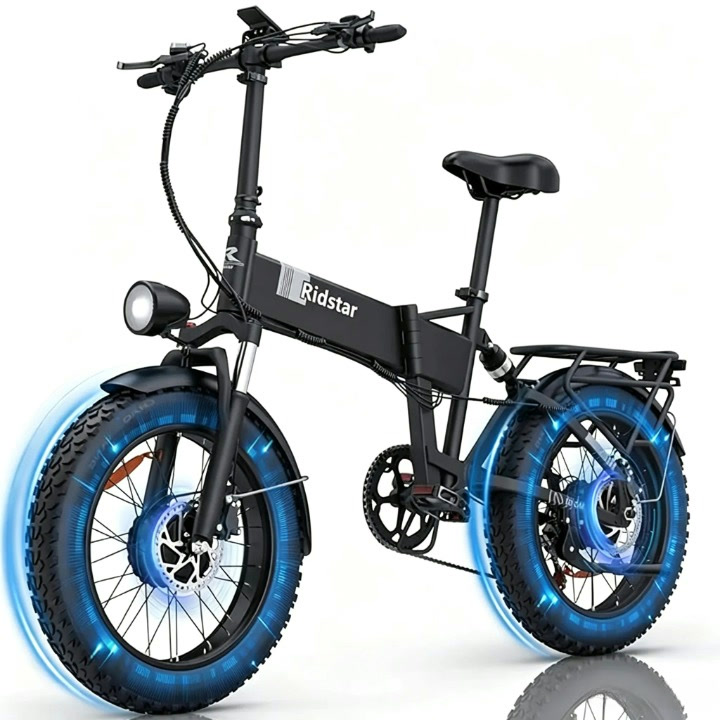
folding
Ridstar H20 Pro 2000W Folding Fat Tire E-Bike
Save $1,201
Two hub motors, a 1,104 Wh battery, hydraulic brakes at both ends, front and rear suspension and a...
Read the review
