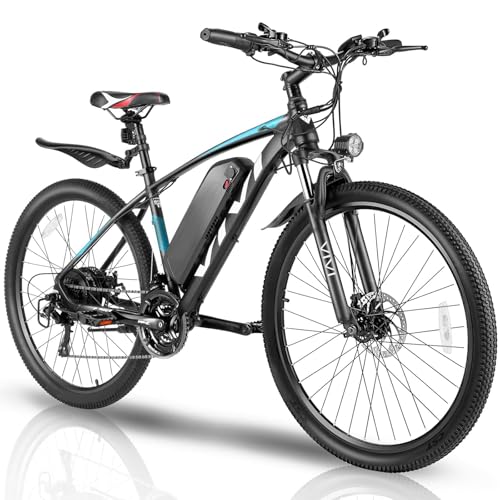
TL;DR — six picks, one per beginner profile
- Heybike Cityscape 2.0 — $1,299. Best all-round first ebike. Class 3 step-through commuter, UL 2849, 4.3★ across 320+ Amazon reviews.
- Vivi 26" Folding — $549. Best dip-toe pick under $600. Genuine UL-certified entry-level folder for buyers not ready to commit $1,000+.
- Razor Rambler 16 — $599. Best familiar-brand starter. Household US name, 16-inch step-through, Class 2 (15 mph) max — gentlest learning curve on the list.
- Heybike Mars 2.0 — $1,499. Best for first-timers with storage limits. Folds for car trunk + RV + small apartments.
- Eleglide T1 — $1,599. Best for bike-path-only commuters. Class 1 (15.5 mph EU spec), 62 mi range, traditional commuter geometry.
- Eleglide M1 — $899. Best off-road weekend explorer. Cheapest credible mountain ebike on Amazon US.
How we built this list
Beginner ebike buyers fail differently than experienced riders. The most common first-purchase regrets fall into four buckets — bought too much bike (1500W+ "mopeds" that aren't road-legal), bought a UL-uncertified bike and can't charge it indoors, bought a brand whose warranty handler doesn't respond, or bought too cheap and the bike falls apart in 6 months. We filtered every Amazon US ebike on the platform against those four failure modes before ranking, and what's left is the picks below — six bikes across price tiers from $549 to $1,599, every one of which a first-time buyer can buy without later regret.
We deliberately ranked by beginner profile rather than spec sheet. A 22-year-old grad student gifting themselves a $549 starter ebike has different needs than a 55-year-old commuter buying their first proper $1,299 daily-driver. The picks below answer different questions, not the same one. Use the decision tree at the bottom to figure out which profile fits you — most first-time buyers should land on either the Cityscape 2.0 (ready-to-commute) or the Vivi/Razor (dip-toe under $600).
Each pick links to its full review on the site (we don't summarise specs in this guide — read the linked review for that). For more options across the price band, see our Best Electric Bikes Under $1,500 guide; for folding-specific picks, see Best US Folding Ebike on Amazon.
The picks, in detail
#1 Best All-Round First Ebike — Heybike Cityscape 2.0 ($1,299)
Read the full Heybike Cityscape 2.0 review. Why it wins overall for first-timers: it hits the sweet spot where enough features without overwhelming. Step-through frame means no awkward leg-over mounting on day one. Class 3 capability (28 mph theoretical, 24 mph in normal use) gives you room to grow without forcing it — most first-timers ride at 15-20 mph for the first month and graduate to higher speeds gradually. UL 2849 certification matters from day one if you live in an apartment building or charge at work — non-UL ebikes are increasingly being banned from indoor charging post-Bronx-fire-incident lawsuits, and that's a load-bearing constraint to get right before buying.
320+ owner reviews on Amazon at 4.3★ is the trust signal that pushes this above other commuter options at the price. First-time buyers benefit disproportionately from a deep owner-review pool — when something goes wrong (and on a $1,299 ebike, eventually something will), you can search the review pool for someone with the same problem. The Cityscape 2.0 has enough volume that almost every common issue has a documented fix.
Compromises a first-timer should know about: 62 lb is heavy if you carry up stairs daily, mechanical disc brakes (not hydraulic — fade on long descents), basic display without app integration. None of those bite for a first-timer riding 5-15 miles each way on paved streets with ground-level storage.
#2 Best Dip-Toe Under $600 — Vivi 26" Folding ($549)
Read the full Vivi 26" Folding review. Buy this if you want to try ebikes without committing more than $600. The Vivi is honest: it's a $549 bike doing $549 things competently. UL certified, real Vivi warranty handling (not gray-market import), and a deep Amazon review history at consistent 4★+ ratings — that's a real signal at this price tier where most listings are review-farmed.
Specs: 500W rated / 1000W peak motor, 36V × 10.4Ah (374 Wh) battery, Class 2 (20 mph max), 32 mi realistic range. The folding mechanism is functional rather than premium — fits in a car trunk, doesn't fold in 5 seconds for daily transit boarding. Frame welds are visible, drivetrain is entry-level, the display is basic. It's a $549 bike. What you're buying is the safety net — if you decide ebikes aren't for you after 3 months, you've spent $549 and learned something. If you decide you love it, you've spent $549 and have a working bike to ride while you save for the upgrade.
#3 Best Familiar-Brand Starter — Razor Rambler 16 ($599)
Read the full Razor Rambler 16 review. Razor has been making US scooters and bikes for 25+ years, and that brand recognition matters for first-timers who want a familiar name and an English-speaking warranty handler. The Rambler 16 is a 16-inch step-through MINI ebike (not a folder, despite Amazon-search confusion) — small wheels, low standover height, simple Class 2 operation (15 mph max). 350W rated motor, 36V × 10Ah (360 Wh) battery, 12-mile realistic range.
This is the gentlest learning-curve bike on the list. 15 mph max means new riders can't accidentally hit 25 mph in a panic. Step-through + 16-inch wheels mean even short or older riders mount comfortably. The 12-mile range forces you to plan trips, which is actually a useful constraint for someone learning to live with an ebike — you don't ride 30 miles unintentionally and discover you're lost with a dead battery.
Buy it if: short flat rides under 5 miles, recreational neighbourhood riding, gifting to someone testing ebikes for the first time. Skip it if: you have a meaningful commute, ride hills, are over 6'0" (the 16-inch frame becomes uncomfortable for tall riders), or want to graduate to longer rides eventually (the 360 Wh battery caps you at ~12 miles realistic).
#4 Best for First-Timers with Storage Limits — Heybike Mars 2.0 ($1,499)
Read the full Heybike Mars 2.0 review. If your first-time-buyer constraint is storage — small apartment, no garage, want to fit it in a car trunk for weekend rides — the Mars 2.0 folds, and it does so without sacrificing the build quality of a non-folder at the same price. UL 2849, hydraulic disc brakes, 624 Wh battery (33% larger than the Cityscape 2.0's 468 Wh), 750 W rated rear hub motor, fat tyres for rough pavement.
The fold is the right kind for first-timers: it's a car-trunk + RV-bay fold (compresses to roughly 35" × 20" × 30"), not a Brompton-class daily-stairs fold. So you don't get a bike you can carry up 4 flights of stairs every day, but you do get a bike that fits in your boot for road trips, behind your couch in a studio apartment, or in an RV bay for camping trips.
Trade-offs: 77 lb is heavy. The fold is functional, not graceful — takes 30-40 seconds, not 10. Class 3 is overkill for a first-time-buyer's first month, but the display switches down to Class 2 / Class 1 if you want to start gentler. For first-timers who specifically need foldability, this is the right pick over the Cityscape 2.0.
#5 Best for Bike-Path-Only Commuters — Eleglide T1 ($1,599)
Read the full Eleglide T1 review. The Eleglide T1 is EU-specification — 250W rated motor, 15.5 mph (25 km/h) max, Class 1 (pedal-assist only, no throttle). Don't buy this for road commuting where you need to keep pace with 25-35 mph traffic — the 15.5 mph cap will make you a road hazard. Buy this for bike-path-only commutes where 15.5 mph is plenty and the longer range (62 mi claimed) plus the conventional commuter geometry give you a more refined first-bike experience.
First-timers who fit this profile: bike-path-only commuters in cities like Portland (Oregon), Davis (California), Boulder (Colorado), Cambridge (Massachusetts), or any college town where dedicated bike infrastructure dominates. Riders nervous about speed and traffic. Older buyers wanting a calmer, more European-style ebike feel — the T1 rides like a Dutch city commuter, not an American 28-mph Class 3 monster.
Trade-offs: $1,599 is the most expensive pick on this list and it's the slowest. That's not a contradiction — you're paying for a more refined ride at a slower speed, not raw performance. If "refined and slow" doesn't appeal, skip it for the Cityscape 2.0.
#6 Best Off-Road Weekend Explorer — Eleglide M1 ($899)
Read the full Eleglide M1 review. For first-time buyers who want their first ebike to do gravel paths, fire roads, packed singletrack on weekends — not for daily commuting. 250W rated, 15.5 mph EU spec, 47 mi claimed range, 27.5" wheels with knobby tyres, lockout-equipped front fork. The M1 is the cheapest credible mountain-style ebike on Amazon US — real off-road geometry rather than a beach cruiser pretending to be a mountain bike.
Don't expect Specialized / Trek build quality at $899 — frame welds are visible, hub bearings are mid-tier, warranty is 1 year. But for first-time buyers wanting to occasionally explore non-paved surfaces without spending $3,000+ on a real mid-drive mountain ebike, the M1 is the entry point. The 15.5 mph cap means it's not appropriate as a daily road commuter — buy this AS A SECOND CONSIDERATION after a road bike, not as your only ebike.
How to choose between them — first-timer decision tree
Want one ebike that does daily commuting + occasional weekend rides? → Heybike Cityscape 2.0. The all-round first pick for ~70% of first-time buyers in the US.
Budget under $700 and willing to start small? → Vivi 26" Folding (if you want a folder) or Razor Rambler 16 (if you want a familiar-brand mini bike). Both are honest entry-level picks at their respective price points.
Need to fit it in a car trunk, RV, or studio apartment? → Heybike Mars 2.0. The fold-for-storage premium is worth $200 over the Cityscape 2.0 if storage is the constraint.
Live in a college town with dedicated bike infrastructure, never need to keep pace with road traffic? → Eleglide T1. The bike-path commuter pick where 15.5 mph is plenty.
Want to explore gravel and off-road on weekends, not commute? → Eleglide M1. The mountain-curious pick at $899.
Still not sure? → Default to the Heybike Cityscape 2.0. It's the highest-confidence first pick and the bike most likely to grow with you for the first 2-3 years.
Beginner-specific things to avoid on Amazon
First-time buyers fall into specific traps. Watch for these:
- "1500W+ motor" listings. US ebike law caps Class 3 at 750W rated. Anything advertising higher is a moped — riding it on bike infrastructure is technically illegal in most states, and many municipalities now ticket these bikes specifically.
- "UL Certified" without showing the UL 2849 mark. UL 2580 (cells only) and UL 2271 (battery packs) don't certify the bike. The fire-safety cert that matters for indoor charging is UL 2849 (full-system). Insist on seeing the cert mark in product photos before buying.
- Random 7-letter brand names with 4.7★ ratings + 200 reviews from launch month. That's the review-farming pattern. Stick to Heybike, Eleglide, Vivi, Razor — established brands whose listings you can verify against owner forums.
- Bikes claiming 80+ mi range under $700. Physics: 80 mi requires 50+ Ah battery capacity, costing $400+ in cells alone. Marketing claim is inflated 2-3×.
- "Mountain bike" listings with skinny tyres and no front suspension. Real mountain ebikes have 2.4"+ tyres and a lockout-equipped front fork. Anything skinnier is a road bike with a marketing label.
Worth knowing before you buy your first ebike
Class 1 vs 2 vs 3 in plain English: Class 1 = pedal-assist only, you have to pedal to get power, max 20 mph. Class 2 = throttle + pedal-assist, max 20 mph. Class 3 = pedal-assist to 28 mph + throttle to 20 mph. For first-timers, Class 1 or Class 2 is gentler. Class 3's 28 mph is faster than most new riders are comfortable with for the first month. Most modern bikes including the Cityscape 2.0 and Mars 2.0 are Class 3 by default with a setting to switch down to Class 2 or Class 1 — start at the lower setting and graduate up. See our class explainer guide for the full state-by-state breakdown.
Budget for accessories on top of the bike price: plan $150-300 extra. UL-rated helmet ($60-100), good-quality U-lock or chain lock ($50-100, theft is real), front + rear lights if not included ($30-50), pump + multi-tool ($30-50), pannier or basket if you'll commute or grocery shop ($40-80). Some Amazon listings include lights and a basic lock; verify before assuming.
Range realism — the most common first-purchase disappointment: manufacturer ranges are measured at the lowest assist on flat ground at the lightest rider weight. Real-world range is typically 50-70% of the marketing claim. A bike claiming 50 mi will give you ~25-35 mi at PAS 3 with a 175 lb rider on rolling terrain. Use our range calculator to estimate realistic numbers for your specific terrain + weight + assist level before buying.
Test ride before committing if possible: Amazon's return window covers buyer's remorse, but if a local bike shop carries any of these brands (Heybike, Razor, and Eleglide have growing US dealer networks), an in-person test ride is the highest-leverage 30 minutes a first-time buyer can spend. Even riding a different ebike of similar class will tell you whether you actually want a Class 3 vs a Class 1, a step-through vs a top-tube frame, hydraulic vs mechanical brakes.
More content on the site
Other guides that may help: Best Electric Bikes Under $1,500 on Amazon US for buyers focused on the value tier; Best US Folding Ebike on Amazon if foldability is your primary constraint; Best UK Ebike Under £1,000 for UK readers. Or jump into individual reviews — we have new ones landing every week.