Review · Heybike
folding7.8/10Heybike Ranger S
Reviewed by John Weeks · daily commuter
At a glance
Run this in our range calculator →Verdict in 30 seconds
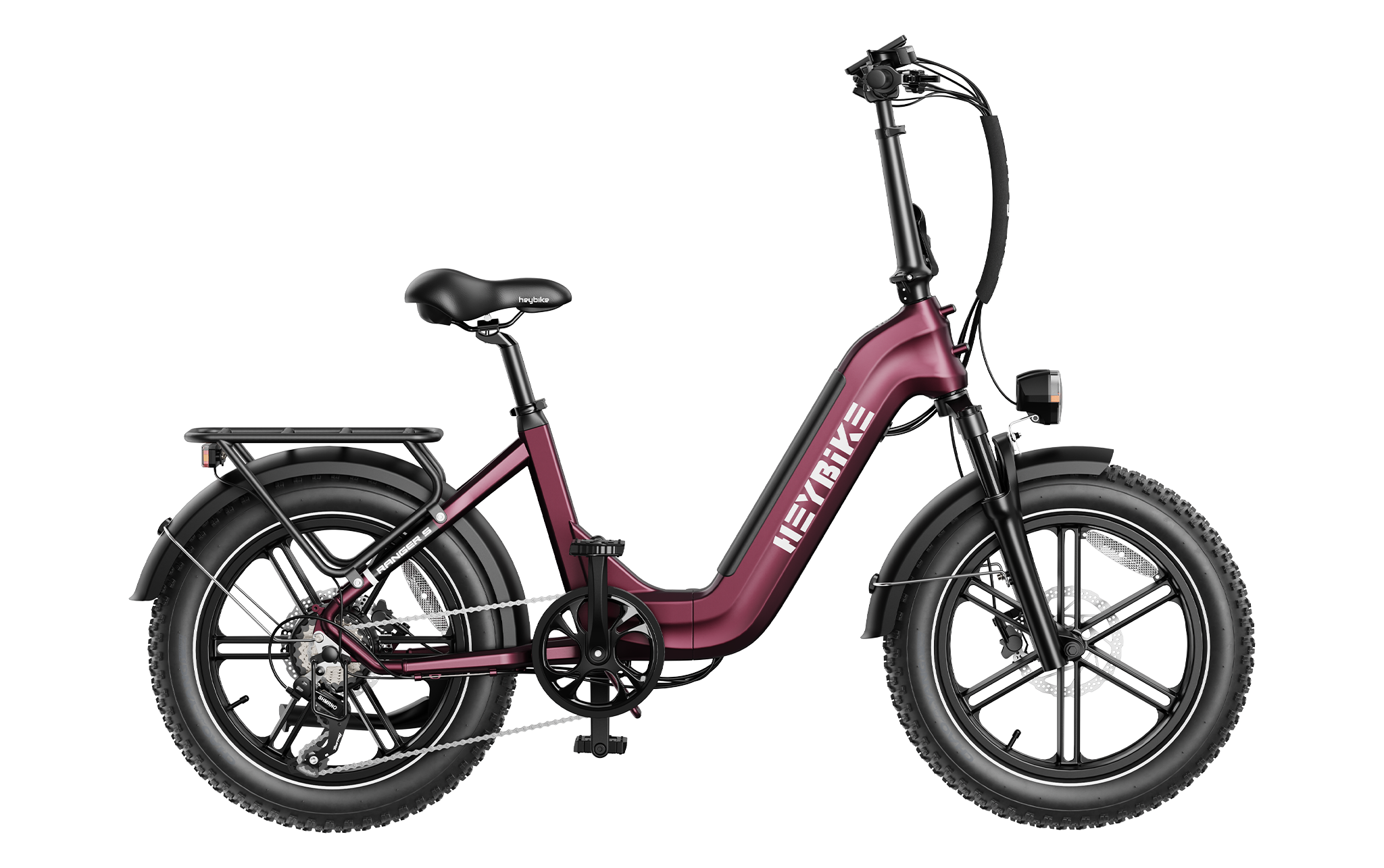
The Heybike Ranger S is the step-through twin of the Mars 3.0: same 750 W rated rear-hub motor, 1400 W peak, 80 Nm torque, 20×4 Kenda fat tires, foldable, 28 mph Class 2. The frame drops the top tube (4'11" minimum standover) and adds a heavy-duty rear rack rated to 150 lb so it doubles as a small-cargo bike. Electric...
Pros
- + **Step-through frame** with 4'11" minimum standover — usable by short riders, anyone with limited mobility, anyone in formal clothing.
- + **150 lb rear rack** is the standout cargo spec at this price — fits a child seat plus groceries, or two heavily-loaded panniers.
- + **UL2849 + UL2271 certification** — meets NYC, SF, and major-city residential at-rest charging requirements.
- + **Class 1/2/3 switchable** via LCD (no app required) — same hardware covers all three US e-bike classes.
- + **3.5 hour charge time** — fastest in the value-folder tier. Useful for opportunistic charging at work.
- + **1000 W combo upgrade option** at $1,299 for heavier riders or hilly areas.
Cons
- - **Cadence sensor** — power is on/off, not effort-proportional. The Mars 3.0's torque sensor is the in-brand upgrade.
- - **Front-only suspension** — no rear shock. Rough surfaces transmit through the seatpost.
- - **Mechanical disc brakes**, not hydraulic. Fine for flat city use; less confident on long descents.
- - **72 lb assembled** — at the heavy end for a "folding" bike. Single-arm car-trunk lift is a stretch.
- - **Tourney-tier drivetrain** — shifts notchy under load.
Who is this for?
- Riders who want low-step access — short riders, anyone with knee/hip mobility limits, riders in formal clothing or skirts who don't want to swing a leg over a top tube.
- Single-parent school-run + grocery loop — the 150 lb rear rack handles a Yepp child seat plus week's shopping in panniers, all on a sub-75 lb bike that folds for apartment storage.
- Apartment commuters who need to bring the bike inside — the fold + removable battery means you have two ways to manage a small-elevator building.
What surprises us about this bike
A step-through frame, full 750 W rated motor (1400 W peak), 692 Wh battery, hydraulic-style stopping power, and a 150-lb-rated rear rack — for $1,199. The closest cross-shop is the Aventon Sinch.2 STepThru ($1,599) or the Lectric XP Lite 2.0 ($799 with weaker spec). Heybike's pricing here is aggressive even by their own standards.
The catch is that the Ranger S still uses a cadence sensor rather than the torque sensor that landed on the Mars 3.0. In practice this means power is on/off based on whether your pedals are turning, not how hard you push. For step-through bikes used for relaxed errands and short commutes — this exact use case — that's actually fine. Step-through riders typically aren't pushing hard up steep hills; they're cruising flat city streets where on/off PAS is unnoticeable. If you want a torque sensor, the Mars 3.0 is the in-brand alternative.
Power, ride, and class spec
The motor is the same 750 W rated unit Heybike puts in the Mars 3.0 — but tuned for the slightly different frame geometry and cadence sensor. Electric Bike Report's review measured the bike at "about 28 mph as advertised" with PAS engaged, and noted strong throttle pickup from a stop. Hill performance is solid for a Class 2: the bike held 18–22 mph on a 6% grade in PAS 5 in their testing — adequate for typical urban inclines, slower than the Mars 3.0's 16+ mph at 8% (which has the higher-torque setup).
The Ranger S ships as Class 2 by default — 20 mph throttle and 20 mph PAS — and unlocks to Class 3 (28 mph PAS) via the LCD display menu. There's no app required for the unlock, which some owners prefer. Class 1 (PAS only, 20 mph) is also a one-tap setting. All three modes are road-legal in 38+ US states; check local rules for bike-path restrictions on Class 3.
A 1000 W combo variant exists at $1,299 — same frame, larger 1400 W peak motor (rated up to 1000 W rather than 750 W). If you weigh 250+ lb or live somewhere hilly, the combo is worth the extra $100. For most commuters under 200 lb on flat ground, the standard 750 W is more than enough.
Range and battery
Heybike's headline range is 55 miles. Mountain Weekly News measured roughly 35 miles on a mixed urban + light-trail loop at PAS 3 with a 180 lb rider. Electric Bike Report's standardized test produced figures in the same ballpark. Plan around 30–45 miles for daily riding at typical commuter assist levels.
The pack is a 48 V / 14.4 Ah / 692 Wh removable lithium-ion with UL2849 system certification + UL2271 battery certification — the gold standard for at-rest charging in NYC, San Francisco, and most multi-unit residential buildings. Charge time is approximately 3.5 hours on the included 4 A charger (faster than the Mars 3.0's 5–6 hours because the smaller-capacity-per-cell pack accepts higher charge-rate per amp).
The battery drops out of the down tube for off-bike charging. There's only one battery slot — no dual-battery option. For long-range needs, the Heybike Hauler offers dual-battery; the Ranger S doesn't.
Build, fit, and the cargo angle
Where the Ranger S meaningfully differs from the Mars 3.0 is the frame and rack. The step-through geometry drops the top tube to a true low-step (4'11" minimum standover) — making it usable for shorter riders, anyone with mobility limitations, or anyone who rides in a skirt or formal trousers and doesn't want to swing a leg over a top tube.
The rear rack is rated to 150 lb — a meaningful step up from the Mars 3.0's 100 lb rating. That's enough for either a Yepp Maxi child seat (5 lb seat + up to 49 lb child = ~54 lb total) plus 90 lb of cargo, or a standard pannier rack with 30 lb on each side plus a 90 lb top-mount. It's not a full cargo bike — for serious two-kid hauling you want the Heybike Hauler or a true longtail — but for one kid plus the school-run grocery stop, it's well within spec.
Folded dimensions are 40 × 20 × 31 inches, identical to the Mars 3.0. Unfolded the bike is 70 × 24 × 50 in. The fold is single-pivot mid-frame; takes about 15 seconds with practice. The bike fits riders 4'11" to 6'3" per Heybike's sizing chart. The seatpost telescopes 12 inches; handlebar is height-adjustable.
Tires are 20×4 Kenda fat tires (puncture-resistant) with reinforced sidewalls. Rated for paved + gravel + light off-road. The Ranger S has slightly less aggressive tread than the Mars 3.0 — Heybike tunes the Ranger more for street use.
Compromises at $1,199
The cuts to hit this price are about the same as the Mars 3.0:
- Mechanical disc brakes, not hydraulic. 180 mm rotors. Stop fine but require more lever pressure than hydraulic and need pad-refresh every 600–800 mi.
- Cadence sensor — power is on/off based on pedal motion, not pedal effort. Less sophisticated than the Mars 3.0's torque sensor; fine for cruising, jerkier in low-PAS modes.
- Tourney-tier 7-speed Shimano cassette — gear range is fine for the bike's use case, shift quality is basic.
- Front spring fork only — no rear suspension. The Mars 3.0's Horst-link rear is the differentiator there. The Ranger S is meaningfully less smooth on rough surfaces.
The Ranger S leans into different trade-offs than the Mars 3.0: it sacrifices the rear shock and the torque sensor to fund the step-through frame and the heavier-duty rear rack. For a step-through commuter who occasionally hauls cargo, this is the right trade. For an aggressive rider who wants suspension, look at the Mars 3.0.
Verdict
The Ranger S won Electric Bike Report's 2024 Best Folding E-Bike under $1,500 award for good reason: it's the only true 750W rated folding bike in its price tier with this combination of step-through frame + 150 lb rack + 692 Wh battery + UL certification. The compromises are honest and well-aligned with the use case it's designed for: relaxed step-through commuting with occasional small-cargo hauling.
If you currently own a Heybike Ranger (the original, non-S), the S adds the step-through frame and the larger rear rack — a meaningful ergonomic upgrade if those features matter to you. For a brand-new buyer, the choice between the Ranger S and the Mars 3.0 comes down to step-through-vs-top-tube and rear-rack-capacity-vs-rear-suspension.
If you're cross-shopping the Aventon Sinch.2 ST ($1,599), the Sinch wins on hydraulic brakes and torque sensor; the Ranger S wins on price ($400 less) and rear rack capacity (150 lb vs 65 lb). For most commuters, the Ranger S is the better value.
Frequently asked questions
Ranger S vs Mars 3.0 — which one for me?
They're cousins, not duplicates. Both are 20×4 folding fat-tire bikes with the same 750 W rated motor, same 28 mph top speed, same fold dimensions. The Ranger S has a step-through frame and a 150 lb rear rack; the Mars 3.0 has a top tube and full rear suspension plus a torque sensor. Pick the Ranger S if low-step access matters or you want to carry meaningful cargo. Pick the Mars 3.0 if rear suspension matters or you want torque-sensor pedal feel. Same brand, same support, same warranty.
Is the 1000 W combo upgrade worth $100?
For most riders, no — the 750 W is plenty for typical commuter use under 200 lb on flat-to-moderate terrain. Three cases where the 1000 W combo is worth the $100: (1) you weigh 250+ lb fully loaded, (2) you live somewhere with sustained 8%+ grades on your daily route, (3) you frequently haul both the rear rack at full capacity AND a child seat. Otherwise, save the $100 and put it toward a Yepp Maxi seat or a better lock.
How does the cadence sensor really feel day-to-day?
On flat ground it feels fine — start pedaling, motor engages within a quarter-rotation, ride at constant speed. It's noticeable on hill starts and from a stop: the motor kicks in at full PAS-level power as soon as the cranks turn, which can be jerky if you're standing on the pedals starting uphill. After a week or two most owners adapt to "spin up smoothly rather than mash the pedal." If that adaptation feels like a deal-breaker, the Mars 3.0's torque sensor is the in-brand alternative — same brand, same warranty, $0 price difference (both $1,199).
Can it carry a child seat?
Yes — better than most bikes in its tier. The 150 lb rear rack rating handles a Thule Yepp Maxi (5 lb seat + up to 49 lb child = ~54 lb total) with 96 lb of headroom remaining for cargo on top or in panniers. Heybike publishes seat-mounting guidance on their support pages. Mounting points are standard, so a Burley Steel-D rack adapter, Yepp Maxi EasyFit, or Thule Yepp Maxi all bolt up cleanly. The frame stiffness is rated for the load. Note: this is a single-child seat — for two kids, use the Heybike Hauler or a dedicated longtail.