Tern GSD S10
Tern Bicycles
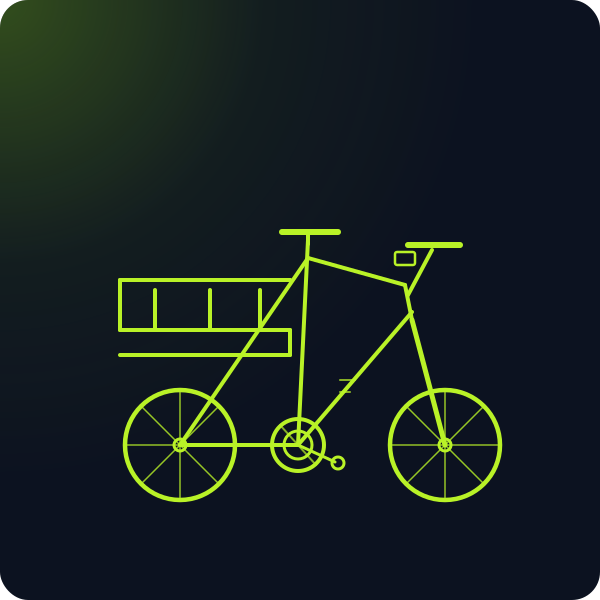
If you're replacing a car rather than adding to a garage — and your terrain has real hills — the Tern GSD S10 is the answer at any price under $7,000. The Bosch CX mid-drive, dual-battery option (1,090 Wh combined), and triple-rated frame put it in a different durability class than the $2k contenders. At nearly 3× the price, it...
Key specs
- Motor Watts
- 250
- Motor Type
- mid-drive
- Motor Torque Nm
- 85
- Battery Wh
- 545
- Range Miles
- 60
- Top Speed Mph
- 20
- Ebike Class
- 1
- Weight Lbs
- 75
- Payload Lbs
- 440
- Is Folding
- 0
- Is Step Through
- 1
- Passenger Capable
- 1
Pros
- + Bosch CX mid-drive — handles real climbs loaded
- + Triple-rated frame for 200 kg / 440 lb dynamic loading
- + Dual-battery option scales range to ~80 mi (1,090 Wh combined)
- + Tern dealer service network in US, UK, EU, AU
- + Compact wheelbase fits standard bike parking and most trains
Cons
- - Single 545 Wh battery is undersized for car-replacement use — budget for dual
- - Class 1 in US (20 mph, no throttle) — no Class 3 option for fast commutes
- - MSRP $5,999 means the dual-battery + Clubhouse + Yepp build totals ~$7,500
What surprises us about this bike
The GSD's frame triangulation feels like a different category of cargo bike. Tern triples-rates the frame for 200 kg / 440 lb, including dynamic loads — i.e. the frame is engineered for repeated daily loaded use over years, not just an occasional shopping run. After 3+ years of daily school-run reports on r/cargobikes, frame fatigue failures are essentially absent. That's not true of the $2k tier.
Power and battery
Bosch Performance Line CX produces 85 Nm of torque from a mid-drive that pulls at the bottom bracket — the highest-leverage point on a bike. On a 12% grade with two kids and groceries, the CX accelerates rather than lugs. The single 545 Wh battery delivers ~40 mi of mixed urban riding loaded; the dual-battery option (Atlas configuration, +545 Wh) doubles range to ~80 mi and is the only configuration we'd buy for daily car-replacement use.
Cargo and the family question
The GSD is engineered around the kid + cargo use case rather than retrofitted for it. The deck height is intentionally low (loaded centre of gravity), the wheelbase is short for parking and hauling onto trains, and the Atlas-rear-rack accepts everything: Yepp Maxi child seats, Tern's own Clubhouse railings, conventional panniers. Two-up adult riding is genuinely usable, unlike on the Lectric/Aventon/Rad where it's awkward.
Build quality and what gives
Magura MT5 hydraulic brakes (4-piston) — overkill on most bikes, appropriate here. Schwalbe Pickup tyres with reflective sidewalls are the gold-standard cargo tyre. Drivetrain is Shimano Deore 10-speed — durable, serviceable at any bike shop. The S10 trim is the entry to the line; the S00 (Rohloff hub + belt drive, $7,099) eliminates derailleur maintenance entirely. There is no obvious cost-cutting; everywhere you look, the parts spec is cargo-bike-appropriate.
Who should buy it (and who should skip)
Buy this if you're genuinely replacing a car — daily school + commute + groceries — especially in hilly terrain. Buy the dual-battery (Atlas) configuration. Skip this if your alternative is an additional family car (the GSD won't replace a long-haul vehicle) or if your use is occasional weekend cargo runs (a $2k Aventon Abound or Lectric XPedition does that fine for a quarter of the price). The GSD justifies its premium for the daily-use buyer, not the occasional one.
Best for
- - Families genuinely replacing a car with daily kid + commute + cargo riding
- - Hilly terrain (San Francisco, Seattle, Bristol, Lisbon, Sydney)
- - Riders within reach of a Tern dealer for service
- - Long-term owners — the durability/parts story justifies the premium over 5+ years
Is the Tern GSD worth $4,000 more than the Lectric XPedition?
For occasional cargo use, no — the Lectric covers it for a quarter of the price. For daily car-replacement use, especially on hills, yes. The Bosch CX mid-drive's hill-climbing capability is in a different league, the frame is engineered for dynamic loading over years rather than years of cargo, and Tern's dealer service network exists where Lectric's doesn't. Buy the GSD if you're using it daily; buy the Lectric if you're using it weekly.
GSD S10 vs S00 — which trim should I buy?
S10 (10-speed Shimano Deore, $5,999) is the volume seller and the right buy for most. S00 (Rohloff 14-speed internal hub + Gates belt drive, $7,099) eliminates derailleur and chain maintenance entirely — the right choice if you're commuting daily in wet weather or hate drivetrain maintenance. Performance is identical; the difference is purely transmission.
Do I need the dual-battery option?
If you're car-replacing, yes. Single 545 Wh delivers ~40 mi loaded; dual-battery (Atlas configuration, +545 Wh) delivers ~80 mi. The marginal cost is roughly $750. Skip the dual battery only if your daily round-trip is under 25 mi and you can charge nightly.
Will the Tern GSD fit on a train or in a small flat?
Yes — the GSD's wheelbase is intentionally short (180 cm), and it stands vertically on the integrated rear stand for storage. It fits in standard bike-storage rooms in European apartment buildings and on most US commuter rail bike racks. The Tern HSD is even smaller if storage is the binding constraint.
Is the Bosch CX overkill for flat terrain?
It's not overkill — it's higher torque headroom than you'll use on flat terrain, but the smoother power delivery and instant response are noticeable even there. If your terrain is genuinely flat and your daily mileage is under 20 mi, you're paying for capability you won't fully use. The 'overkill' question is really a price question.
How does the Tern GSD compare to the Yuba Spicy Curry?
Both are premium cargo bikes with Bosch mid-drives. Yuba's wheelbase is longer (more stable two-up, less manoeuvrable), Tern is more compact. Yuba is more popular in the US; Tern is the global standard. Ride both before buying — fit and feel decide here, not specs.
Is the GSD's 5-year frame warranty actually meaningful?
Yes — Tern honours it. The frame is the part most likely to be the long-term liability on a cargo bike (everything else is replaceable component spec). Five years on a $6k bike at 200 kg dynamic-load rating is a real warranty, not a marketing one.