Rad Power RadWagon 5
Rad Power Bikes
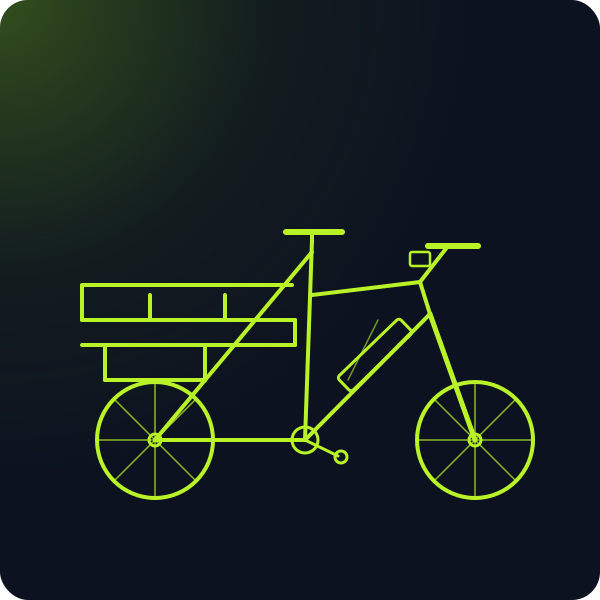
If you want a US cargo bike from the brand with the largest service network — and you're willing to pay a small premium for that peace of mind — the RadWagon 5 is the answer. The 80 Nm hub motor handles family duty, but the 400 lb payload trails the Lectric and Aventon and the single 672 Wh battery...
Key specs
- Motor Watts
- 750
- Motor Type
- hub
- Motor Torque Nm
- 80
- Battery Wh
- 672
- Range Miles
- 45
- Top Speed Mph
- 20
- Ebike Class
- 2
- Weight Lbs
- 75
- Payload Lbs
- 400
- Is Folding
- 0
- Is Step Through
- 1
- Passenger Capable
- 1
Pros
- + Largest US service-partner network in the cargo segment
- + Hydraulic brakes standard
- + Lowest deck height — easiest kid loading
- + Mature accessory ecosystem (running boards, panniers, child seats)
Cons
- - Lowest payload in the cargo trio (400 lb vs 440-450 elsewhere)
- - Smallest battery in segment (672 Wh) and no dual-battery option
- - Class 2 only — no 28 mph throttle option
What surprises us about this bike
Rad Power has the most mature US service infrastructure of any direct-to-consumer e-bike brand — that matters more than spec sheets suggest when you're 18 months into ownership and a sensor fails. The RadWagon 5 itself is a deliberate evolution of the original RadWagon: redesigned frame, integrated battery, hydraulic disc brakes standard, slightly lower deck for kid loading. Nothing dramatic; everything refined.
Power and battery
The 750W rear hub puts out 80 Nm — between the Aventon Abound's 60 Nm and the Lectric XPedition's 85 Nm. In real-world use it's adequate for the 400 lb payload on flat-to-rolling terrain, but you'll feel it on grades over 8% with a full load. The 672 Wh battery is the lowest in this segment; Rad claims 45 mi mixed riding, owner reports cluster at 25-35 mi loaded. No dual-battery option — a real limitation if your terrain is hilly.
Cargo and the family question
400 lb payload is the lowest of the three big-three US cargo bikes (Lectric 450, Aventon 440). For most families that's still enough — 180 lb rider + two kids at 90 lb total + 30 lb of groceries = 300 lb, well within the limit. The deck height is the lowest of the three, which makes loading kids easier but reduces ground clearance. Rad's own accessory ecosystem (running boards, deck pads, panniers) is the most complete in the segment.
Build quality and what gives
Hydraulic brakes and integrated battery are the headline upgrades over the original RadWagon. The display is functional but visibly cheaper than the Aventon's. Tyres are Rad-branded and noticeably draggy. The kickstand is the weakest part of the bike — owner reports of bent stands within the first year are common; the standard upgrade is a Massload centre stand. The frame and welds are solid.
Who should buy it (and who should skip)
Buy this if your priority is service-network coverage — Rad has more US service partners than Lectric and Aventon combined, and replacement parts are stocked for the longest. Skip this if you need maximum payload (Lectric wins), maximum polish (Aventon wins), or maximum range (XPedition's dual battery is uncatchable here). Rad's pitch is durability and serviceability; weigh that against the lower payload and battery.
Best for
- - Buyers who prioritise long-term service availability over headline specs
- - Families with shorter daily rides (under 20 mi round-trip)
- - Riders who want the most complete first-party accessory ecosystem
- - Anyone replacing an aging RadWagon 4 — same accessories carry over
How does the RadWagon 5 compare to the Lectric XPedition 2.0?
Lectric wins on raw value: dual-battery range standard, 450 lb payload, 28 mph Class 3 throttle, $700 cheaper. Rad wins on serviceability: more service partners, longer parts availability, mature accessory line. For cold purchase price + range, XPedition. For long-term ownership confidence, RadWagon 5.
Can the RadWagon 5 climb steep hills with a full load?
Adequately on grades up to ~8%, with effort. On grades over 10% with two kids and groceries you'll feel the 80 Nm hub motor lugging. If your terrain is hilly (Seattle, San Francisco), seriously consider stepping up to a Bosch CX mid-drive bike like the Tern GSD instead. The RadWagon 5 is happiest on flat-to-rolling.
How long do Rad Power batteries actually last?
Rad rates the battery for ~800 charge cycles to 80% capacity. Owners on r/RadPowerBikes commonly report 4-5 years of daily use before noticeable capacity drop. Replacement batteries are stocked at $399-549 — one of the strongest cases for buying into the Rad ecosystem versus a brand that may have offboarded by year 5.
Does Rad Power ship to Canada?
Yes — Rad has a Canadian site (radpowerbikes.ca) with full shipping coverage. Service partners are concentrated in major metros. Pricing in CAD is typically 25-30% above the USD price plus duties — verify with current inventory at order time.
Why is the RadWagon 5 payload lower than competitors?
Rad rates payload conservatively — they include a safety margin in the published 400 lb figure. The frame and rear stays are not the limit on this bike; the deck mounting hardware is. In practice riders regularly load over 400 lb without issue, but Rad will not warranty above the rating.
Is the RadWagon 5 worth upgrading from the RadWagon 4?
If your RadWagon 4 still works, no — keep it. The RadWagon 5 adds hydraulic brakes, an integrated battery, and a redesigned deck, but those don't justify selling and re-buying. If you're shopping fresh, the 5 is the one to get.
How does it compare to the Aventon Abound?
Similar pricing ($2,299 vs $2,099). Aventon's 60 Nm torque sensor feels smoother in the city; Rad's 80 Nm cadence sensor feels more punchy off the line. Aventon has slightly better tyres and a less-cheap-feeling display. Rad has the bigger service network. For pure ownership experience, Aventon edges it. For long-term parts and service confidence, Rad.